

Search results for "tommi+musturi/2010/05/song-without-words/2009/09/what-god-said/2011/04/matti-suurpaa-parnasso-1951–2011-parnasso-1951–2011"
Breathe out, breathe in
30 June 1999 | Archives online, Fiction, poetry
Poems from Nio dagar utan namn (‘Nine days without names’, Söderströms, 1998). Introduction by Bror Rönnholm
Quickly, at a zebra crossing
moments
          not of wonder but of
 something closely related: the tree
          upturned by the gale
 with its roots to the heavens, the lit-up
          church spire against the night sky, a few
simple gravestones viewed at a
          suitable season, a quartet from the Marriage of Figaro
 or just standing at a roaring
          crossing and writing this, invisible
 to all in exhaust fumes and a faint blue
          light from a hidden sun, a few
times mistaken for a
loved pupil More...
World noises
30 September 1992 | Archives online, Fiction, Prose
Poems from Fahrenheit 121 (1968) and Jos suru savuaisi (‘If grief should smoulder’, 1968). Introduction by Tuula Hökkä
For truth to tell
I like horses most
creating Those
It came off best
*
Morning came to the meadow;
horses were born out of mist.
How quiet they were:
one leant a head on his master’s armour,
his breath rose warm,
his moist eye gleamed in the daybreak,
his coat a casbah carpet-weaver’s hand-woven pile,
his muzzle softer than a phallus. More…
How much did Finland read?
30 January 2014 | In the news
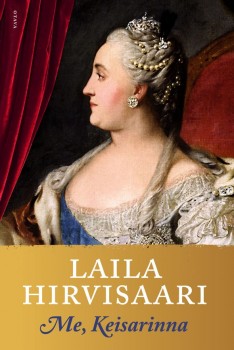 The book year 2013 showed an overall decrease – again: now for the fifth time – in book sales: 2.3 per cent less than in 2012. Fiction for adults and children as well as non-fiction sold 3–5 per cent less, whereas textbooks sold 4 per cent more, as did paperbacks, 2 per cent. The results were published by the Finnish Book Publishers’ Association on 28 January.
The overall best-seller on the Finnish fiction list in 2013 was Me, Keisarinna (‘We, tsarina’, Otava), a novel about Catherine the Great by Laila Hirvisaari. Hirvisaari is a queen of editions with her historical novels mainly focusing on women’s lives and Karelia: her 40 novels have sold four million copies.
However, her latest book sold less well than usual, with 62,800 copies. This was much less than the two best-selling novels of 2012: both the Finlandia Prize winner, Is, Jää (‘Ice’) by Ulla-Lena Lundberg, and the latest book by Sofi Oksanen, Kun kyyhkyset katosivat (‘When the doves disappeared’), sold more than 100,000 copies.
The winner of the 2013 Finlandia Prize for Fiction, Riikka Pelo’s Jokapäiväinen elämämme (‘Our everyday life’, Teos) sold 45,300 copies and was at fourth place on the list. Pauliina Rauhala’s first novel, Taivaslaulu (‘Heaven song’, Gummerus), about the problems of a young couple within a religious revivalist movement that bans family planning was, slightly surprisingly, number nine with almost 30,000 copies.
The best-selling translated fiction list was – not surprisingly – dominated by crime literature: number one was Dan Brown’s Inferno, with 60,400 copies.
Number one on the non-fiction list was, also not surprisingly, Guinness World Records with 35,700 copies. Next came a biography of Nokia man Jorma Ollila. The winner of the Finlandia Prize for Non-Fiction, Murtuneet mielet (‘Broken minds’, WSOY), sold 22,600 copies and was number seven on the list.
Eight books by the illustrator and comics writer Mauri Kunnas featured on the list of best-selling books for children and young people, with 105,000 copies sold. At 19th place was an Angry Birds book by Rovio Enterntainment. The winner of the Finlandia Junior Prize, Poika joka menetti muistinsa (‘The boy who lost his memory’, Otava), was at fifth place.
Kunnas was also number one on the Finnish comic books list – with his version of a 1960s rock band suspiciously reminiscent of the Rolling Stones – which added 12,400 copies to the figure of 105,000.
The best-selling e-book turned was a Fingerpori series comic book by Pertti Jarla: 13,700 copies. The sales of e-books are still very modest in Finland, despite the fact that the number of ten best-selling e-books, 87,000, grew from 2012 by 35,000 copies.
The cold fact is that Finns are buying fewer printed books. What can be done? Writing and publishing better and/or more interesting books and selling them more efficiently? Or is this just something we will have to accept in an era when books will have less and less significance in our lives?
On Caj Westerberg
31 March 1980 | Archives online, Authors
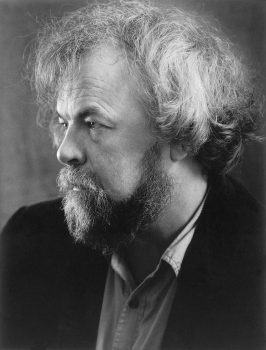
Caj Westerberg. Photo: Pentti Sammallahti
Caj Westerberg established his reputation with the publication, in 1967, of his first volume of poems: Onnellisesti valittaen (‘Cheerful complaint’). The work was immediately praised for its descriptive power and visual imagery. The other outstanding feature – preserved in subsequent works – is the author’s capacity for emotion, for a passionate involvement in human existence, casting the sensitive individual from the crest of ecstasy to the trough of despair. In Westerberg’s next two collections, Runous (‘Poetry’, 1968) and En minä ole ainoa kerta (‘I am not the only one’, 1969), these key features are firmly sustained. At the same time, Westerberg is beginning to extend the mordancy of his themes. In his fourth book, Uponnut Venetsia (‘Sunken Venice’, 1972), the style has became move conversational and laconic, but does not deviate from his main thematic concerns. Westerberg’s work can be seen as a cool, developing continuum: all the poems, whether long or short, whether aphoristic epitomes of experience or pure ‘imagistic’ visions, convey a unified individual response to the world and existence, and a prevailing intensity. With each publication, brought out as all his earlier works by Otava, Westerberg has developed and enhanced his style. His two most recent works, Kallista on ja halvalla menee (‘It comes dear and it’s going cheap’, 1975) and Reviirilaulu ‘Territorial song’, 1978), have all the marks of works which will become classics. Westerberg’s poems are moving and full of surprising associations; he is both sensitive to the present and alive to the past. His style maintains a fine balance between the conversational and the stylized. Westerberg takes the role of the poet seriously. At a recent conference he put it thus: ‘The poet’s fundamental impulse is to reveal the hidden. That is one of his tasks. That is his folly. The poet is the seer, the prophet, the truth-teller.’
Translated by Mary Lomas
Funny stuff: best-selling books in February
13 March 2014 | In the news
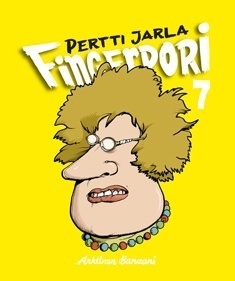 The list of best-selling books – compiled by the Finnish Booksellers’ Association – shows that in February comedy was popular among readers. Number one on the Finnish fiction list was Fingerpori 7 (‘Fingerborg 7’, Arktinen Banaani), the latest comics book by Pertti Jarla, featuring silly stuff taking place in the city of Fingerpori.
Riikka Pulkkinen’s new novel, a romantic comedy entitled Iiris Lempivaaran levoton ja painava sydän (‘Iiris Lempivaara’s restless and heavy heart’, Otava) which was originally published in a weekly women’s magazine, was number four. A satirical television series featuring two silly women devoted to dating and clubbing has also resulted in a book written by the two actresses, Heli Sutela and Minna Koskela: Anne ja Ellu lomamatkalla (‘Anne and Ellu on holiday’, published by Annen ja Ellun tuotanto) made its way to the seventh place. Number eight was Pertti Jarla’s Fingerborg 4!
However, number two was a first novel about problems arising in a religious family, Taivaslaulu (‘Heaven song’, Gummerus), by Pauliina Rauhala. Number three was a first novel by an immigrant Somali woman, Nura Farah: Aavikon tyttäret (‘Daughters of the desert’, Otava) tells the story of women in Somalia in the second half of the 20th century.
On the non-fiction list, among cookbooks and diet guides, books on how to maintain a hormonal balance or how to wield a kettlebell sold well. A new biography, Tove Jansson (Tammi), telling the life story of the Moomin genius (1914–2001), the artist, painter, author and cartoonist, was number seven; the author is Tuula Karjalainen. (The book will be published in several countries this year, a World English edition in December.)
At the top of the best-selling children’s books list is a book entitled Muumit ja tekemisen taika – ‘The Moomins and the magic of doing’ (Tammi). This ‘Moomin’ book is written by Clive Alan: we know absolutely nothing about him (he is absent from his publisher’s list of authors!) – except that the name is a pseudonym.
Well, as before, it is our opinion that all the Moomin books really worth reading were created by Tove Jansson herself.
A smell of the sea
30 March 2000 | Archives online, Fiction, poetry
Poems from Namnet på tavlan Klee målade (The name of the picture Klee painted’, Schildts,1999; Kleen taulun nimi, Otava, 1999; Finnish translation by Jaakko Anhava). Introduction by Hannu Väisänen
Old harmony
You see an old street and stop outside a gate to a shadowy inner courtyard. An oak tree grows there, its crown stretches towards the light. How big it is! On a bench underneath it an old couple sit looking at you. They are trying to discover what you once were. Beside them lies an old lute, like a large, gleaming fruit. You go over to it, pick it up, play a chord. The old woman and the old man look at you without surprise. It has all happened once before, after all. Not much more is needed, only a deep silence. The oak tree murmurs, the old couple have gone, you sit there with your wife and see someone entering the courtyard. Do we know him, you say. But scarcely have you finished your question than the courtyard is empty again, a moment in eternity. More…
In praise of idleness (and fun)
21 December 2012 | Letter from the Editors
As the days grow shorter, here in the far north, and we celebrate the midwinter solstice, Christmas and the New Year, everything begins to wind down. Even here in Helsinki, the sun barely seems to struggle over the horizon; and the raw cold of the viima wind from the Baltic makes our thoughts turn inward, to cosy evenings at home, engaging in the traditional activities of baking, making handicrafts, reading, lying on the sofa and eating to excess.
It is a time to turn to the inner self, to feed the imagination, to turn one’s back on the world of effort and achievement. To light a candle and perhaps do absolutely nothing – which can in itself be a form of meditation.
That’s what we at Books from Finland will be trying to do, anyway. Support in our endeavour comes from an unlikely quarter. In 1932 the British philosopher Bertrand Russell published an essay entitled ‘In Praise of Idleness’, in which he argued cogently for a four-hour working day. ‘I think that there is far too much work done in the world,’ he wrote; ‘that immense harm is caused by the belief that work is virtuous’.
Russell was no slouch, as his list of publications alone shows. But his argument was a serious one, and we mean to put it into practice, at least over the twelve days of Christmas. ‘The road to happiness and prosperity,’ he wrote, ‘lies in an organised diminution of work.’ More…
Eye to eye
30 September 1993 | Archives online, Fiction, poetry
A selection of previously untranslated poems by the Finland-Swedish modernist poet Gunnar Björling (1887–1960), introduced by Birger Thölix
Like silent sounds sail passes after sail.
But the night’s globe stands
and just as open stands the wide sea
and all the days expire in morning brightening.
Like a thing not expired
a life-warm scent throbs
through my limbs
and my hand is filled with tablets to read
and new hearts burn.
1933 More…
A poet of the fresh air
30 June 1987 | Archives online, Authors, Interviews
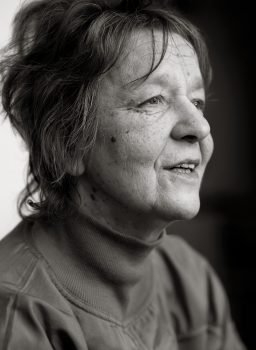
Sirkka Turkka. Photo: Pertti Nisonen
Sirkka Turkka is interviewed by Markku Huotari
Snowflakes are already covering the forest, and an angry wind is blowing off Lake Lohjanjärvi. It is autumn, and in the courtyard, at the roots of a stunted rowan, is a lounge chair, its paint already peeling.
‘I’ve left the chair there because my mother used to sit in it and knit.’
I start at Sirkka Turkka’s comment. In my mind is her last-but-one volume of poetry, Vaikka on kesä (‘Although it’s summer’, 1983); its poems sound a contemporary lament, occasioned by her mother’s death.
‘There’s nothing made-up in my poetry,’ says Sirkka Turkka.
Landscape, nature, the circular path of life – all of these have left their wounds in Sirkka Turkka’s poetry. But as she writes in Tule takaisin, pikku Sheba (‘Come back, little Sheba’, 1986), winner of the Finlandia Prize 1987, ‘from the wounds life grows’. More…
Bombast and the sublime
17 January 2013 | Reviews
 Torsten Pettersson
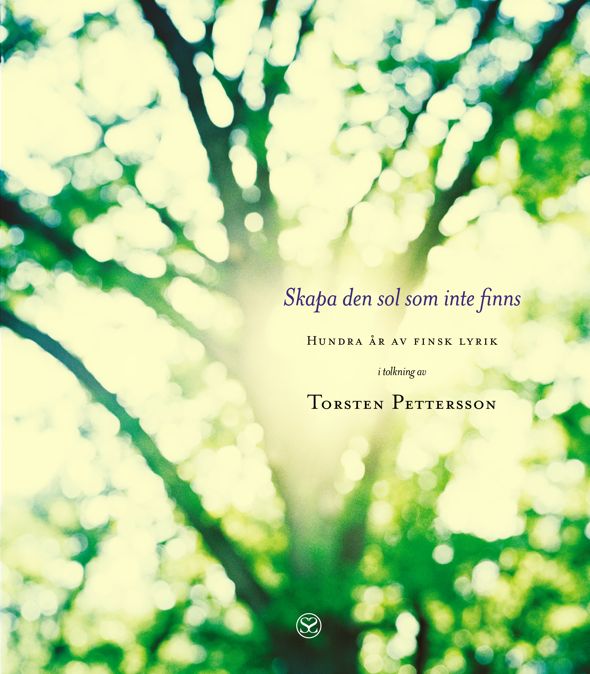
Skapa den sol som inte finns. Hundra år av finsk lyrik i tolkning av Torsten Pettersson
[Create the sun that is not there. A hundred years of Finnish poetry in Swedish translations by Torsten Pettersson]
Helsinki: Schildts & Söderströms, 2012. 299 p.
ISBN 978-951-52-3034-8
€25, paperback
In the 1960s my mother sometimes used to amuse herself and us children by reciting, in Finnish, in our bilingual family, selected lines of verse from the half-forgotten poetry canon of her school years.
Eino Leino (died 1926) and the great tubercular geniuses Saima Harmaja, Uuno Kailas, Katri Vala and Kaarlo Sarkia (all dead by 1945) were familiar names to me as a child. Early on, I realised that their poetry was both profoundly serious and also slightly silly, just because of its high-flown seriousness. More…
Eroica
31 December 1984 | Archives online, Fiction, poetry
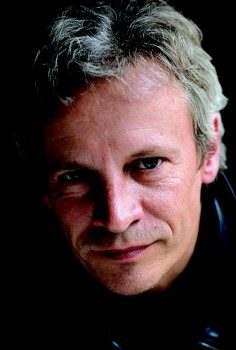
Ilpo Tiihonen. Photo: Irmeli Jung
Poems from From Eroikka (‘Eroica’, 1982). Introduction by Pertti Lassila
Ilpo Tiihonen (born 1950) published his first collection of poetry in 1975. From the beginning, his poems have been couched in the language of the street, and he uses slang liberally. Tiihonen has always been opposed to the miniature idylls of nature that were so characteristic of the 1970s. He aims at the secularisation of poetry, and he uses humour and comedy as a counterweight to high culture. He has evidently been influenced in his technique by Mayakovsky and Yesenin, to whom he often refers in his poems. His preferences in the poetic tradition are apparent in the fresh and liberal new interpretations of poems by Gustav Fröding contained in his collection Eroikka. Unusually for a contemporary Finnish poet, Tiihonen makes extensive use of rhyme. The result is often strongly lyrical poems that could almost be called modern broadsheet ballads, and may also bring Brecht to mind. More…
All my loving
15 February 2013 | This 'n' that
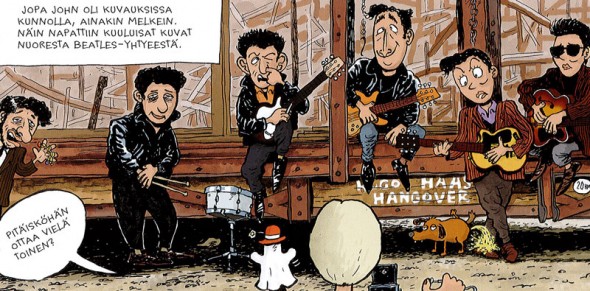
(Early days in Hamburg) Even John behaved himself in the photo sessions, at least almost. This is how the famous photos of the young Beatles were taken.
–Should I take one more? (Astrid the photographer)
One day in the antediluvian times of dawning Beatlemania, a schoolboy in a Finnish small town found himself smitten head over heels by the new pop songs by (probably) the most famous band in the world ever (so far). Like some two billion other teenagers, he learnt by heart every single song the Beatles recorded. Yeah!
The schoolboy grew up and became the illustrator and writer Mauri Kunnas (born 1950), whose storybooks, mostly for children, have now been translated into 30 languages.
But his interest in the Fab Four never left him, and last year he published his illustrated history of John, Paul, George and Ringo, from the day they were born to the day when Please, Please Me / Ask Me Why became number one in the British Top 20 in 1962. As the book is partly written in his native local dialect, its title is Piitles. Tarina erään rockbändin alkutaipaleesta (‘Beatles. The story of the first stage of a rock band’, Otava, 2012).
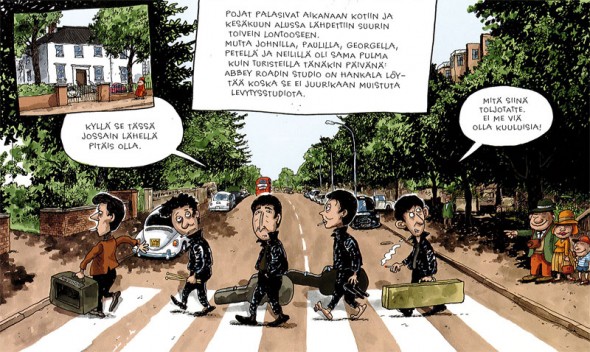
At last the boys came home from Germany, and in June 1962 they left for London with high hopes. But John, Paul, George, Pete and Neil had the same problems that tourists experience even today: The Abbey Road studio is hard to find because it doesn’t look like a recording studio. – It ought to be around here somewhere. – What are you staring at, we’re not famous yet!
In this 77-page graphic story the Beatles grow from babies into celebrities. The large number of hilarious visual details keeps the reader vigilant: for example, in their early days on Hamburg’s Reeperbahn John, Paul, George and Pete (Best) stay in lodgings behind a cinema that are less than hygienic, so on closer examination the lads turn out to be wearing underpants with yellow spots.

–To Eppy! –To my boys!
Julia Lennon, Klaus Voormann, Astrid Kirchherr, Stuart Sutcliffe, Cynthia, Brian Epstein, George Martin: the faces in the gallery of characters are instantly recognisable. Piitles illustrates how Beatlemania was born, and it is truly the work of a faithful fan.
You may say I’m a dreamer
25 November 2014 | Fiction, poetry
Prose poems from Tärnornas station – en drömbok (‘The Lucia Maids’ Station – a dream book’‚ Ellips, 2014). Introduction by Michel Ekman
I nurse a very small, perfectly formed child. It’s a girl. She smiles openly at me, even though she is so small. There is no doubt, neither about that nor anything else. The girl is the size of a nib pen, and just as exclusive. The nursing is going very well, it doesn’t hurt, and she can suckle without any problems. We are both at ease and yet awake, not introspective. The girl has intelligent eyes.
The milk keeps flowing.
Nothing runs dry.
Everything is obvious and neither of us is surprised. Just the fact that she is so small. Like a fountain pen. She is swathed in strips of bird cherry white bandages – like the ones mum had in her summer medicine cabinet – a cocoon, a chrysalis, but she’s not cramped, just secure. It smells good around us. I nurse my daughter who is perfect and the right size.

A door to the other side
7 September 2012 | Extracts, Non-fiction
Building bird-houses is author Jyrki Vainonen’s hobby: he has crafted dozens of nesting boxes and hung them on trees for winged tenants. Roaming in the woods may be bring surprises, though: the bird-house man suddenly finds the world underfoot opening up or a moment… An extract from the collection of stories Linnunpöntön rakentaja (‘Builder of bird-houses’, Atena, 2012)
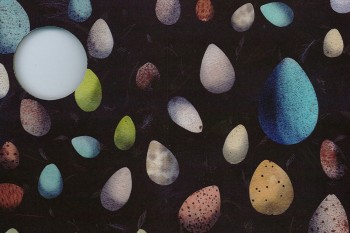
Birds coming up… Inside front cover of Linnunpöntön rakentaja by Elina Warsta/Solmu
The hinge was rusty, but after a cleaning and oiling it seemed to work, and didn’t even squeak. I had found it in a piece of board that was lying beside the road on the way to the dump. The board may have once served as part of a door frame.
The next day I rode my bike there again and unscrewed the hinge from the board, and now it looked quite handsome attached to the side wall of the birdhouse. I set the still floorless, roofless box upright and tried the door, opening the clasp and lifting the side wall on its hinges. It worked well, didn’t jam or make any sound. Next I attached the pieces of wood I’d already cut to form the roof and floor of the birdhouse. I inserted the floor and nailed through the three walls of the box – all except the wall that formed the door. Then I nailed the roof in place with several nails.
Now I had a box that would make it easy to watch the life inside. It would doubtless be wonderful to be able to see the nest from so close, and from the side rather than the top, as I usually had before. I could take photos, too. More…
Under cover
29 March 2012 | Extracts, Non-fiction
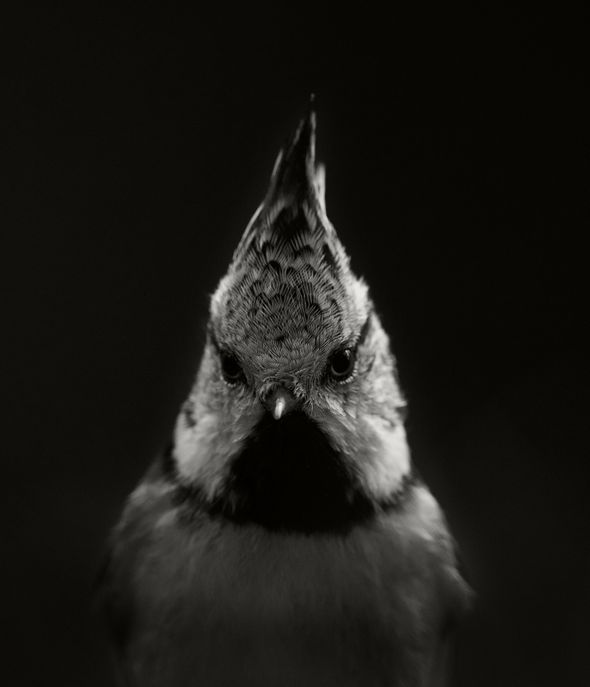
Soul-bird: crested tit. Photo: Heikki Willamo