

Search results for "tommi+musturi/2010/05/song-without-words/2009/09/what-god-said/2011/04/matti-suurpaa-parnasso-1951–2011-parnasso-1951–2011"
Say what you like
30 March 2007 | Fiction, poetry
Poems from Sanomattomia lehtiä and Leikitään kotia (‘Newsless newssheets’, ‘Let’s play house’, Tammi, 2004 and 2005)
Scent of morning
Say what you like about life, but life’s nothing that’s been said. The sun sets in a sepia setting where together a man and a woman walk out of the picture. At the start of the romantic’s story candles are lit, the girl stoops to hear better. Lonely stones roll from the horizon’s laughter, farewell to the continuity we love. Just for a second you could see from his face what he’d look like in twenty years. More…
On the road, in the world
21 March 2013 | Reviews
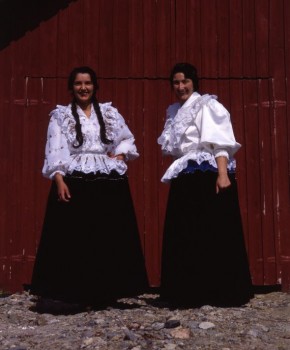
In Romani dress: Finnish Romani women still wear their traditional velvet skirts (which weigh 5-8 kilos). Photo: Topi Ikäläinen, 1983
Suomen romanien historia
[A history of Finland’s Romani people]
Toimittanut [Edited by] Panu Pulma
Helsinki: Suomalaisen Kirjallisuuden Seura (the Finnish Literature Society), 494 p., ill.
ISBN 978-952-222-364-7
€57, hardback
The Romani people set out from India around a thousand years ago; there are those who even claim that they originated in Egypt long before that. This latter account was favoured among the Romani in Europe, and so their leaders took to styling themselves the Dukes of ‘Egypt Minor’ or ‘Little Egypt’.
The Romani of Europe are generally considered to have come from northern India in the 15th century. They arrived in Finland – which at that time was part of Sweden – in 1512.
Five hundred years later, it seems a fitting time to publish Suomen romanien historia, a volume edited by Panu Pulma, PhD, a university lecturer in Finnish and Nordic history, with chapters contributed by a total of 14 additional experts.
The Romani who reached Stockholm, also in 1512, were said to be from ‘Egypt Minor’. This purported connection with Egypt is the origin behind the English word gypsy. The Swedish word zigenare (related to the German Zigeuner) did not come into use until the 17th century. More…
Drama queen: on writing, and not writing, plays
14 June 2010 | Articles, Authors
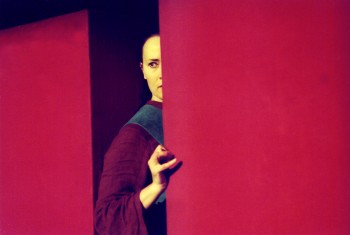
The queen who chose not to rule: Christina of Sweden in the play Queen C (first produced at the Finnish National Theatre in 2003, directed by the author, Laura Ruohonen, with Wanda Dubiel in the role of the Queen). Photo: Leena Klemelä
Extracts from ‘Postscript’, published in Kuningatar K ja muita näytelmiä (‘Queen C and other plays’, Otava, 2004)
It’s hard to read plays. I was bitterly disappointed at the age of eight, when I hid in my grandmother’s attic and opened up Romeo and Juliet, a book that seemed to promise lust and appalling acts. But it wasn’t even a real book; it was just talking from beginning to end! Where was the plot, the action, the much talked-about love story?
It’s also hard to write plays. Novels and works of poetry are closed miniature worlds that invite the reader in. A play always serves two masters. It has to be open and porous to allow the actor and the performance to penetrate into it. More…
Poems
30 December 1998 | Fiction, poetry
From Gården (‘The courtyard’, 1969)
The brown tablecloth hung over the edge.
I sat below there unseen in the odour of cabbage and warmth.
The sky hung on rusty hooks, the women of the courtyard shrank.
They were the only flowers the summer had.
They carried pails to the back yard where there was no sun.
Father read the newspaper, in the middle drawer of the writing table were
bills, promissory notes, pawn tickets, the rent book, everything in order. More…
Geneswing
30 June 2001 | Fiction, poetry
Poems from Tuulen vilja (‘Windcrop’, WSOY, 2000)
Longbeaked birds
created for the deepfunnelled gloxinia – everything exactly right.
The sport of colours, survival (though I always felt I was
sunset in the morning).
I walk over the living, the playful swing of genes,
uniqueness in splinters: capsules,
family trees, root systems, leafage.
In the geneswing little deviations of dimension,
as if I were perpetually outlining waves with my finger.
The primal miracle of seeds: I press
a mixture of summer flowers in the soil, exploding
a serial miracle. More…
HEL YES!
24 September 2010 | This 'n' that
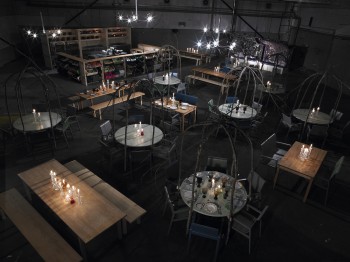
Dinner time: HEL YES pop-up restaurant in London; lighting by Harri Koskinen. Photo: Adam Laycock
Run that by me again, please?
Oh: HEL is the airport abbreviation of Helsinki, and the second word completes the title given to a pop-up restaurant set up by a team of Finnish designers and chefs in London. It takes place at 1–3 Wenlock Road, London N1, between 15 September and 3 October.
HEL YES! is commissioned and produced by the Finnish Institute in London as part of its Arts & Culture Programme, in anticipation of Helsinki’s role as World Design Capital in 2012.
The restaurant offers inventive Finnish dishes, the dinner service plates are mix ‘n’ match vintage Iittala and the diners sit on Alvar Aalto and Artek’s ‘403’ chairs painted in a new range of colours.
We hear the reservations for dinner are now been fully booked, but coffee and drinks are available in the restaurant, a former depot. See what the press said, here.
Poems
30 June 1987 | Archives online, Fiction, poetry
Poems from Vattenhjulet (‘The water-wheel’, 1986). Introduction by Thomas Warburton
Together with time
One day the door to my room closed
and fate said to me: be still.
It was then that I discovered time.
It had lain hidden beneath a lid
of events and hasty decisions.
It was then that I raised the lid.
So strange! There time lay
completely unused, completely itself
smooth and fresh, as if resting.
I looked at time with reverence.
I saw myself new, I sank into
a miraculous eventlessness
together with time
listened to myself living:
a barely perceptible murmur.
The water-wheel
The old horse plods heavily with blinkered eyes
the wheel turns slowly and inexorably
creating time, a thing that is not visible
that is really nothing
			with the right to kill.
Talking to Andrei
30 June 1998 | Fiction, poetry
Poems from Efter att ha tillbringat en natt bland hästar (‘After spending a night among horses’, Söderströms, 1997)
The snow is whirling over the roses of the inner courtyard
The snow is whirling over the roses of the inner courtyard.
Did not bring boots or scarf with me, leaf
through books, don’t know what to do with all this light!
You would not approve of the colours.
It’s too impressive, Andrei Arsenyevich, there is too
much, too much of everything!
You swapped your wings for an air balloon, a clumsy
contraption twined together from ropes and rags, I remember it well.
Earlier, I had a lot and didn’t remember. Hard
to keep to the point. Hard to keep to the point.
Hope to get back. Hope to get back to the principle
of the wings. Fact remains: the cold preserved
the rose garden last night. ‘The zone is a zone, the zone is life,
and a person may either perish or survive as
he makes his way through this life. Whether he manages it or
not depends on his sense of own worth.’* A hare
almost leapt into the vestibule here at the Foundation,
mottled against the snow; in the hare’s diary it’s October, after all.
You seem to be in quite a malignant humour,
and it is possible that none of this interests you.
On the other hand, you quite often complain yourself.
I’m writing because you are dead and because I woke up
last spring in my hotel facing the street in Benidorm to that wonderful
high twittering. One ought not to constantly say sorry, one ought
not to constantly say thank you, one ought to say thank you. Lake Mälaren like lead down there. The rest is white and red. More…
Among horses
30 June 1998 | Authors, Interviews

Photo: Cato Lein
‘Now it’s really damned difficult to know whether these poems will be close to the reader, or strange,’ Tua Forsström said a couple of days before the publication last autumn of her collection Efter att ha tillbringat en natt bland hästar (‘After spending a night among horses’).
Her previous collection, Parkerna (‘The parks’), published five years ago, found its readers and swept the board of literary prizes. The new poems, too, come close to the reader; the book’s Finland-Swedish publisher has sold out and the prize-boards have been swept again, including the Nordic Council Prize for Literature.
Writing the new collection took five years, as was the case with Parkerna. Tua Forsström writes slowly: nine collections in a quarter of a century. Her first collection, En dikt om kärlek och annat (‘A poem about love and other things’), appeared in 1972. More…
The daughter
A short story from Meddelande (‘Messages’, Schildts, 1998)
Mother, hello! It’s me … can’t hear you very well. I rang a while ago, but maybe you were having your nap?
(Cheerfully) Yes, of course, you can take a nap whenever you like. I can always phone back.
But Mother, listen to what I’m saying now: that’s the last thing I want you to do. It’s awful if you’re just sitting there by the phone, waiting and waiting. You mustn’t do that. I can phone later when I phone, you know that. How’re things?
But that’s good. Great. And you’ve made your evening cup of tea? More…
Writes of passage
20 June 2013 | This 'n' that
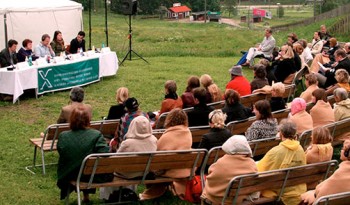
Debating the word: participants at the Lahti Reunion. Photo: LIWRE
The 26th Lahti International Writers’ Reunion took place at Messilä Manor (some 120 km from Helsinki, on Lake Vesijärvi) from 15 to 18 June.
Chaired by Virpi Hämeen-Anttila and Joni Pyysalo, writers from more than 20 countries held discussions in Finnish, English and French.
This summer the theme was ‘Breaking walls’. ‘Problems demand answers, answers demand questions. If attitudes harden, arms talk, and everyone erects a wall around himself, where is literature in the equation? Is the highest wall right there inside the writer? Or is literature itself a protecting wall? What happens when walls break down?’
The first Writers’ Reunion took place in Lahti – first at Mukkula Manor – fifty years ago; more than a thousand writers, translators, critics and other professionals both Finnish and foreign have come to Lahti to discuss writing. The Reunion has always been open to the public as well.
The biannual Reunion began life in 1963, during the Cold War. Writers from both sides of the Iron Curtain met under the oaks of Mukkula. In the Reunion’s blog some participants and organisers share their experiences of the past; here, the meeting’s one-time international secretary Marianne Bargum recalls the late 1970s and early 1980s:
‘…following in the footsteps of the legendary publisher Erkki Reenpää who knew everybody and all languages, I did my best to persuade big stars to come to Mukkula. Some writers had difficulties when they realised that they were not as well known in Finland as in their own countries. The French poet Michel Deguy left after one day, very offended when nobody knew how big a name he was. (I met him in Paris some years later and he apologised.)
A scandal with huge political consequences came close when the French philosopher Bernard-Henry Lévy said some derogatory things about the Soviet head of state Brezhnev. The Russian delegate, Michael Baryshev, threatened to leave the conference, and Valentina Morozova, interpreter and politruk, had to phone the Soviet Embassy in Helsinki and explain that this was not very serious. The famous British critic and writer Al Alvarez did his best to calm down the antagonists in a panel.’
My own first personal experiences of this international fête (which could mean either wading in the mud on the way to the huge tent sheltering the discussions or basking in hot sunshine followed by the most gentle nightless nights), from the sunny summer of 1983: interviewing Salman Rushdie and Jayne Anne Phillips, among others, for the Finnish Broadcasting Company. Another time the bag containing some hundred copies of the latest issue of Books from Finland, fresh from the printing press, sat on a bus heading for Lahti while I sat on the one behind – which then broke down in the middle of the road, and this was before mobile phones. The driver did have a radio phone though, and the participants got their copies in time.
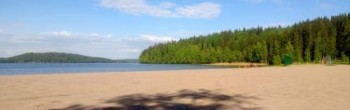
Soccer on the sand: Messilä beach. Photo: LIWRE
Among the traditions is a midnight football match between Finns and foreigners: the summer night is light and long. This time the result of the Finland against the rest of the world was convincing 6-3 to Finland.
Utopia or dystopia?
15 October 2013 | This 'n' that
 ‘The fate of our societies lies in equity’, claims Martti Ahtisaari – winner of the Nobel Peace Prize in 2008 – in his foreword to a study entitled A recipe for a better life: Experiences from the Nordic countries (2013).
The study was compiled and written by Heikki Hiilamo and Olli Kangas with Johan Fritzell, Jon Kvist and Joakim Palme and published by Crisis Management Initiative (a Finnish, independent, non-profit organisation founded in 2000 by Ahtisaari, President of Finland from 1994 to 2000). It is available here.
‘The Nordic experience’ is presented in chapters dealing with the trustworthiness of the society, the role of the state, the amount of efficiency and inefficiency as well as the homogeneity of the Nordic societies and the social investments of these societies in their citizens.
(The Nordic countries consist of Denmark, Finland, Iceland, Norway and Sweden as well as their associated territories – with different levels of autonomy – the Faroe Islands and Greenland [Denmark] and Åland [Finland].)
         ‘"The Nordic enigma" is a successful marriage between hard-core competitive capitalism
          and the pursuit of egalitarian policies’.
The study provides a concise summary of how these societies function with additional comments on the socio-historical development of independent Finland. It presents the reader with pros and cons, arguments and facts.
        ‘For some analysts the Nordic welfare state is a dystopia to be avoided at all costs....
        It is simply argued that that the welfare state destroys the incentives to work.’
        ‘Despite their strong welfare states and heavy tax burdens – often said to be poison
        to competitiveness – the Nordic countries are doing well in economic terms.’
The reader is indeed challenged to ponder the best recipes for a better life. Last but not least: how will the ‘recipes’ need to be adapted in the future?