

Search results for "tommi+musturi/2010/05/song-without-words/2009/09/what-god-said"
The Session
30 June 1982 | Archives online, Fiction, Prose
Pappas flicka (‘Daddy’s girl’, 1982), an extract of which appears below, is published in Finland by Söderstrom & C:o and in Sweden by Norstedt. The Finnish translation is published by Tammi. Introduction by Gustaf Widén
At first I say nothing, as usual.
Dr Berg also sits in silence. I can hear him moving in his chair and try to work out what he’s doing. Is he getting out pen and paper? Or perhaps he has a tiny soundless tape-recorder he is switching on.
Or is he just settling down, deep down into his armchair, one leg crossed over the other, like Dad used to sit? I used to climb up on to his foot. The he would hold my hands and bounce his foot up and down, and you had to say “whoopsie” and finally with a powerful kick, he would fling me in the air so that I landed in his arms.
I have worked it out that the little cushion under my head is to stop us lunatics from turning our heads round to look at Herr Doktor.
It would certainly be nice to sit bouncing up and down on Dr Berg’s foot. His ankle would rub me between my legs …
I soon start feeling ashamed and blush.
“Mm,” says Dr Berg, as if reading my thoughts. Or can he see my face from where he is sitting? I try rolling my eyes up to catch a glimpse of him, but all I can see is the ceiling with all its thick beams.
“I seem to have been here before,” I say. More…
Daughter of Cain
30 June 1985 | Archives online, Fiction, Prose
An extract from the novel Kainin tytär (‘Daughter of Cain’, 1984). In the following extract Anna and Risku spend a single night recalling the early days of their relationship; Anna is in the country, Risku is in the city. Introduction by Soila Lehtonen
Anna
The moon hangs before the bosom of the sky, a slender crescent, but giving light all the same.
On the horizon a black, glimmering line emerges from the water. It is the skerry, a low, lone rock.
I shut off the motor. The sea laps minutely against the side of the boat. This far out there are no longer any birds.
The silence here is deeper than even that of an empty room.
The skerry is as black and glistening as the back of a pike.
Light is matter, it’s never steady.
Whatever is understood in life is understood in a sudden blue illumination, like lightning cleaving the night to expose the landscape – shadows, hollows and all. More…
The guest event
12 November 2010 | Fiction, Prose
A short story from Vattnen (‘Waters’, Söderströms, 2010)
It was a lagoon. The water was not like out at sea, not a turquoise dream with white vacation trimming on the crests of the waves. This water was completely still and strange, brown yet clear, sepia and umber, perhaps cinnamon, possibly cigar with the finest flakes of finest wrapper. Clean. This water of meetings was clear and clean in a non-platonic, remarkably earthbound way.
Sediment and humus, humus floating about in the morning sun.
It felt comforting, as if the water didn’t repel the foreign bodies as a matter of course, didn’t immediately suppress the other particles and sanctimoniously hasten to force anything that wasn’t water, anything that could be interpreted as pollution and encroachment, down to the bottom and let it dissolve and die all by itself. This water sang its earth-brown song of unity without thereby becoming any less water than water-water was.
Helena felt cold. More…
On the bridge
30 June 1993 | Archives online, Fiction, Prose
From Saksalainen sikakoira (‘Schweinehund’, WSOY, 1992). Introduction by Tuva Korsström
From somewhere beneath the bridge – I still hadn’t managed to get across it, which may sound pathetic, or even ridiculous, unless you take into account my exceptional state of mind – or, rather, to one side, I heard a dragging, ominous grinding and rumbling. It stopped for a moment; then, after a short but clearly defined pause, there was a heavy splash. A snow-plough was emptying its load into the bay from the end of the pier. The mounds of snow sank deep into the black water; the tightly packed, sticky snow rose slowly to the surface in greyish-yellow blocks and clods; loose pieces of snow boiled and foamed in the eddies and melted before my eyes. My time was melting away, too, being junked, my remaining time… More…
I’ll never forget you
30 September 2000 | Fiction, Prose
An extract from the novel Mariposa (Schildts, 1999)
Roza and Melancholie were sitting in a bar drinking beer. They hadn’t met for a long time because they bored each other. But they were best friends nonetheless. What do you do when you can’t stand meeting your best friend? You switch on your answerphone and tell lies. Today by mistake one of them had answered the phone.
Roza was dressed in her brother Armand’s old clothes, a bad habit which irritated people but which she found hard to break. Her brother had vanished long ago leaving his clothes behind. They smelled of tobacco and sweat. Roza used them to keep him alive. She could spend whole evenings going through his wardrobe. There was a dress shirt, not that you’d have expected it.
The two young women studied each other. Melancholie noted that Roza had bitten down her cuticles again.
‘How’s life?’ she asked.
‘So-so. And you?’ More…
Sensitivity session
30 June 1978 | Archives online, Fiction, Prose
An extract from the novel Ja pesäpuu itki (‘And the nesting-tree wept’). Introduction by Pekka Tarkka
Taito Suutarinen knew quite a bit about Freud. Where Mannerheim’s statue now stands, Taito felt that there ought instead to be an equestrian statue of Sigmund Freud. It would be like truth revealed.
Freud, urging on his trusty stallion Libido, would be clad from head to foot in sexual symbols – hat, trousers, shoes: one hand thrust deep into his pocket, the other grasping a walking-stick. The stick would point eloquently in the direction of the railway tracks, where the red trains slid into the arching womb of the station.
Taito had also attended a couple of seven-day sensitivity training courses, where people expressed their feelings openly, directly and spontaneously. By the end of the first course Taito was so direct and spontaneous that he couldn’t get on with anybody. By the end of the second he was so open that everyone was embarrassed. Every member of the group had cried at least once, except the group leader. Never before had Taito witnessed such power. He could not wait to found a group of his own. Taito’s group met in a basement room, where they reclined on mattresses to assist the liberation process. Everyone was free to have problems, quite openly. You were not regarded as ill: on the contrary, if you realized your problem you were more healthy than a person who still thought he mattered. Moreover, as Taito, fixing you with his piercing gaze, was always careful to emphasize, every problem was ultimately a sexual problem. Taito would spontaneously scratch his crotch as he spoke, making it clear that he himself had virtually no problems left. More…
The gender of the soul
Scenes from the play Kuningatar K / Queen C
Characters:
Christina, the Queen
Friend
The Queen Mother
Karl Gustav, the Count [Christina’s suitor, the King-to-be]
Descartes, philosopher
Official
Man
The King
Oxenstierna, Per Brahe
A choir of midwives
The play can be performed with six actors (3 female, 3 male). Other ways of dividing the roles are possible. All stage directions may be altered.
1. Prologue
The eels’ court
CHRISTINA
If eels had a court then a great female eel would sit in the centre and the little males would writhe about like seaweed around the throne. However they would not be envious of the queen, because they would know that if they swam up into rivers and lakes, into fresh waters, they themselves would gradually become females, great and heavy, and would be able to rule and close into their great embrace all the small little gentlemen. They just have to wait.
KARL GUSTAV
I don’t know. What I do know is that a great black eel, as thick as a rope, was pulled out of the well last night and the Queen looked at its silver stomach and its thrashing tail, but the eel looked the Queen in the eyes and in the heart and since then she has never been the same. More…
Gatecrashing the universe: the poems of Ilpo Tiihonen
4 December 2009 | Authors, Reviews
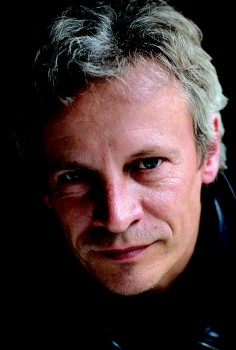
Ilpo Tiihonen – Photo: Irmeli Jung
Ilpo Tiihonen defies definition: he is, at one and the same time, a cosmopolitan poet who draws his influences from Latin America and the early Soviet avant garde, and a local poet for the whole of Finland, a fabulist who plays with language and a rough-hewn romantic of everyday life.
In Tiihonen’s selected poems, Lyhyt oodi kaikelle (‘A short ode to everything’, 2000), readers are invited to admire the prospekts of Moscow and Paris’s Montparnasse.
Most fondly pictured, however, are spring work-days wherever Tiihonen (born 1950) is living – in recent years, the working-class Helsinki suburb of Kallio, which has on the one hand scrubbed up to become a favourite of students and the more bohemian middle-class and on the other gained notoriety for its bread-lines, prostitutes and street winos. More…
In one hundred springtimes
23 November 2012 | Extracts, Non-fiction
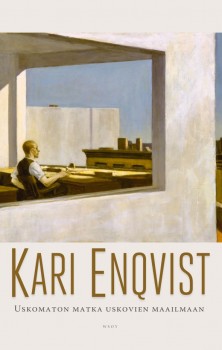 Extracts from Uskomaton matka uskovien maailmaan (‘An unbelievable journey into the world of the believers’, WSOY, 2012)
In his new book the writer, professor of cosmology, a scientist without a religion Kari Enqvist explores religiosity, how it manifests itself in present-day Finland, in various churches and parishes. How will the expanding scope of science and secularisation change the world and the forms of spirituality in the course of the next century?
When, in July 1969, Neil Armstrong climbed down the ladder on to the surface of the Moon, it was a huge propaganda coup for both the United States and the scientific world view. Manned space flights as a way of gaining knowledge are both ineffective and brain-numbingly expensive, but it is hard to imagine a stronger individual and universally understandable demonstration of the superiority of the scientific world view than an astronaut on the surface of a foreign celestial body. Everyone can recognise it as a triumph of both engineering technology and the hard sciences.
But the astronaut solution has been tested already, and I do not believe that space travel will expand our consciousnesses in the next century. It is possible that we will not even have visited Mars. Fantasies about manned flights to other stars are, in my opinion, utopian in the extreme and I do not really believe that humans as physical beings will ever leave the solar system. Journeys to the stars are inconceivably long and so expensive that they cannot be embarked on merely in order to fulfil the Buck Rogers fantasies of teenage boys. Carrying humans to the closest one, alpha Centauri, a mere four light years away, would take, at best, hundreds of years (we can dismiss rockets that travel at the speed of light as mere scientific fantasy). Even if deep-freezing to slow vital functions were possible, it would make as much sense to pay hundreds of billions to freight pig carcasses to the planets. For everything that human beings can do can be done better – and, more importantly, more cheaply – by machines. Even if the spirit were willing, the flesh is so weak that silicone beats it hollow.
So it is my guess that in place of the macrocosmos the scientific world view will seek consolidation in the microcosmos. As a cosmologist, I am not happy to admit this, but admit it I must. More…
Suburban dreams
30 March 2004 | Fiction, Prose
Extracts from the novel Kahden ja yhden yön tarinoita (‘Tales from two and one nights’, Sammakko, 2003)
Reponen, Tane, Aleksi and Little Juha; once we all climbed up the path to the old dump with bows on our backs, our arrows sticking out from the tops of our boots. It was April. In the field above the dump puddles reflected the opaque sky, where we were going to shoot our arrows.
The field was the highest point in our neighbourhood. We could see the shopping centre, the library and the sawdust running track through the school woods. We could see the high-rise flats on Tora-alhontie road and the huts in the allotments. We could make out the thick spruce forest of Sovinnonvuori along the greenish grey coastline at Kapeasalmi. Our homes sat there below us. Softly droning cranes, yellow totem animals of hope, swung back and forth above the unfinished houses. In the distance was the centre of town with all its churches and scars. Here everything was just beginning. The swaggering confidence of ten-year-old boys was straining within us and would carry us far like Geronimo’s bow. More…
Really existing?
30 March 2007 | Fiction, Prose
Extracts from the novel Mehiläispaviljonki. Kertomus parvista (‘The Bee Pavilion. A story about swarms’, Teos, 2006)
There are few old buildings in this town. Most are demolished to make way for new ones long before they reach the end of their first century.
Nevertheless, one brick building in our part of town, built at the beginning of the last century, was spared demolition for a long time. The two-storey building functioned as a Support Centre for the Psychically Ill and later on, for a couple of winters, as a shelter for alcoholics. The board fence that had surrounded the building for decades was taken down long before the building itself, but the maples on the sidewalk cast their shadows on its windows to the very end. When the lilacs and dogwoods in the back garden were in bloom, their heavy racemes shed purple and white on the sand. More…
Helsinki: World Design Capital 2012
13 January 2012 | This 'n' that
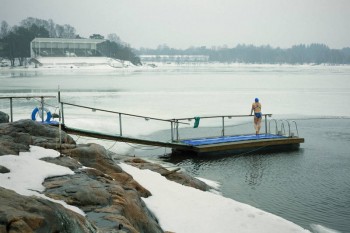
Swimming in the rain: winter joys of Helsinki. Photograph: Valtteri Hirvonen – Eriksson & Co.
After Turin (Italy, 2008) and Seoul (Republic of Korea, 2010), 2012 Helsinki is the third World Design Capital, selected in 2009 by the International Council of Societies of Industrial Design (ICSID).
Helsinki was considered to be a city where ‘design has for decades been a pivotal enabler to building an open city’.
The theme is ‘Open Helsinki – Embedding Design in Life‘. The idea is to improve the everyday life and environment of the citizens and the development of both public services and private enterprises.
In addition to Helsinki, the realisation of the Design Capital year will be carried out by four other cities: neighbouring Espoo, Vantaa and Kauniainen as well as Lahti (some hundred kilometres north of the capital). The Finnish government, two ministries, 21 commercial companies and some universities will co-operate in this project, which has a budget of 16 million euros (2010–2013).
The programme includes some 300 different events, half of them development projects, themed ‘The changing city’ or ‘New solutions’; the other half consists of various exhibitions and encounters for the citizens of Helsinki, tourists and design people.
The ultimate goal of this all is said to be ‘permanent change’. Whatever that really means – good luck!
However, as writer and design critic Kaj Kalin noted in a review in Helsingin Sanomat newspaper (30 December), Finland is full of well-educated designers, but lacks both investment money prepared to take risks and working industry: soon all production will have moved to cheaper countries – and nobody will be able to produce anything. New Finnish design, Kalin argues, mostly approximates merely to ‘a show parade of models and prototypes’.
Sealspotting
14 June 2009 | Reviews
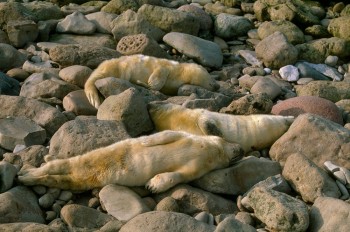
Zzzzzzz! In the grey seal kindergarten babies take a nap after dinner. – Photo: Seppo Keränen
Taskinen, Juha
Paluu Saimaalle
[Return to Lake Saimaa]
Helsinki: WSOY, 2009. 204 p., ill.
ISBN 978-951-0-33745-5
€ 38.90, hardback
Keränen, Seppo & Lappalainen, Markku
Hylkeet [The seals]
Helsinki: Maahenki, 2009. 151 p., ill.
ISBN 978-952-56-5266-6
€ 45, hardback
Sälar
Helsingfors: Söderströms, 2009.
151 p., ill.
Swedish translation: Annika Luther
ISBN 978-951-52-2603-7
€ 45, hardback
The private life of the species of seal that lives only in Lake Saimaa has been carefully investigated lately. Almost everything about this highly endangered species has been revealed, thanks to technological devices such as transmitters that can be glued to their backs…
STOP! WARNING: as I realise that not everybody wants to know what pinnipeds do in their spare time, I suggest you quit reading now, if you aren’t interested in the lives and fates of an obscure group of about 260 mammals that live in a lake in the remote west of Finland.
In a class of one’s own
18 December 2009 | Reviews
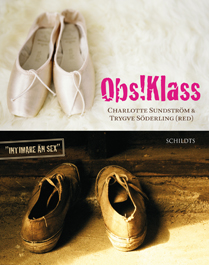 Obs! Klass
Red. [Ed. by] Charlotte Sundström & Trygve Söderling
Helsingfors: Schildts, 2009. 288 p.
ISBN 978-951-50-1891-5
€27, paperback
De andra. En bok om klass
Red. [Ed. by] Silja Hiidenheimo, Fredrik Lång, Tapani Ritamäki, Anna Rotkirch
Helsingfors: Söderströms, 2009. 288 p.
ISBN 978-951-522-665-5
€26.90, paperback
Me muut. Kirjoituksia yhteiskuntaluokista
Helsinki: Teos, 2009. 267 p.
ISBN 978-951-851-259-5
€27.90, paperback
At some time in their lives, all members of the Swedish-speaking minority in Finland have been confronted with the phrase ‘Swedish-speaking better people’ [Svenska talande bättre folk], uttered in tones of contempt. Encouraged by news and entertainment media with little regard for the consequences, Finland’s Finnish-speaking majority is hopelessly fascinated by the image of us Finland-Swedes as a uniform and monolithic haute bourgeoisie that resides in the coveted Helsinki neighbourhoods of Eira and Brunnsparken. More…