

Search results for "tommi+musturi/2010/05/song-without-words/2009/09/what-god-said"
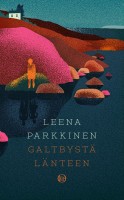
Leena Parkkinen: Galtbystä länteen [West from Galtby]
19 December 2013 | Mini reviews, Reviews
 Galtbystä länteen
[West from Galtby]
Helsinki: Teos, 2013. 339 p.
ISBN 978-951-851-510-7
€32.90, hardback
Leena Parkkinen’s first novel, Sinun jälkeesi, Max (‘After you, Max’) was awarded the Helsingin Sanomat literature prize for best first work of 2009. Her new novel contains crime story ingredients, but the focus is on love between siblings, loss and the demand for truth. The story begins in 1947, after the war, on an island in the south-western Finnish archipelago. Sebastian, brother of Karen, has returned from the front; it’s time to mend the best clothes and dancing shoes. But to the horror of the island community, the body of a young girl is found on the shore, and Sebastian gets the blame. Sixty-five years later her brother’s fate has not left Karen alone, and she sets out to find the truth. Capable of handling different times, Parkkinen (born 1979) is also a skilful interpreter of conflicting sentiments, as unexpected twists develop towards the end.
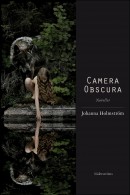
Johanna Holmström: Camera Obscura
6 January 2010 | Mini reviews, Reviews
 Camera Obscura
Helsinki: Söderströms, 2009, 334 p.
ISBN 978-951-52-2616-7
€ 24,90, hardback
This short story collection is Johanna Holmström’s fourth book since her debut in 2003. Camera Obscura is a fabric of narratives and personal destinies which create a dense, novel-like whole. The preamble is a young environmental activist’s suicide. The form is interwoven with the content, so that the stories in the book can be read as separate narratives, but to understand them fully we must read them all. Each person’s destiny is shaped in part by the choices and actions of others; to what extent is the individual responsible for the whole? Holmström (born 1981) writes fiction that is unpredictable but stylistically assured. She seamlessly weaves with classic fairytale motifs and also has a keen eye for detail and psychology. Camera Obscura is at once eerie, suspense-filled and socially aware.
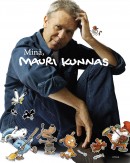
Minä, Mauri Kunnas [I, Mauri Kunnas]
4 March 2010 | Mini reviews, Reviews
 Minä, Mauri Kunnas
[I, Mauri Kunnas]
Muistiin merkitsi [As told to] Lotta Sonninen
Helsinki: Otava, 2009. 182 p., ill.
ISBN 978-951-1-23186-8
€ 40, hardback
Mauri Kunnas (born 1950) is a cartoonist and graphic artist. His children’s books have been translated into 28 languages; the translations have sold approximately 2,5 million copies. His anthropomorphic canine characters from Koiramäki, Doghill, are well known for their adventures in historical milieus; researching these settings is one of Kunnas’ passions. His reinterpretations of Finnish literary classics are also popular: The Canine Kalevala and Seven Dog Brothers offer affectionately humorous homages to the Kalevala, the Finnish folk epic, and the classic novel by Aleksis Kivi. Joulupukki (1981), published in English as Santa Claus, is arguably the world’s best-known Finnish children’s book. In this book, Kunnas gives a lively account of his childhood and youth, as well as his influences and the different phases of his career as an illustrator. The text is complemented by photos from Kunnas’ family album and his own archives, from adventure stories he illustrated as a boy to a pair of hippy bell-bottomed jeans adorned with doodles.
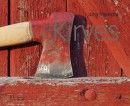
Juha Maasola: Kirves [The axe]
4 March 2010 | Mini reviews, Reviews
 Kirves
[The axe]
Helsinki: Maahenki, 2009. 207 p., ill.
ISBN 978-952-5652-74-1
€ 44, hardback
This book by Juha Maasola, a forestry protection officer, provides an economic, cultural and social history of the axe from prehistoric times to the present day. The axe was the sole implement used for felling trees in Finland up until the turn of the 20th century. Most Finnish men still know how to chop their own wood for the sauna, while one axe model produced by Fiskars has won awards for outstanding product design. This impressively illustrated work also explains the techniques and history of forestry and logging. In the 1940s, wartime ‘woodcutting bees’ united the Finnish nation, with women picking up their axes and joining in. Buildings have traditionally been constructed from wood, and builders had to be handy with a hatchet. This skill gave carpenters their name in Finnish: kirvesmies – literally, ‘axeman’. A list of over 300 Finnish-language terms meaning ‘axe’, gleaned from the archives of the Research Institute for the Languages of Finland, is included. The book concludes with a look at portrayals of the use of axes in Finnish literature, film and art.
Jari Tervo: Koljatti [Goliath]
23 October 2009 | Mini reviews, Reviews
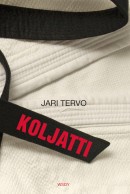 Koljatti
[Goliath]
Helsinki: WSOY, 2009. 317 p.
ISBN 978-951-0-35610-4
25 €, hardback
Jari Tervo (born 1959) writes comic, swiftly paced, linguistically accomplished prose with touches of historicism, philosophy and social commentary. Koljatti is a contemporary satire that prompted a great deal of fuss in the Finnish press for its perceived nastiness: the similarities between its character Pekka Lahnanen, an isolated and beleaguered prime minister, and Matti Vanhanen, the current Finnish Prime Minister, are clear. This novel outlines some crude caricatures, but its critical barbs are aimed not at politics, but rather at the relationship between the media and politics. This book, which describes the events of a single fast-paced weekend, portrays politics as theatre, in which the only thing that matters is how things appear; the media will drop any substantive questions in their relentless pursuit of new sensationalist headlines of politicians’ private lives. The news may not look the same after reading this novel. Tervo is one of Finland’s most popular authors; three of his novels have appeared in translation, in four languages. [Read a short story here.]
Ruminations
16 April 2010 | Authors, Reviews

Vilja-Tuulia Huotarinen. Photo: Heini Lehväslaiho
One of the most exciting features of Finnish poetry since 2000 has been the wealth and breadth of poetry by young women. Compared to literature written by women in earlier decades, contemporary poetry appears to have freed itself from one-track feminism and knotted brow earnestness to become a literature with a richer approach to womanhood, its forms and history.
The first collection by Vilja-Tuulia Huotarinen (born 1977), Sakset kädessä ei saa juosta (‘You mustn’t run with scissors in your hand’, 2004) was a glimpse into the culturally restricted but nevertheless autonomous world of young girls. Mother’s instructions and Father’s advice will be broken down as one grows up; in spite of the genderised system, it is still possible for a young woman to make her own choices. More…
Tomi Kontio: Viidakon kutsu [The call of the jungle]
12 February 2010 | Mini reviews, Reviews
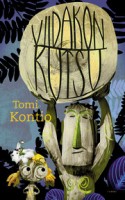 Viidakon kutsu
[The call of the jungle]
Helsinki: Tammi, 2009, 240 p.
ISBN 978-951-31-5042-6
16.20 €, hardback
Poet and author Tomi Kontio’s book for young teenagers is a take-off of the boys’ adventure story and fantasy novel, a genre he has used in the past. But Kontio leads 12-year-old Alma and Alpo into the jungle… of eastern Finland – the backwoods of Kainuu, to be precise. There they meet the Vimbas, a tribe living in harmony with nature, who teach them many important lessons. Kontio succeeds in combining his two narrative talents: he doesn’t underestimate the value of lively and lyrical language to his target audience, and he entertains his readers with fabulations that mix the rational and the absurd into a cohesive whole. Viidakon kutsu is a portrait of a world that is considerably brighter than in Kontio’s previous books for young readers.
Linnut vauhdissa [Birds caught in motion]
18 December 2009 | Mini reviews, Reviews
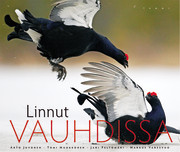 Arto Juvonen & Tomi Muukkonen & Jari Peltomäki & Markus Varesvuo
Linnut vauhdissa
[Birds caught in motion]
Helsinki: Tammi, 2009. 191 p., ill.
ISBN 978-951-31-4605-7
€ 39, hardback
Linnut vauhdissa features the work of several specialist bird photographers, contains astonishingly sharp photos of birds caught in mid-flight. This book breaks with convention by presenting surprising analogies and juxtapositions of photographs, thereby providing a more in-depth viewing experience than mere biological facts and identification of species. The majority of the photos were shot in Finland, where the Nordic light and winter snow offer unique qualities for nature photography. The preface was written by Hannu Hautala, arguably Finland’s best-known nature photographer. All of the photographers whose work is presented here are experienced birders. They also maintain a website that attracts many visitors, both from Finland and abroad.
Maria Turtschaninoff: Arra. Legender från Lavora [Arra. Legends from Lavora]
12 February 2010 | Mini reviews, Reviews
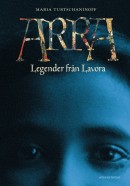 Arra. Legender från Lavora
[Arra. Legends from Lavora]
Helsinki: Söderströms, 2009. 251 p.
ISBN 978-951-52-2604-4
19.90 €, hardback
Legender från Lavora by Maria Turtschaninoff (born 1977) is limpid and leisurely in tone, yet the story of Arra, a girl from a poor family, is intense, tragic and original. Because she is mute, Arra is thought to be feeble-minded, and thus of no value to her family. She becomes, in fact, an ‘invisible child’ – the author’s reference to neglected children of the present day. The girl uses a special power to compensate for the contempt of those around her: she binds herself in living connection with nature, which leads her in the end to glory and honour. Because of Arra’s long period of muteness as she enters her teens, dialogue is a very small portion of the book. The narrative may be challenging for young readers, but the vivid love story of Arra and Prince Surando has an irresistible, magical enchantment.
Night of the Living….
5 September 2013 | In the news
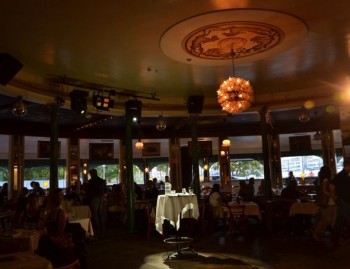
Poetry in focus: Kaisaniemi Restaurant, Helsinki, 24 August. Photo: Irene Dimitropoulos
…Poets was the main event of the annual literature festival Runokuu, Poetry Moon, taking place on 24 August in a Helsinki restaurant. The theme was the sea: the invited guests were from around the Baltic Sea – as well as beyond.
The Poetry Moon festival is organised by Nuoren Voiman Liitto and Helsinki Festival, now for the ninth time, with more than 30 events taking place in the city between 22 and 28 August.
‘In four hours writers and languages kept changing fast,’ reports Irene Dimitropoulos, an intern at FILI (Finnish Literature Exchange): ‘You had to throw yourself into the rhythms and sounds of languages both familiar and strange.
‘The programme contained lots of poetry, but the short story and non-fiction were also included. The idea of the literary evenings is to meet with writers from abroad and also to support translated foreign poetry, as very little gets translated into Finnish, so translators perform with poets.
‘The stylistic and thematic variations of different generations of writers were introduced in many ways. A translation of I Am Going to Clone Myself Then Kill the Clone and Eat It [2009/2012] by the American poet Sam Pink was published in Finnish earlier this year: his style, both simple and strikingly comical, and the way he depicts everyday experiences and the violent fantasies they invoke, made the audience laugh. Crowds were also drawn to listen to the Finnish novelist Monika Fagerholm and the German poet and translator Ulrike Draesner; Fagerholm read from her book of lyrical essays on the sea, Draesner her poems dealing with womanhood and the interaction between language and body.’
Among the other poets were Peeter Sauter and Maarja Kangro from Estonia, Igor Belov and Irina Maksimova from Russia and Toh Hsien Min from Singapore.
Seita Parkkola: Usva [Mist]
29 January 2010 | Mini reviews, Reviews
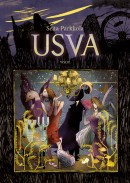 Usva
Usva
[Mist]
Kuvitus: [Ill. by] Jani Ikonen
Helsinki: WSOY, 2009. 375 p.
ISBN 978-951-0-35352-3
19.70 €, hardback
Usva, the 13-year-old protagonist of Seita Parkkola’s novel of the same name, is unusually tall. From her height, she can see farther and more clearly than other people. Usva is a coming of age story in a minor key, its melancholy underlined by Jani Ikonen’s dark black and white illustrations. The images ooze with romantic dereliction, run-down buildings, storm-driven tree limbs, fish on dry land gasping for air. The illustrations are a good example of the visual world brought to life by the success of Japanese manga. Parkkola aptly describes the painful aspects of puberty from the point of view of both the child and the parent. She adds an air of mystification to the age of 13, which she sees as a turning point between childhood and adulthood. The novel can be read as a vision of the near future, of the disintegration of societal support, the increasing fragility of parenthood. Childhood’s end arrives at an ever younger age, and adulthood is entered with a leap, eyes open, without parental support to guide a child into her own adulthood.
Thrills and spills
23 October 2009 | This 'n' that
In September the comic strip Viivi & Wagner by Juba, number two in August on the list of best-selling books (Mitä Suomi lukee, ‘What Finland reads’ – in Finnish only), gave way to Jari Tervo’s political satire Koljatti (‘Goliath’) and to a new thriller by Ilkka Remes (Isku ytimeen, ‘Strike to the core’).
Number three was Kjell Westö’s novel Älä käy yöhön yksin (in Finnish; the original, Gå inte ensam ut i natten, was published in Swedish, Westö’s mother tongue; ‘Don’t go out into the night alone’) and number four Kari Hotakainen’s novel Ihmisen osa (‘The human condition’).
Numbers eight and nine were new thrillers / crime novels by Leena Lehtolainen and Matti Rönkä. Historical novels by Kaari Utrio and Laila Hirvisaari took the fifth and sixth places.
Not surprisingly, the international bestsellers Paulo Coelho, Henning Mankell, Donna Leon and Patricia Cornwell led the translated fiction list.
As for non-fiction, the doings of Finnish Security Police interests people greatly: a history of it from 1949 to 2009 (edited by Matti Simola), entitled Ratakatu 12 (‘Ratakatu street 12’, WSOY) made its way to the top. It was followed by a biography of the industrial magnate Pekka Herlin of the Kone elevator company, Koneen ruhtinas (‘The prince of Kone’) – and Hitler by Ian Kershaw.
Mirkka Lappalainen: Susimessu – 1590-luvun sisällissota Ruotsissa ja Suomessa [Wolf Mass. Civil war in Sweden and Finland in the 1590s]
4 June 2010 | Mini reviews
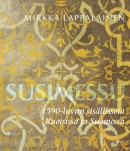 Susimessu – 1590-luvun sisällissota Ruotsissa ja Suomessa
[Wolf Mass. Civil war in Sweden and Finland in the 1590s]
Helsinki: Siltala, 2009. 319 p.
ISBN 978-952-234-016-0
€32, hardback
Sweden at the end of the 16th century was riven by struggles for power: the opponents were the Protestant Duke Charles and Sigismund, King of Poland and Sweden, a strong supporter of the Counter-Reformation in the Nordic lands. A peasant uprising that came to be known as the ‘Cudgel War’ was underway in Finland – then part of the kingdom of Sweden. This book recounts the dramatic history of that civil war and, in line with current interpretive methods of historical research, explodes some popular myths that have been built up around these events. Mirkka Lappalainen has gained recognition as a bold writer who skilfully combines micro- and macro-level history. She characterises Sigismund, whom the Vatican supported to no avail, as a ‘melancholy, absent-minded vacillator, who preferred to play music.’ Lappalainen provides a fascinating alternative historical interpretation of what would have happened if the Vatican’s plans to wrest Finland away from Sweden and unite it with Poland had come to fruition.
Survival games
9 October 2009 | Authors, Reviews
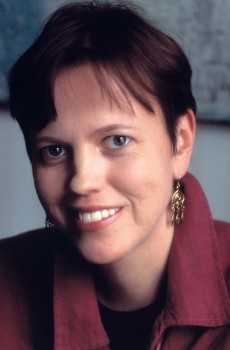
Sari Malkamäki. - Photo: Irmeli Jung
Fathers and sons, mothers and daughters in Sari Malkamäki’s new short stories
The relationship between parents and children is the central theme of Sari Malkamäki’s fifteen new short stories. She published her first collection in 1994; in Jälkikasvu (‘Offspring’, Otava, 2009), her tenth book, the few stories in which children don’t appear nevertheless allude to childhood experiences or to a child who sets the narrative in motion.
The point of view may be that of the child or of the parent, the focus of description some moment that forms a turning point in the characters’ circumstances, or even in their lives. Malkamäki’s children are often touchingly resourceful and brave, even when their adults fail them. More…
New from the archive
30 April 2015 | This 'n' that
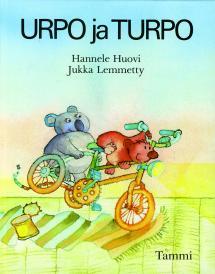 The first of Hannele Huovi’s much loved Urpo ja Turpo (‘Urpo and Turpo’) books – featuring two little bears, the grey, bob-tailed Urpo, who likes flowers, and Turpo, the grey, intrepid adventurer – appeared in 1987.
With comically characterised illustrations by Jukka Lemmetty, these vignettes cast a philosophical light on life as seen from a small child’s viewpoint, whether the subject is monsters at bedtime, what to play on a rainy day, using the family dog as a sailing ship or learning good manners.
Hannele Huovi (born 1949) won the prestigious Eino Leino Prize in 2009. Her work has been translated into Swedish, Danish, Norwegian, Estonian, German, Japanese, Russian and Arabic.