

Search results for "tommi+musturi/2010/05/song-without-words/2009/09/what-god-said"
In praise of idleness (and fun)
21 December 2012 | Letter from the Editors
As the days grow shorter, here in the far north, and we celebrate the midwinter solstice, Christmas and the New Year, everything begins to wind down. Even here in Helsinki, the sun barely seems to struggle over the horizon; and the raw cold of the viima wind from the Baltic makes our thoughts turn inward, to cosy evenings at home, engaging in the traditional activities of baking, making handicrafts, reading, lying on the sofa and eating to excess.
It is a time to turn to the inner self, to feed the imagination, to turn one’s back on the world of effort and achievement. To light a candle and perhaps do absolutely nothing – which can in itself be a form of meditation.
That’s what we at Books from Finland will be trying to do, anyway. Support in our endeavour comes from an unlikely quarter. In 1932 the British philosopher Bertrand Russell published an essay entitled ‘In Praise of Idleness’, in which he argued cogently for a four-hour working day. ‘I think that there is far too much work done in the world,’ he wrote; ‘that immense harm is caused by the belief that work is virtuous’.
Russell was no slouch, as his list of publications alone shows. But his argument was a serious one, and we mean to put it into practice, at least over the twelve days of Christmas. ‘The road to happiness and prosperity,’ he wrote, ‘lies in an organised diminution of work.’ More…
Eye to eye
30 September 1993 | Archives online, Fiction, poetry
A selection of previously untranslated poems by the Finland-Swedish modernist poet Gunnar Björling (1887–1960), introduced by Birger Thölix
Like silent sounds sail passes after sail.
But the night’s globe stands
and just as open stands the wide sea
and all the days expire in morning brightening.
Like a thing not expired
a life-warm scent throbs
through my limbs
and my hand is filled with tablets to read
and new hearts burn.
1933 More…
A poet of the fresh air
30 June 1987 | Archives online, Authors, Interviews
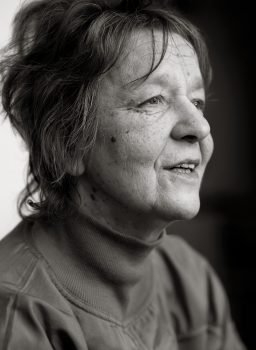
Sirkka Turkka. Photo: Pertti Nisonen
Sirkka Turkka is interviewed by Markku Huotari
Snowflakes are already covering the forest, and an angry wind is blowing off Lake Lohjanjärvi. It is autumn, and in the courtyard, at the roots of a stunted rowan, is a lounge chair, its paint already peeling.
‘I’ve left the chair there because my mother used to sit in it and knit.’
I start at Sirkka Turkka’s comment. In my mind is her last-but-one volume of poetry, Vaikka on kesä (‘Although it’s summer’, 1983); its poems sound a contemporary lament, occasioned by her mother’s death.
‘There’s nothing made-up in my poetry,’ says Sirkka Turkka.
Landscape, nature, the circular path of life – all of these have left their wounds in Sirkka Turkka’s poetry. But as she writes in Tule takaisin, pikku Sheba (‘Come back, little Sheba’, 1986), winner of the Finlandia Prize 1987, ‘from the wounds life grows’. More…
Bombast and the sublime
17 January 2013 | Reviews
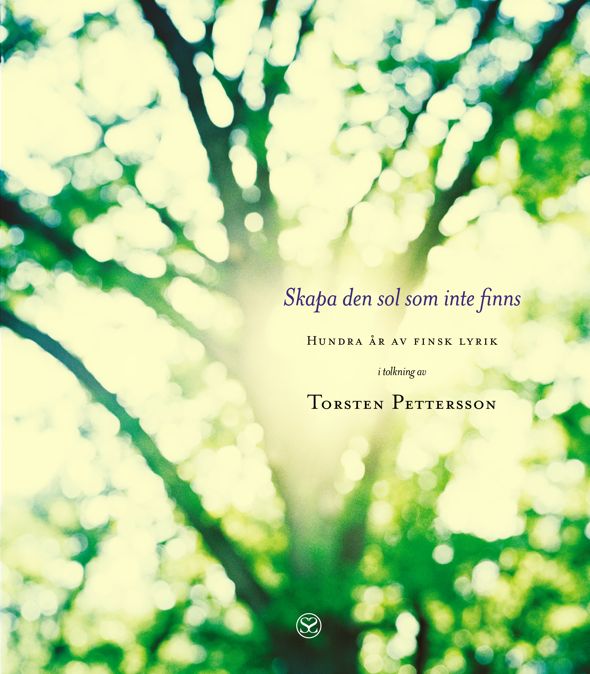 Torsten Pettersson
Skapa den sol som inte finns. Hundra år av finsk lyrik i tolkning av Torsten Pettersson
[Create the sun that is not there. A hundred years of Finnish poetry in Swedish translations by Torsten Pettersson]
Helsinki: Schildts & Söderströms, 2012. 299 p.
ISBN 978-951-52-3034-8
€25, paperback
In the 1960s my mother sometimes used to amuse herself and us children by reciting, in Finnish, in our bilingual family, selected lines of verse from the half-forgotten poetry canon of her school years.
Eino Leino (died 1926) and the great tubercular geniuses Saima Harmaja, Uuno Kailas, Katri Vala and Kaarlo Sarkia (all dead by 1945) were familiar names to me as a child. Early on, I realised that their poetry was both profoundly serious and also slightly silly, just because of its high-flown seriousness. More…
Eroica
31 December 1984 | Archives online, Fiction, poetry
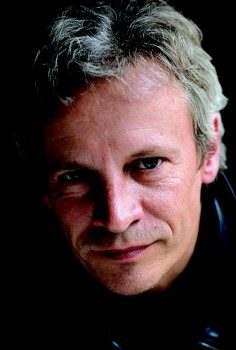
Ilpo Tiihonen. Photo: Irmeli Jung
Poems from From Eroikka (‘Eroica’, 1982). Introduction by Pertti Lassila
Ilpo Tiihonen (born 1950) published his first collection of poetry in 1975. From the beginning, his poems have been couched in the language of the street, and he uses slang liberally. Tiihonen has always been opposed to the miniature idylls of nature that were so characteristic of the 1970s. He aims at the secularisation of poetry, and he uses humour and comedy as a counterweight to high culture. He has evidently been influenced in his technique by Mayakovsky and Yesenin, to whom he often refers in his poems. His preferences in the poetic tradition are apparent in the fresh and liberal new interpretations of poems by Gustav Fröding contained in his collection Eroikka. Unusually for a contemporary Finnish poet, Tiihonen makes extensive use of rhyme. The result is often strongly lyrical poems that could almost be called modern broadsheet ballads, and may also bring Brecht to mind. More…
All my loving
15 February 2013 | This 'n' that
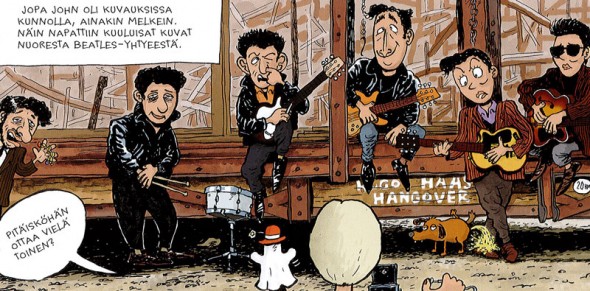
(Early days in Hamburg) Even John behaved himself in the photo sessions, at least almost. This is how the famous photos of the young Beatles were taken.
–Should I take one more? (Astrid the photographer)
One day in the antediluvian times of dawning Beatlemania, a schoolboy in a Finnish small town found himself smitten head over heels by the new pop songs by (probably) the most famous band in the world ever (so far). Like some two billion other teenagers, he learnt by heart every single song the Beatles recorded. Yeah!
The schoolboy grew up and became the illustrator and writer Mauri Kunnas (born 1950), whose storybooks, mostly for children, have now been translated into 30 languages.
But his interest in the Fab Four never left him, and last year he published his illustrated history of John, Paul, George and Ringo, from the day they were born to the day when Please, Please Me / Ask Me Why became number one in the British Top 20 in 1962. As the book is partly written in his native local dialect, its title is Piitles. Tarina erään rockbändin alkutaipaleesta (‘Beatles. The story of the first stage of a rock band’, Otava, 2012).
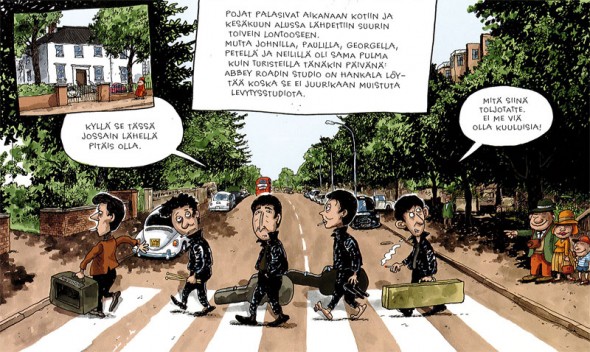
At last the boys came home from Germany, and in June 1962 they left for London with high hopes. But John, Paul, George, Pete and Neil had the same problems that tourists experience even today: The Abbey Road studio is hard to find because it doesn’t look like a recording studio. – It ought to be around here somewhere. – What are you staring at, we’re not famous yet!
In this 77-page graphic story the Beatles grow from babies into celebrities. The large number of hilarious visual details keeps the reader vigilant: for example, in their early days on Hamburg’s Reeperbahn John, Paul, George and Pete (Best) stay in lodgings behind a cinema that are less than hygienic, so on closer examination the lads turn out to be wearing underpants with yellow spots.

–To Eppy! –To my boys!
Julia Lennon, Klaus Voormann, Astrid Kirchherr, Stuart Sutcliffe, Cynthia, Brian Epstein, George Martin: the faces in the gallery of characters are instantly recognisable. Piitles illustrates how Beatlemania was born, and it is truly the work of a faithful fan.
You may say I’m a dreamer
25 November 2014 | Fiction, poetry
Prose poems from Tärnornas station – en drömbok (‘The Lucia Maids’ Station – a dream book’‚ Ellips, 2014). Introduction by Michel Ekman
I nurse a very small, perfectly formed child. It’s a girl. She smiles openly at me, even though she is so small. There is no doubt, neither about that nor anything else. The girl is the size of a nib pen, and just as exclusive. The nursing is going very well, it doesn’t hurt, and she can suckle without any problems. We are both at ease and yet awake, not introspective. The girl has intelligent eyes.
The milk keeps flowing.
Nothing runs dry.
Everything is obvious and neither of us is surprised. Just the fact that she is so small. Like a fountain pen. She is swathed in strips of bird cherry white bandages – like the ones mum had in her summer medicine cabinet – a cocoon, a chrysalis, but she’s not cramped, just secure. It smells good around us. I nurse my daughter who is perfect and the right size.

A door to the other side
7 September 2012 | Extracts, Non-fiction
Building bird-houses is author Jyrki Vainonen’s hobby: he has crafted dozens of nesting boxes and hung them on trees for winged tenants. Roaming in the woods may be bring surprises, though: the bird-house man suddenly finds the world underfoot opening up or a moment… An extract from the collection of stories Linnunpöntön rakentaja (‘Builder of bird-houses’, Atena, 2012)
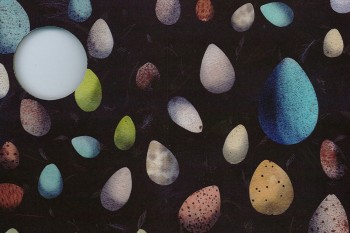
Birds coming up… Inside front cover of Linnunpöntön rakentaja by Elina Warsta/Solmu
The hinge was rusty, but after a cleaning and oiling it seemed to work, and didn’t even squeak. I had found it in a piece of board that was lying beside the road on the way to the dump. The board may have once served as part of a door frame.
The next day I rode my bike there again and unscrewed the hinge from the board, and now it looked quite handsome attached to the side wall of the birdhouse. I set the still floorless, roofless box upright and tried the door, opening the clasp and lifting the side wall on its hinges. It worked well, didn’t jam or make any sound. Next I attached the pieces of wood I’d already cut to form the roof and floor of the birdhouse. I inserted the floor and nailed through the three walls of the box – all except the wall that formed the door. Then I nailed the roof in place with several nails.
Now I had a box that would make it easy to watch the life inside. It would doubtless be wonderful to be able to see the nest from so close, and from the side rather than the top, as I usually had before. I could take photos, too. More…
Under cover
29 March 2012 | Extracts, Non-fiction
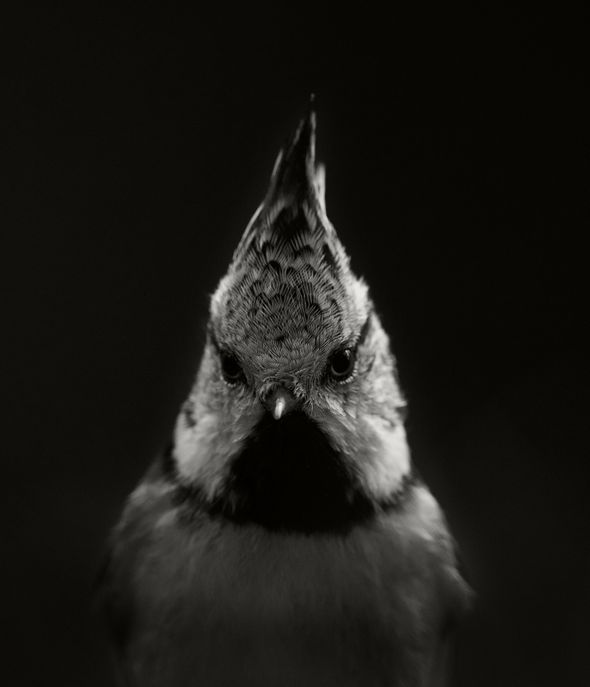
Soul-bird: crested tit. Photo: Heikki Willamo
The photographer and writer Heikki Willamo lived for a year in the forest – not full-time, but for long periods in all seasons, sleeping in his lean-to. This two-hundred, preserved hectare fragment lies in the midst of felled clearings, farmed forest and habitation in southern Finland.
Many Finns still say that being in a forest is a peaceful and empowering experience; Willamo recorded his thoughts on this as well as his black-and-white photographs in his book, Vuosi metsässä (‘A year in the forest’, Maahenki, 2012. See also extracts from Viimeiset vieraat [‘The last visitors’] here) More…
How I saved the world for communism
30 September 1996 | Archives online, Fiction, Prose
Extracts from the novel Kreisland (WSOY, 1996). Rosa Liksom’s first novel is a picaresque story of a heroine whose adventures range through Finland, Soviet Russia and America. Introduction by Soila Lehtonen
Maid Agafiina: Got myself some shiny black rubber boots, the kind with the red felt lining, and a colorful crepe de chine dress and a rayon coat, and while shopping for all that I checked out the four wonders of Moscow: a bell that doesn’t ring, a cannon you can’t fire, a ruler who doesn’t speak, and money that doesn’t stink.
In no time at all I made up a new personality, learned the language real good, and obtained a Soviet citizen’s passport. I was totally excited by everything I’d seen. My cheeks were as red as the flag. I wanted to find out about everything and see every achievement of this huge Soviet land. More…
Timeless time
30 December 2005 | Fiction, poetry
Poems from Jumala saalistaa öisin eli Jobin kirjaan meidän on aina palaaminen. Osittain kursivoituja runoja (‘God hunts at night, or, we shall always return to the Book of Job. Partly italicised poems’, Otava, 2005)
Greek delights
I eat Giorgios D. Haniotis'
                    small joys
     buried in powdered sugar,
vanilla, rose petal and strawberry,
           as if wooing his three daughters,
reading Angelos Sikelianos' poem
                         'A country wedding':
and it is a beautiful blue day, Sunday,
the strange charm of Greek letters: i kiriaki,
hazelnut kernels dipped in thyme honey,
white herb ashes from the roadside,
a cigarette taste deep as sin,
tobacco smoke the only haze one can stand looking at,
a little quarrelsome noise, bus station flu,
promises made by Turks,
the threadbare pile carpet of the entrance hall as a word of honor, More…
The solitary walker
30 June 1983 | Archives online, Authors
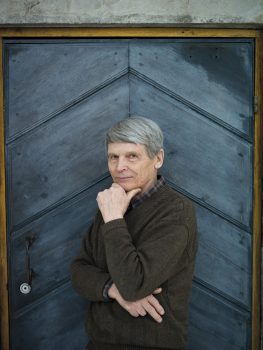
Antti Hyry. Photo: Jouni Harala
Antti Hyry, born in 1931, is a writer from northern Finland. His work is coloured by elements characteristic of the region near the Arctic Circle: rugged nature, wintry frost, the light of long summer nights, the Laestadian fundamentalist Christian sect, and the strict rules of an agrarian community.
Hyry is an engineer by training, and although he has never worked as an engineer, his world view has been built on a physical and technological foundation. This orientation, together with a basic intuition which is close to nature, has created in his works a world of fascinating conflict in which troubled man, weighed down by responsibilities, studies his environment as if to test whether it exists, and to discover what laws govern it. More…
This journey
30 September 1995 | Archives online, Fiction, poetry
Poems from Tämä matka (‘This journey’, 1956). Introduction by Jukka Petäjä
You took a planet
For Erik Lindegren
The stars arranged themselves
round a red magnet
by request,
and shaped fugitive systems and mirror reflections,
space’s sonorous grammar.
Oh, those hatched-out faces of the apathetic! –
and the grudge of those who can no longer read
(apart from cruel bibles, containing pressed roses and corpses).
Oh, ourselves! – here in the lonely sublunar place,
hair and eyes in the wind, in our hands
	                                                ignorance and boomerang-echoes.
Oh, these vaultings of the word! – changing skies
where the glyphs rise like distress flags.
I looked for a question
	                    whose answer is this mutabor.

I kneel
	   to gather up the shattered fragments of a glyph
scored with the brilliant wounded secret
where I lost my wings
	               before my choosing fingers were formed.