

Search results for "tommi+musturi/2010/05/song-without-words/2009/09/what-god-said"
A Note on Nine Contemporary Poems from Finland
31 March 1987 | Archives online, Articles, Fiction, Non-fiction, poetry
Contemporary Finnish poetry, translated and introduced by Anselm Hollo
The last couple of months, it has been my pleasure to browse around in a tightly packed shelf of books of poetry published in Finland in the last five years. On the showing of these, and of the excellent anthology Modern finlandssvensk lyrik (‘Modern Finland-Swedish poetry’, 1980), edited by Claes Andersson and Bo Carpelan, poetry certainly seems to be alive and well in the old homeland. In a way, the sheaf translated here is just first travel notes, individual works that struck my fancy seemed translatable: thus, by no means a ‘representative selection’.
Claes Andersson’s poem ‘When I was born, Helsinki was…’ was quite simply a direct hit (perhaps an unfortunate metaphor in that it deals, in part, with the WW2 air raids on Helsinki) – it brought back personal memories from my early childhood. But beyond those immediate circumstances, it is also a very moving evocation of the magnificent and terrifying world of magic children inhabit. Helena Anhava’s ‘These years…’, with its marvelous image of the great hinge turning in the human psyche at certain points familiar to anyone who has lived into middle age, seemed a fine example of her impressive body of meditative lyric poems, sharing a tenor of wistfulness not uncommon in Finland’s poetry with Bo Carpelan’s ‘You drive up…’, which is also a poem of the pangs of change. In Carpelan’s text, the clash between ‘wonderful clear Vivaldi’ on the protagonist’s car radio and the perceived tawdriness of the environment is beautifully balanced between genuine revulsion for the latter and a self-irony directed against the self-declared ‘finer sensibilities’ of the class that can afford them. Tua Forsström‘s ‘Do you want to hear something’ moves in a lovely dance figure from myth to everyday present: we see the interior world that is Nausicaa’s island shimmering through the exterior in which ‘someone’s/ balcony door whines all night like a cat’. More…
Oh heiferiness and humanness
30 September 2007 | Fiction, poetry
Kesäillan kevyt käsitteellisyys.
III laulu: Suvisimfonia, omistettu Joel Lehtoselle.
‘A summer evening’s slight conceptualness’.
III song: Summer symfony, dedicated to the author
Joel Lehtonen (1881–1934)
From Eros (WSOY, 2002)
A summer evening’s slight conceptualness
Ah summer evening, and its eveningness,
its prodigious wonders and their bridgefulness
when the nightunited seamlessness
steals into one’s heart with restfulness
O heiferiness and humanness,
ah shivering shimmeringness,
innocents’ innocuousness
and vastness with its stresslessness –
five or six chicks of a dabchick,
and deep water, lapfulness.
Our blue sky’s mirrored changefulness!
the spruces’ tall topliness, their tips’ sacredness
the yellow-billed black singer’s flutiness.
Nested cosiness, mutual tootiness! More…
Midwinter in a minor key
23 December 2009 | Letter from the Editors
Finland’s end-of-year celebrations, both Christmas and New Year, take place in a thoroughly muted mode. At noon on Christmas Eve the Christmas Peace is rung out from the mediaeval cathedral in Turku, with the pious and seldom realised hope that peace and harmony will be unbroken for the following twelve days.
It’s true, though, that there’s little of the carousing that characterises Christmas celebrations further south; by and large, people stay behind closed doors, and there’s plenty of time, in the dark mornings and evenings and the brief twilight between them, to eat and drink and sleep – and, for those whose souls are not entirely claimed by the television and food-induced torpor, to read. More…
On Matti Rossi
31 March 1978 | Archives online, Authors
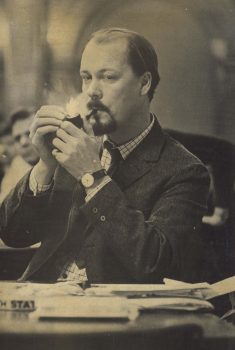
Matti Rossi. Photo: SKS archives
The appearance in 1965 of Matti Rossi’s (born 1934) first work in Finnish, Näytelmän henkilöt (‘Dramatis personae’, Tammi), brought him immediate recognition as an important writer. It confirmed him as a skillful translator – he had already ten important translations to his name – and revealed a new but already mature poet. Näytelmän henkilöt contains biting political parody, highly original myth verse and the Finnish version of a series of poems on Vietnamese themes, which he had first published in English.
Rossi has always worked in many styles and genres. Leikkeja kahdelle (‘Games for two’, Tammi, 1966) is a magnificent collection of sensual love poems; his fantasy poem for the stage, Tilaisuus (‘The occasion’, Tammi, 1967), examines the nature and causes of violence; the events in Czechoslovakia are the subject of his analytical political satire Käännekohta (‘Turning-point’), written as a play for television in 1969. These were followed by a long period in which Rossi’s poetry reflects his political commitment to the far left. He brought out a book about his experiences during a visit of more than a year to South America, and his scathing poetry has always played its part in political controversy. He has composed songs for the stage, and an outstanding ballad narrative, Puulintujen vuolija (The carver of wooden birds’, 1975). More…
Poems
31 March 1978 | Archives online, Fiction, poetry
Poems from Laulu tummana tulevi (‘The song comes darkly’, 1976). Introduction by Pentti Saaritsa
1
                      I have longed for you
as the burning heath for rain,
                      I have asked for you
as fingers of moss for shade,
                      I have yearned for you
as the dusty mind for tears,
                      and I have loved you
as distant lightning the dark,
                      I have been in you
as flowering pine in the wind.
The blue will-o’-the-wisps dance,
strangers stitching happiness.
Silvery the spring mornings,
the trumpets bright in summer,
the autumns cranberry-red,
the white legend of winter. More…
Finlandia Junior Prize 2011
7 December 2011 | In the news
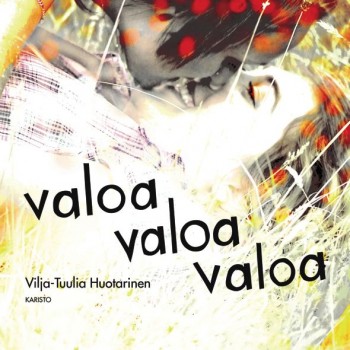 The musician Paula Vesala has chosen, from a shortlist of six, a book for young people by the poet Vilja-Tuulia Huotarinen, Valoa valoa valoa (‘Light light light’, Karisto). The story, which is set at the time of the Chernobyl nuclear power station disaster, poetically describes the passion and pain of first love, longing for mother and death.
‘Not just what is told, but how it is told. The rythm and timbre of Vilja-Tuulia Huotarinen’s language are immensely beautiful. Her phrases do not exist merely to tell the story, but live like poetry or song. Valoa valoa valoa does not incline toward young people from the world of adults; rather, its voice comes, direct and living, from painful, confusing, complex youth, in which young people should really be protected from adults and their blindness. I would have liked to read this book when I was fourteen,’ commented Vesala.
The other five shortlisted books were a picture book for small children, Rakastunut krokotiili (‘Crocodile in love’, Tammi) by Hannu Hirvonen & Pia Sakki, a philosophical picture book about being different and courageous entitled Jättityttö ja Pirhonen (‘Giant girl and Pirhonen’, Tammi) by Hannele Huovi and Kristiina Louhi; a dystopic story set in the 2300s, Routasisarukset (‘Sisters of permafrost’, WSOY), by Eija Lappalainen & Anne Leinonen; a novel about the war experiences of an Ingrian family, Kaukana omalta maalta (‘Far away from homeland’, WSOY) by Sisko Latvus and an illustrated book about gods and myths of the world, Taivaallinen suurperhe (‘Extended heavenly family’, Otava) by Marjatta Levanto & Julia Vuori.
The prize, awarded by the Finnish Book Foundation on 23 November, is worth €30,000.
Landscapes of the mind
30 June 1986 | Archives online, Fiction, poetry
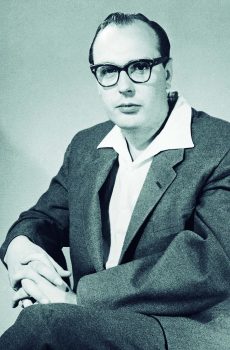
Tuomas Anhava. Photo: Otava
In his book Suomalaisia nykykirjailijoita (‘Contemporary Finnish writers’), Pekka Tarkka describes Tuomas Anhava’s development as a poet as follows: In his first work, Anhava appears as an elegist of death and loneliness; and this classical temperament remains characteristic in his later work. Anhava is a poet of the seasons and the hours of the day, of the ages of man; and his scope is widened by the influence of Japanese and Chinese poetry. As well as his miniature, crystalclear, imagist nature poems, Anhava writes, in his Runoja 1961 (‘Poems 1961’), brilliant didactic poems stressing the power of perception and rebuffing conceptual explanation. The mood in Kuudes kirja (‘The sixth book’, 1966) is of confessionary resignation and intimate subjectivity.
Anhava’s literary inclinations reflect his most important translations, which include William Blake’s The Marriage of Heaven and Hell (1959), selections of Japanese tanka poetry (1960, 1970, 1975), Saint John Perse’s Anabasis (1960), a selection from the works of Ezra Pound, published under the title Personae, and selections from the work of the Finland-Swedish poets Gunnar Björling and Bo Carpelan.

Song of the black
My days must be black,
to make what I write stand out
on the bleached sheets of life,
my rage must be the colour of death, to make my black love stand out,
my nights must be summer white and snow white,
to make my black grief burn far,
since you're grieving and I love you
for your undying grief.
Let the sun's rolled gold gild dunghills,
let the moon's blue milk leak out till it's empty,
              we're not short of those.
The obscure black darkness of the cosmic night
glitters on us enough.
From Runoja (1955)
Breathe out, breathe in
30 June 1999 | Archives online, Fiction, poetry
Poems from Nio dagar utan namn (‘Nine days without names’, Söderströms, 1998). Introduction by Bror Rönnholm
Quickly, at a zebra crossing
moments
          not of wonder but of
 something closely related: the tree
          upturned by the gale
 with its roots to the heavens, the lit-up
          church spire against the night sky, a few
simple gravestones viewed at a
          suitable season, a quartet from the Marriage of Figaro
 or just standing at a roaring
          crossing and writing this, invisible
 to all in exhaust fumes and a faint blue
          light from a hidden sun, a few
times mistaken for a
loved pupil More...
World noises
30 September 1992 | Archives online, Fiction, Prose
Poems from Fahrenheit 121 (1968) and Jos suru savuaisi (‘If grief should smoulder’, 1968). Introduction by Tuula Hökkä
For truth to tell
I like horses most
creating Those
It came off best
*
Morning came to the meadow;
horses were born out of mist.
How quiet they were:
one leant a head on his master’s armour,
his breath rose warm,
his moist eye gleamed in the daybreak,
his coat a casbah carpet-weaver’s hand-woven pile,
his muzzle softer than a phallus. More…
A gay fantasy on national themes
19 March 2012 | Authors, Reviews
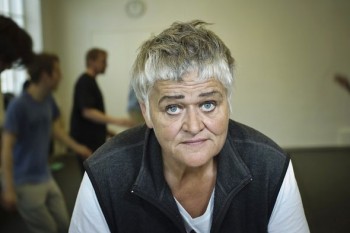
Pirkko Saisio. Photo: Laura Malmivaara
Why does the private become political? Who makes it happen? Why should religious doctrines define private matters such as sexuality? Why should those who wield power in the political system define personal sexuality?
Pirkko Saisio (born 1949), a theatremaker as well as a prolific and versatile author of plays, novels, film and television scripts, has written a play for the Finnish National Theatre entitled HOMO! and subtitled, ‘An anarchist musical farce’.
Answers to the above questions – and they are complicated – are to be found in, for example, historical, psychological and sociological research.
In the last century, Stalin and Hitler condemned gays. Thirty years ago homosexuality was considered an sickness in Finland; forty years ago it was a crime. Today, it is still illegal in more than 75 countries: punishments vary from flogging to life imprisonment or death. In democratic societies, the ‘gay problem’ is a question of human rights, and hence a subject for public debate – for example, in a musical play, for of course the issue also involves that eternally fascinating and entertaining feature of human life, love. More…
How much did Finland read?
30 January 2014 | In the news
 The book year 2013 showed an overall decrease – again: now for the fifth time – in book sales: 2.3 per cent less than in 2012. Fiction for adults and children as well as non-fiction sold 3–5 per cent less, whereas textbooks sold 4 per cent more, as did paperbacks, 2 per cent. The results were published by the Finnish Book Publishers’ Association on 28 January.
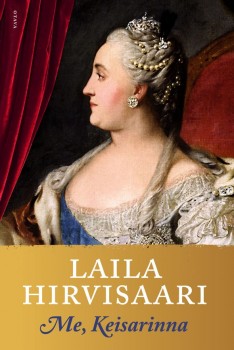
The overall best-seller on the Finnish fiction list in 2013 was Me, Keisarinna (‘We, tsarina’, Otava), a novel about Catherine the Great by Laila Hirvisaari. Hirvisaari is a queen of editions with her historical novels mainly focusing on women’s lives and Karelia: her 40 novels have sold four million copies.
However, her latest book sold less well than usual, with 62,800 copies. This was much less than the two best-selling novels of 2012: both the Finlandia Prize winner, Is, Jää (‘Ice’) by Ulla-Lena Lundberg, and the latest book by Sofi Oksanen, Kun kyyhkyset katosivat (‘When the doves disappeared’), sold more than 100,000 copies.
The winner of the 2013 Finlandia Prize for Fiction, Riikka Pelo’s Jokapäiväinen elämämme (‘Our everyday life’, Teos) sold 45,300 copies and was at fourth place on the list. Pauliina Rauhala’s first novel, Taivaslaulu (‘Heaven song’, Gummerus), about the problems of a young couple within a religious revivalist movement that bans family planning was, slightly surprisingly, number nine with almost 30,000 copies.
The best-selling translated fiction list was – not surprisingly – dominated by crime literature: number one was Dan Brown’s Inferno, with 60,400 copies.
Number one on the non-fiction list was, also not surprisingly, Guinness World Records with 35,700 copies. Next came a biography of Nokia man Jorma Ollila. The winner of the Finlandia Prize for Non-Fiction, Murtuneet mielet (‘Broken minds’, WSOY), sold 22,600 copies and was number seven on the list.
Eight books by the illustrator and comics writer Mauri Kunnas featured on the list of best-selling books for children and young people, with 105,000 copies sold. At 19th place was an Angry Birds book by Rovio Enterntainment. The winner of the Finlandia Junior Prize, Poika joka menetti muistinsa (‘The boy who lost his memory’, Otava), was at fifth place.
Kunnas was also number one on the Finnish comic books list – with his version of a 1960s rock band suspiciously reminiscent of the Rolling Stones – which added 12,400 copies to the figure of 105,000.
The best-selling e-book turned was a Fingerpori series comic book by Pertti Jarla: 13,700 copies. The sales of e-books are still very modest in Finland, despite the fact that the number of ten best-selling e-books, 87,000, grew from 2012 by 35,000 copies.
The cold fact is that Finns are buying fewer printed books. What can be done? Writing and publishing better and/or more interesting books and selling them more efficiently? Or is this just something we will have to accept in an era when books will have less and less significance in our lives?
On Caj Westerberg
31 March 1980 | Archives online, Authors
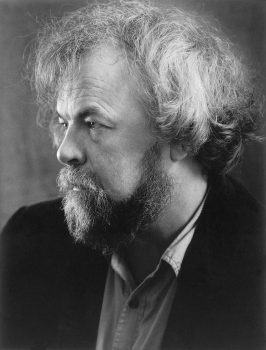
Caj Westerberg. Photo: Pentti Sammallahti
Caj Westerberg established his reputation with the publication, in 1967, of his first volume of poems: Onnellisesti valittaen (‘Cheerful complaint’). The work was immediately praised for its descriptive power and visual imagery. The other outstanding feature – preserved in subsequent works – is the author’s capacity for emotion, for a passionate involvement in human existence, casting the sensitive individual from the crest of ecstasy to the trough of despair. In Westerberg’s next two collections, Runous (‘Poetry’, 1968) and En minä ole ainoa kerta (‘I am not the only one’, 1969), these key features are firmly sustained. At the same time, Westerberg is beginning to extend the mordancy of his themes. In his fourth book, Uponnut Venetsia (‘Sunken Venice’, 1972), the style has became move conversational and laconic, but does not deviate from his main thematic concerns. Westerberg’s work can be seen as a cool, developing continuum: all the poems, whether long or short, whether aphoristic epitomes of experience or pure ‘imagistic’ visions, convey a unified individual response to the world and existence, and a prevailing intensity. With each publication, brought out as all his earlier works by Otava, Westerberg has developed and enhanced his style. His two most recent works, Kallista on ja halvalla menee (‘It comes dear and it’s going cheap’, 1975) and Reviirilaulu ‘Territorial song’, 1978), have all the marks of works which will become classics. Westerberg’s poems are moving and full of surprising associations; he is both sensitive to the present and alive to the past. His style maintains a fine balance between the conversational and the stylized. Westerberg takes the role of the poet seriously. At a recent conference he put it thus: ‘The poet’s fundamental impulse is to reveal the hidden. That is one of his tasks. That is his folly. The poet is the seer, the prophet, the truth-teller.’
Translated by Mary Lomas
Funny stuff: best-selling books in February
13 March 2014 | In the news
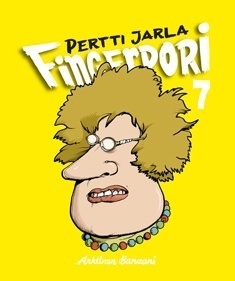 The list of best-selling books – compiled by the Finnish Booksellers’ Association – shows that in February comedy was popular among readers. Number one on the Finnish fiction list was Fingerpori 7 (‘Fingerborg 7’, Arktinen Banaani), the latest comics book by Pertti Jarla, featuring silly stuff taking place in the city of Fingerpori.
Riikka Pulkkinen’s new novel, a romantic comedy entitled Iiris Lempivaaran levoton ja painava sydän (‘Iiris Lempivaara’s restless and heavy heart’, Otava) which was originally published in a weekly women’s magazine, was number four. A satirical television series featuring two silly women devoted to dating and clubbing has also resulted in a book written by the two actresses, Heli Sutela and Minna Koskela: Anne ja Ellu lomamatkalla (‘Anne and Ellu on holiday’, published by Annen ja Ellun tuotanto) made its way to the seventh place. Number eight was Pertti Jarla’s Fingerborg 4!
However, number two was a first novel about problems arising in a religious family, Taivaslaulu (‘Heaven song’, Gummerus), by Pauliina Rauhala. Number three was a first novel by an immigrant Somali woman, Nura Farah: Aavikon tyttäret (‘Daughters of the desert’, Otava) tells the story of women in Somalia in the second half of the 20th century.
On the non-fiction list, among cookbooks and diet guides, books on how to maintain a hormonal balance or how to wield a kettlebell sold well. A new biography, Tove Jansson (Tammi), telling the life story of the Moomin genius (1914–2001), the artist, painter, author and cartoonist, was number seven; the author is Tuula Karjalainen. (The book will be published in several countries this year, a World English edition in December.)
At the top of the best-selling children’s books list is a book entitled Muumit ja tekemisen taika – ‘The Moomins and the magic of doing’ (Tammi). This ‘Moomin’ book is written by Clive Alan: we know absolutely nothing about him (he is absent from his publisher’s list of authors!) – except that the name is a pseudonym.
Well, as before, it is our opinion that all the Moomin books really worth reading were created by Tove Jansson herself.
A smell of the sea
30 March 2000 | Archives online, Fiction, poetry
Poems from Namnet på tavlan Klee målade (The name of the picture Klee painted’, Schildts,1999; Kleen taulun nimi, Otava, 1999; Finnish translation by Jaakko Anhava). Introduction by Hannu Väisänen
Old harmony
You see an old street and stop outside a gate to a shadowy inner courtyard. An oak tree grows there, its crown stretches towards the light. How big it is! On a bench underneath it an old couple sit looking at you. They are trying to discover what you once were. Beside them lies an old lute, like a large, gleaming fruit. You go over to it, pick it up, play a chord. The old woman and the old man look at you without surprise. It has all happened once before, after all. Not much more is needed, only a deep silence. The oak tree murmurs, the old couple have gone, you sit there with your wife and see someone entering the courtyard. Do we know him, you say. But scarcely have you finished your question than the courtyard is empty again, a moment in eternity. More…
A musical advent calendar
9 December 2011 | This 'n' that
The Finnish Broadcasting Company has delved into its vast archives, and its website, YLE Areena, is throughout December featuring a series of musical numbers, many with reference to Christmas, sung or played Finnish singers and musicians. These inserts are being broadcast on each day, from 1 to 24 December, and they can be listened to via the Internet (although be warned, the information is given in Finnish only).
Among the Finnish composers are, among others, Oskar Merikanto (1868–1924), Erkki Melartin (1875–1937), Toivo Kuula (1883–1918) and Jean Sibelius. The sopranos Irma Urrila and Helena Juntunen are presented, singing Mozart and Gounoud respectively.
For example: on 6 December, the Finland’s Independence Day, one of the three inserts is a piano piece, entitled Pankakoski, by composer Heino Kaski (who died a day earlier than Sibelius, in September 1957), played by Juhani Lagerspetz (1995). The other two are Andante Festivo (1922), a work originally composed for a string quartet, by Jean Sibelius, played by the Radio Symphony Orchestra (1995) and a song from the 1970s opera Punainen viiva (‘The red line’) by Aulis Sallinen, sung by Matti Salminen (1984).
Fifteen more days to go…
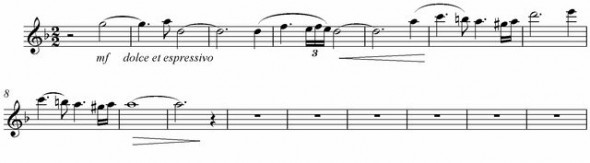
Dolce et espressivo: Violin concerto by Sibelius, 1st movement (1905). Photo: Wikimedia