

Search results for "tommi+musturi/2010/05/song-without-words/2009/09/what-god-said"
Ordinary people
30 June 1990 | Archives online, Fiction, poetry
Poems from Vaikka aamuun on vielä aikaa (‘Though it’s still a long time till morning’, 1989) Introduction by Risto Rasa
This time
 this time of consensus
 that teaches
           the poor to love the prosperous,
           the bossed to love the bossers
           the kicked to love the kickers
           and all of us to love humility
 obedience and biddability
 before the hingdom, the power and the glory:
 this time
 cries out for a tearer-up,
 calls for a muster
 of thousands and thousands
 of serious and honest busters.  More...
Translation prize to Angela Plöger
23 October 2014 | In the news
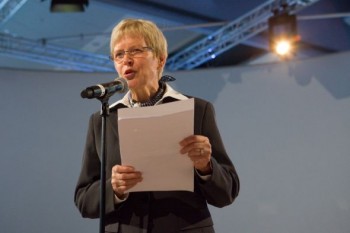
Angela Plöger, Frankfurt Book Fair, 8 October. Photo: Katja Maria Nyman
The 40th Finnish State Prize for the Translation of Finnish Literature of 2014 – worth €15,000 – was awarded to the German translator Angela Plöger at the Frankfurt Book Fair on 8 October.
Dr Angela Plöger (born 1942) studied Finnish and Fennistics in Berlin; she first came to Finland in the 1960s after having become interested in the Finnish language as a result of learning Hungarian.
‘I had been to the restaurant at the Helsinki Railway Station where Bertolt Brecht was thinking how the noblest part of a man is his passport, and how Finns are a people who keeps silent in two languages.’
Plöger then defected to West Germany, starting her career anew. She has also translated texts from Hungarian and Russian. In her speech in the Finnish Pavilion of the Book Fair Plöger said that in her opinion translating literature is the most fascinating profession in the world.
Her first translation of a Finnish novel was Tamara, by Eeva Kilpi, published in 1974. Among the most recent of the 40 novels Plöger has translated during the past five decades from Finnish are the novels Kätilö (‘Midwife’, 2011) by Katja Kettu and Kun kyyhkyset katosivat (‘When the doves disappeared’, 2012) by Sofi Oksanen. Among the other works Plöger has translated are novels by Leena Lander, Eeva-Kaarina Aronen, Anja Snellman, Kaari Utrio, Johanna Sinisalo, Risto Isomäki and Antti Tuuri, as well as a number of drama texts by Laura Ruohonen, Juha Jokela, Aki Kaurismäki, Pirkko Saisio and Sofi Oksanen.
The Minister for Culture and Housing, Pia Viitanen, thanked Plöger for her extensive and multi-faceted work in the field of language and literature and in promoting Finnish literary culture in Germany.
The prize, worth € 15,000, has been awarded by the Ministry of Education and Culture since 1975 on the basis of a recommendation by FILI – Finnish Literature Exchange.
Say what you like
30 March 2007 | Fiction, poetry
Poems from Sanomattomia lehtiä and Leikitään kotia (‘Newsless newssheets’, ‘Let’s play house’, Tammi, 2004 and 2005)
Scent of morning
Say what you like about life, but life’s nothing that’s been said. The sun sets in a sepia setting where together a man and a woman walk out of the picture. At the start of the romantic’s story candles are lit, the girl stoops to hear better. Lonely stones roll from the horizon’s laughter, farewell to the continuity we love. Just for a second you could see from his face what he’d look like in twenty years. More…
Winner of the Nordic Council Literature Prize
6 November 2014 | In the news
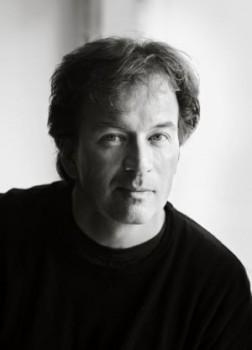
Kjell Westö. Photo: Kata Portin
The Nordic Council Literature Prize 2014 went to Kjell Westö and his novel Hägring 38 (‘Mirage 38’, 2013; in Finnish, Kangastus 38). The prize, awarded since 1962 and worth €47,000, was given on 29 October at a ceremony in Stockholm.
Among the 13 nominees was another Finn, the poet Henriikka Tavi with her collection Toivo (‘Hope’, 2011).
The jury said: ‘The Nordic Council Literature Prize goes to the Finnish writer Kjell Westö for the novel Mirage 38, the evocative prose of which breathes life into a critical moment in Finland’s history [the time before the Winter War, 1939–1940] – one that has links to the present day.’ Here, more on Westö and his winning novel.
On the road, in the world
21 March 2013 | Reviews
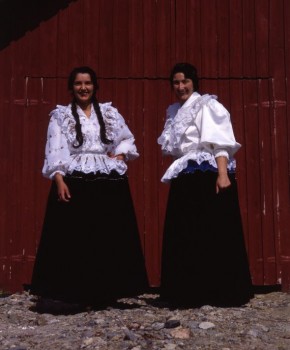
In Romani dress: Finnish Romani women still wear their traditional velvet skirts (which weigh 5-8 kilos). Photo: Topi Ikäläinen, 1983
Suomen romanien historia
[A history of Finland’s Romani people]
Toimittanut [Edited by] Panu Pulma
Helsinki: Suomalaisen Kirjallisuuden Seura (the Finnish Literature Society), 494 p., ill.
ISBN 978-952-222-364-7
€57, hardback
The Romani people set out from India around a thousand years ago; there are those who even claim that they originated in Egypt long before that. This latter account was favoured among the Romani in Europe, and so their leaders took to styling themselves the Dukes of ‘Egypt Minor’ or ‘Little Egypt’.
The Romani of Europe are generally considered to have come from northern India in the 15th century. They arrived in Finland – which at that time was part of Sweden – in 1512.
Five hundred years later, it seems a fitting time to publish Suomen romanien historia, a volume edited by Panu Pulma, PhD, a university lecturer in Finnish and Nordic history, with chapters contributed by a total of 14 additional experts.
The Romani who reached Stockholm, also in 1512, were said to be from ‘Egypt Minor’. This purported connection with Egypt is the origin behind the English word gypsy. The Swedish word zigenare (related to the German Zigeuner) did not come into use until the 17th century. More…
Drama queen: on writing, and not writing, plays
14 June 2010 | Articles, Authors
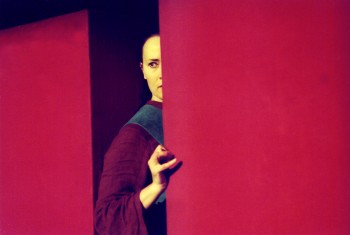
The queen who chose not to rule: Christina of Sweden in the play Queen C (first produced at the Finnish National Theatre in 2003, directed by the author, Laura Ruohonen, with Wanda Dubiel in the role of the Queen). Photo: Leena Klemelä
Extracts from ‘Postscript’, published in Kuningatar K ja muita näytelmiä (‘Queen C and other plays’, Otava, 2004)
It’s hard to read plays. I was bitterly disappointed at the age of eight, when I hid in my grandmother’s attic and opened up Romeo and Juliet, a book that seemed to promise lust and appalling acts. But it wasn’t even a real book; it was just talking from beginning to end! Where was the plot, the action, the much talked-about love story?
It’s also hard to write plays. Novels and works of poetry are closed miniature worlds that invite the reader in. A play always serves two masters. It has to be open and porous to allow the actor and the performance to penetrate into it. More…
Poems
30 December 1998 | Fiction, poetry
From Gården (‘The courtyard’, 1969)
The brown tablecloth hung over the edge.
I sat below there unseen in the odour of cabbage and warmth.
The sky hung on rusty hooks, the women of the courtyard shrank.
They were the only flowers the summer had.
They carried pails to the back yard where there was no sun.
Father read the newspaper, in the middle drawer of the writing table were
bills, promissory notes, pawn tickets, the rent book, everything in order. More…
Geneswing
30 June 2001 | Fiction, poetry
Poems from Tuulen vilja (‘Windcrop’, WSOY, 2000)
Longbeaked birds
created for the deepfunnelled gloxinia – everything exactly right.
The sport of colours, survival (though I always felt I was
sunset in the morning).
I walk over the living, the playful swing of genes,
uniqueness in splinters: capsules,
family trees, root systems, leafage.
In the geneswing little deviations of dimension,
as if I were perpetually outlining waves with my finger.
The primal miracle of seeds: I press
a mixture of summer flowers in the soil, exploding
a serial miracle. More…
HEL YES!
24 September 2010 | This 'n' that
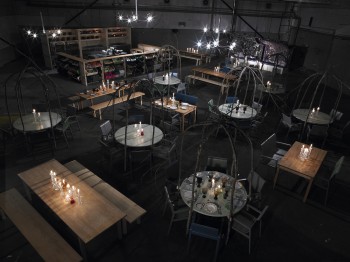
Dinner time: HEL YES pop-up restaurant in London; lighting by Harri Koskinen. Photo: Adam Laycock
Run that by me again, please?
Oh: HEL is the airport abbreviation of Helsinki, and the second word completes the title given to a pop-up restaurant set up by a team of Finnish designers and chefs in London. It takes place at 1–3 Wenlock Road, London N1, between 15 September and 3 October.
HEL YES! is commissioned and produced by the Finnish Institute in London as part of its Arts & Culture Programme, in anticipation of Helsinki’s role as World Design Capital in 2012.
The restaurant offers inventive Finnish dishes, the dinner service plates are mix ‘n’ match vintage Iittala and the diners sit on Alvar Aalto and Artek’s ‘403’ chairs painted in a new range of colours.
We hear the reservations for dinner are now been fully booked, but coffee and drinks are available in the restaurant, a former depot. See what the press said, here.
Poems
30 June 1987 | Archives online, Fiction, poetry
Poems from Vattenhjulet (‘The water-wheel’, 1986). Introduction by Thomas Warburton
Together with time
One day the door to my room closed
and fate said to me: be still.
It was then that I discovered time.
It had lain hidden beneath a lid
of events and hasty decisions.
It was then that I raised the lid.
So strange! There time lay
completely unused, completely itself
smooth and fresh, as if resting.
I looked at time with reverence.
I saw myself new, I sank into
a miraculous eventlessness
together with time
listened to myself living:
a barely perceptible murmur.
The water-wheel
The old horse plods heavily with blinkered eyes
the wheel turns slowly and inexorably
creating time, a thing that is not visible
that is really nothing
			with the right to kill.
Talking to Andrei
30 June 1998 | Fiction, poetry
Poems from Efter att ha tillbringat en natt bland hästar (‘After spending a night among horses’, Söderströms, 1997)
The snow is whirling over the roses of the inner courtyard
The snow is whirling over the roses of the inner courtyard.
Did not bring boots or scarf with me, leaf
through books, don’t know what to do with all this light!
You would not approve of the colours.
It’s too impressive, Andrei Arsenyevich, there is too
much, too much of everything!
You swapped your wings for an air balloon, a clumsy
contraption twined together from ropes and rags, I remember it well.
Earlier, I had a lot and didn’t remember. Hard
to keep to the point. Hard to keep to the point.
Hope to get back. Hope to get back to the principle
of the wings. Fact remains: the cold preserved
the rose garden last night. ‘The zone is a zone, the zone is life,
and a person may either perish or survive as
he makes his way through this life. Whether he manages it or
not depends on his sense of own worth.’* A hare
almost leapt into the vestibule here at the Foundation,
mottled against the snow; in the hare’s diary it’s October, after all.
You seem to be in quite a malignant humour,
and it is possible that none of this interests you.
On the other hand, you quite often complain yourself.
I’m writing because you are dead and because I woke up
last spring in my hotel facing the street in Benidorm to that wonderful
high twittering. One ought not to constantly say sorry, one ought
not to constantly say thank you, one ought to say thank you. Lake Mälaren like lead down there. The rest is white and red. More…
Among horses
30 June 1998 | Authors, Interviews

Photo: Cato Lein
‘Now it’s really damned difficult to know whether these poems will be close to the reader, or strange,’ Tua Forsström said a couple of days before the publication last autumn of her collection Efter att ha tillbringat en natt bland hästar (‘After spending a night among horses’).
Her previous collection, Parkerna (‘The parks’), published five years ago, found its readers and swept the board of literary prizes. The new poems, too, come close to the reader; the book’s Finland-Swedish publisher has sold out and the prize-boards have been swept again, including the Nordic Council Prize for Literature.
Writing the new collection took five years, as was the case with Parkerna. Tua Forsström writes slowly: nine collections in a quarter of a century. Her first collection, En dikt om kärlek och annat (‘A poem about love and other things’), appeared in 1972. More…