

Search results for "tommi+musturi/2010/05/song-without-words/2009/09/what-god-said"
One hell of a time
31 December 1997 | Archives online, Fiction, Prose
Extracts from Lanthandlerskans son (‘Country shopkeeper’s son’, Söderströms, 1997). Brooklyn Bridge, Christmas Eve: Otto, a Finland-Swede, attempts to start a new life in 1930s America, where swindlers and even gangsters can, he finds, be duped – even Al Capone. Otto’s grandson listens to his story on tape
I have always loved that sight. A city that you see from the air at night, all lit up. It’s’ beautiful – and at the same time so frightening. I don’t really know how to describe it.
Well, it was Christmas Eve. I was wandering around New York. I had eaten at an automat. Do you know what that is? They don’t exist any more, but in the Twenties and Thirties they were common in America. It’s a cafe, but they didn’t have any staff or waiters, instead the walls were full of little glass boxes where the food was on display. You could select what you wanted – sandwiches and pies and salads, anything. Then you put your nickels and dimes in a slot beside the box and the glass opened and’all you had to do was take out the plate. I was fond of the automats. I liked just sitting there and watching other people eat, no one bothered about you, you were left alone and that suited me. When I’d finished eating I went outside again and somehow or other I wandered upon to Brooklyn Bridge. There was a lot of traffic, people were on their way home. Well, just as I was walking there alone in the company of my thoughts I heard someone shouting ‘Help! Help me!’ More…
An eye of the unseen
30 June 2007 | Archives online, Fiction, poetry
Poems and aphorisms by Aaro Hellaakoski. Introduction by Pertti Lassila
Evening
How tranquilly the evening’s darkening,
dusk deepening beneath the trees.
Consult the long alleyways of the skies
for the gift of this evening
and the cause of your ease.
But the waste! the pain and stress –
those reachings into secrets of the dark –
quarrying endlessness,
plummeting bottomlessness,
quizzing every question mark.
Why this rummaging into whence and why?
Empty let’s be. Open and free.
Let secrets come, or let them fly
away, diffuse like cloudscapes
or whisperings through a tree.
Eyes must glow as your spirits peer
through a wakeful cranny in where you are.
Only the silent have ears to hear.
When the doorstep feels the touch of a toe
only the vigilant’s door is ajar.
Huojuvat keulat (’Swaying prows’, 1945) More…
Hotel for the living
30 June 1984 | Archives online, Fiction, Prose
An extract from Hotelli eläville (‘Hotel for the living’, 1983). Introduction by Markku Huotari
Raisa and Pertti are a married couple with three children, Katrielina, Aripertti and Artomikko. When she discovers she is to have another, whom she names Katjaraisa, Raisa decides to have an abortion, because another child, even if welcome, would now jeopardise her career – she has been offered a job with an international company at the very top of the advertising world. Raisa is the successful entrepreneur of the novel – on the one hand coldly calculating, without feeling, on the other superficially sentimental, perhaps the most startlingly ironic of the characters in Jalonen’s novel. His image of the brave new woman?
During her lunch hour Raisa took a walk via the laboratory, asked reception for the envelope and thrust it unregarded into her handbag. She was aware of her already knowing, but short of the envelope, there would as yet be no restrictions, nor were there any decisions that would have to be made. She had called Tom Eriksson, discussed yet again the same points and particulars, and ended tracing a finger over the two beautiful pictures on her wall. ‘The loveliest of seas has yet to be sailed’ and ‘I am life! For Life’s sake.’
She thought of Katjaraisa, her features, the palms the breadth of two fingers, just as Katrielina’s had been, and the same button-eyed gazing look as Katrielina. More…
The monster reveal’d
31 March 1997 | Archives online, Fiction, Prose
Extracts from the novel Frankensteinin muistikirja (‘Frankenstein’s notebook’, Kirjayhtymä, 1996). Ern(e)st Hemingway and Gertrud(e) Stein – the narrator in these extracts – meet the famous creature in Paris. According to Juha K. Tapio in this, his first novel, Mary Shelley’s monster has been leading an interesting life during the past few centuries
My first impression was that there wasn’t anything particularly monstrous about him. I have already said that his age was hard to determine, but there was something about him that tempted one to apply the word ‘elderly’ to him. He was up in years, no doubt about that, but in a rather special, indefinable way – which made it hard to infer, at least from his outward appearance, what stage he had reached in terms of normal human life. It had to do with something outside of time. He was tall and a little more raw-boned than the average person, and this made one wonder, looking at him, what kind of body his very fashionable clothing concealed his suit and tie conformed to the latest style. This was certainly not the misshapen and monstrous creature I vividly remembered from Mary Shelley’s description.
It was obvious that the past decades had brought about an inevitable evolution. More…
And he left the road
30 June 1983 | Archives online, Fiction, Prose
Three short stories from Maantieltä hän lähti (‘And he left the road’). Introduction by Eila Pennanen
And he left the road
And he left the road, walking straight ahead across fields and ditches, past barns and through bushes growing in the ditch. From the fields he went on to the forest, climbed a fence, walked past spruce and pine, juniper bushes and rocks, and came to the edge of a forest and to the swamp. He crossed the swamp, going through small groves of trees if they happened to be in his way. He went on walking rapidly across rivers, through forests, over seas and lakes, and through villages, and finally he came back to the very spot from which he had started walking straight ahead.
In the same way he walked at a right angle to the direction he had first taken and after that, a few times between those two directions. Every time he would start from the road and in the end would always come back to the road in the same direction as when he’d started off. On his rounds, after walking a bit, he would stop and look up every now and then, and each time he looked he would see the sky and sun or the moon and stars. More…
The attentive lover
31 December 1988 | Archives online, Fiction, Prose
In this short story, from his collection Pronssikausi (‘The bronze age’, 1988, on the Finlandia Prize shortlist in 1989), Martti Joenpolvi takes up the subject of the problematic transportation of a human cargo
He braked abruptly; the woman lurched forward, straining against the seat belt, and the car drove into the parking space. The only vehicle parked there was a solitary trailer loaded with timber: a resinous pulpwood-odour came wafting through their open window, so physical, it was as if someone were snooping into the car’s most intimate interior. When they stopped, they got the whiff of a yellow refuse bin, incubated in the heat of the day.
‘What’s up?’
‘We’ve got a problem.’ More…
My creator, my creation
A short story from En tunne sinua vierelläni (‘I don’t feel you beside me’, Teos, 2010)
Sticks his finger into me and adjusts something, tok-tok, fiddles with some tiny part inside me and gets me moving better – last evening I had apparently been shaking. Chuckles, gazes with water in his eyes. His own hands shake, because he can’t control his extremities. Discipline essential, both in oneself and in others.
What was it that was so strange about my shaking? He himself quivers over me, strokes my case and finally locks me, until the morning comes and I am on again, I make myself follow all day and filter everything into myself, in the evening I make myself close down and in the morning I’m found in bed again. Between evening and morning is a black space, unconsciousness, whamm – dark comes and clicks into light, light is good, keeps my black moment short. He has forbidden me it: for you there’s no night. Simply orders me to be in a continuum from morning to evening, evening to morning, again and again. But in the mornings I know I have been switched off. I won’t tell about it. Besides, why does exclude me from the night? I don’t ask, but I still call the darkness night. There is night and day, evening and morning will come. More…
Finlandia Junior Prize 2010
26 November 2010 | In the news
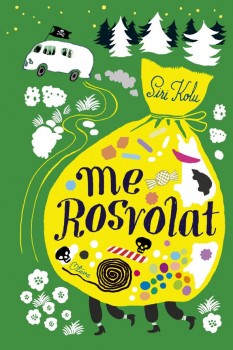 The Finlandia Junior Prize has gone to author Siri Kolu and illustrator Tuuli Juusela for the novel Me Rosvolat (‘Me and the Robbersons’, Otava); they will share the award of €30,000 (see the Prize jury assessments of the shortlist here). The winner was chosen by actor and writer Hannu-Pekka Björkman.
Awarding the prize on 25 November he said: ‘It caught my attention that in none of the six shortlisted children’s books are there any so-called nuclear families, at least not for long. The main characters constantly live and grow without something – the lack of parents or the attention of an adult is a serious matter to a child. However, in these books there is always someone who cares, not perhaps a stereotypical mom or dad, but an adult nevertheless.’ In Björkman’s opinion Me Rosvolat, with its rich language and a whiff of anarchy, presents the reader with moments of realisation and wonderment.
For love or money
30 June 1994 | Archives online, Fiction, Prose
Extracts from the novel Paratiisitango (‘Paradise tango’, WSOY, 1993). Introduction by Markku Huotari
The bishops’ dilemma
They are waiting for Blume in the front room of the office. On the sofa sits a man whom Blume has never learned to like. He himself chose and appointed the man, for a job not insignificant from the point of view of the company. Blume has good reasons for the appointment. If he employed only men he liked, the business would have gone bankrupt years ago.
Reinhard Kindermann gets up from the sofa and waits in silence while Blume hangs up his overcoat. Mrs Giesler stands next to Blume. She does not try to help her superior take off his coat, for she knows from experience that he would not tolerate it, but the old man does allow her to stand next to him and wait in silence, like a servant expressing submission. More…
The bully
31 March 1996 | Archives online, Fiction, Prose
A short story from Tulen jano (‘Thirst for fire’, Gummerus, 1995); power relations between doctor and patient in a situation where the past will not leave either alone
Nurmikallio, an apparently ordinary middle-aged man, came back again and again, and it seemed as if there would be no end to his story.
I listened to him patiently at first. Repeatedly he returned to the same subject. The form and emphases of the story changed, new memories emerged, but the gist was the same: he had failed in his life and believed that the root cause of his failure was a particular person, a childhood class-mate, a bully.
On the basis of his first visit I wrote a short character-sketch:
Intellectually average. Talkative, but by his own account solitary. Difficulties in human relationships, separated, no children. Electrician by profession, says he likes his work. Biggest problem obsessive attachment to childhood traumas.
And that’s all, I thought. But he was not to be so easily dismissed.
Solid, intangible
26 September 2013 | Fiction, poetry
Poems from Mot natten. Dikter 2010 (‘Towards the night. Poems 2010’, Schildts & Söderströms, 2013). Introduction by Michel Ekman
Memory
If you give me time
I don’t weigh it in my hand:
it’s so light, so transparent
and heavy as the thick
shining darkness
in the backyard gateway
to memory
Front-Line Tourists
30 September 1976 | Archives online, Fiction, Prose
An extract from the novel Nahkapeitturien linjalla (‘On the tanners’ line’, 1976)
Paavo Rintala (born 1930) published his first novel in 1954 and since then has brought out a new book almost every year. A merciless critic of the myths surrounding certain national figures and events, he has written about Marshal Mannerheim, against attempts to glorify war, and the ‘inevitability’ of Finland’s involvment in the German Barbarossa plan. He has made considerable use of reportage technique to produce anti-war documentaries and in more recent years worked with international subjects.
His books have been widely translated and are popular in East and West Europe. Paavo Rintala’s novel Sissiluutnantti (‘Commando Lieuenant’, Otava 1963) and its reception were the subject of a book by the ltterary critic Pekka Tarkka (Paavo Rintalan saarna ja seurakunta. ‘Paavo Rintala’s sermon and congregation’, Otava 1966). Paavo Rintala is chairman of the Finnish Peace Committee. The passage below is taken from Nahkapeitturien linjalla (‘On the tanners’ line’, Otava 1976) in which he again turns his attention to the war years. Rintala looks at the events of the years leading up to the war and the course of the war itself through the eyes of many different people – from the leading politicians of the day to the ordinary soldier.
The novel has already been acclaimed as the monument to the ‘unknown soldier’ of the Winter War.

Hessu duly presented himself at the Viipuri office of the Army Information Department (Visitors’ Escort Section), where it was implied that the expected visitors were Very Important People and that a singular privilege was being conferred upon Hessu and such front-line troops that the party might visit. Although His Excellency Field-Marshal Mannerheim made it a rule never to allow front-line visits by ordinary journalists or even by special correspondents, these gentlemen were, it seemed, such influential people that H.E. had agreed to their visit without demur. “You understand, Padre, what a great responsibility this will be for you? These are very high-up people.” More…
The day of mourning
6 November 2014 | Fiction, Prose
Extracts from the novel Katedraali (‘The cathedral’, Teos, 2014). Introduction by Mervi Kantokorpi
I am here now, at this funeral; I’m sitting on a puffy rococo chair which stands in the corner of this large living room – hall – on a Berber rug, one of a series of four pieces of furniture. The fourth is a curly-legged table, painted matt white. I wriggle like anything, trying to rid myself of my too-tight shoes. Fish thrash their tails in the same way. The lady in the dry cleaner’s told me she hates fish. She said that clothes that smell of fish and are brought into her shop make her shake with loathing but also bring her satisfaction because she can wash the awful stench away.
My shoes are impossibly small. They pinch my feet worse every moment. My back aches, too, despite the painkillers. You can’t swallow pills forever, so I just try to find a better position and put up with it. Finally my shoes leave my feet. I kick them underneath the table so that they can’t be seen. I can breathe again. In my shoes I felt as if I were sinking under the ground.
My father once showed me the Stephansdom catacombs. Thousands of people were buried here, before that, too, was forbidden by someone, he said. More…
Melba, Mallinen and me
30 June 1993 | Archives online, Fiction, Prose
From Fallet Bruus (‘The Bruus case’, Söderströms, 1992; in Finnish, Tapaus Bruus, Otava), a collection of short stories
After the war Helsingfors began to grow in earnest.
Construction started in Mejlans [Meilahti] and Brunakärr [Ruskeasuo]. People who moved there wondered if all the stone in the country had been damaged by the bombing or if all the competent builders had been killed; if you hammered a nail into a wall you were liable to hammer it right into the back of your neighbor’s head and risk getting indicted for manslaughter.
Then the Olympic Village in Kottby [Käpylä] was built, and for a few weeks in the summer of 1952 this area of wood-frame houses became a legitimate part of the city that housed such luminaries as the long-legged hop-skip-and-jump champion Da Silva, the runner Emil Zatopek (with the heavily wobbling head), the huge heavyweight boxer Ed Saunders and the somewhat smaller heavyweight Ingemar Johansson who had to run for his life from Saunders. More…