

Search results for "tommi+musturi/2010/05/song-without-words/2009/09/what-god-said"
Locomotive
30 June 1981 | Archives online, Fiction, Prose
A short story from Dockskåpet (‘The doll’s house’). Introduction and translation by W. Glyn Jones
What I am about to write might perhaps seem exaggerated, but the most important element in what I have to tell is really my overriding desire for accuracy and attention to detail. In actual fact, I am not telling a story, I am writing an account. I am known for my accuracy and precision. And what I am trying to say is intended for myself: I want to get certain things into perspective.
It is hard to write; I don’t know where to begin. Perhaps a few facts first. Well, I am a specialist in technical drawings and have been employed by Finnish Railways all my life. I am a meticulous and able draughtsman; in addition to that I have for many years worked as a secretary; I shall return to this later. To a very great extent my story is concerned with locomotives; I am consciously using this slightly antiquated word locomotive instead of loco, for I have a penchant for beautiful and perhaps somewhat antediluvian words. Of course, I often draw detailed sketches of this particular kind of engine as part of my everyday work, and when I am so engaged I feel no more than a quiet pride in my work, but in the evenings when I have gone home to my flat I draw engines in motion and in particular the locomotive. It is a game, a hobby, which must not be associated with ambition. During recent years I have drawn and coloured a whole series of plates, and I think that I might be able to produce a book of them some time. But I am not ready yet, not by a long way. When I retire I shall devote all my time to the locomotive, or rather to the idea of the locomotive. At the moment I am forced to write, every day; I must be explicit. The pictures are not sufficient. More…
Snowbirds
2 November 2011 | Extracts, Non-fiction
The short winter days of the northerly latitudes are made brighter by snow cover, which almost doubles the amount of available light. Reflection from the snow is an aid for photographers working outdoors in winter conditions. A new book, entitled Linnut lumen valossa (‘Birds in the light of snow’), presents the best shots by four professionals, Arto Juvonen, Tomi Muukkonen, Jari Peltomäki and Markus Varesvuo, who specialise in patiently stalking the feathered survivors in the cold
The photographs and texts are from the book Linnut lumen valossa (‘Birds in the light of snow’, edited by Arno Rautavaara. Design and layout by Jukka Aalto/Armadillo Graphics. Tammi, 2011)
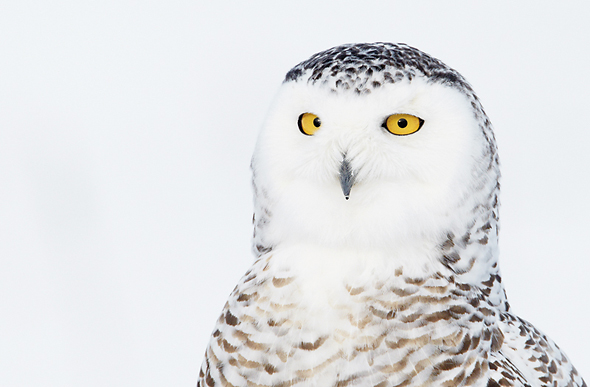
Snowy owl. Photo: Markus Varesvuo, 2010
Season’s greetings
31 December 2002 | Archives online, Fiction, Prose
An extract from the novel Kolmastoista tuoli (‘The thirteenth chair’, Atena, 2002)
The start of the Christmas season was difficult for everybody, but it was one big upset for Ron and Dan, the twins. At Christmas, apparently, their whole world, all their schoolmates and backyard-mates, the whole gang of them, were avoiding the twins. No one seemed to be even talking to the twins, who said everyone was just concentrating on ‘being nice’.
‘Nice!’
The pain on the boys’ faces looked the real thing. They were without chums, and the reason was even more annoying.
‘They have to be nice, for they’re expecting presents from Father Christmas.’
Christmas was coming and was having a weird effect on the youngest. For the twins, effort and a reward for a good try were completely foreign concepts. At this point, their lives were sheer adventure. They were lavished with overflowing care and love – and not one Christmas present. More…
Change the words
30 March 2008 | Fiction, poetry
Poems from Bul bul (‘Bulbul’, WSOY, 2007). Introduction by Karri Kokko
Opening
Which street was it? A question in a poem doesn’t demand an answer, it’s
itself, like that accurate filter, a blood-soaked liver –
The city was a giant, budging my brains, the fireworks’
ash trailed down to earth, the clowns screeched, a book’s face
was waiting like a child’s face,
and they began swarming out, releasing themselves from signposts,
neon signs, from the pages of a closed book (smelling of a dried
ranunculus), from graves, from a woman’s abhorrent womb – More…
In with the new?
17 December 2010 | Letter from the Editors
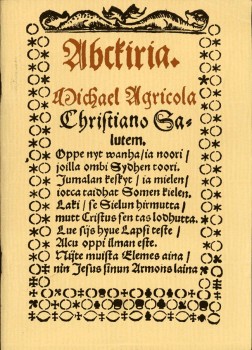
Abckiria (‘ABC book’, 1543): the first Finnish book, a primer by the Reformation bishop Mikael Agricola, pioneer of Finnish language and literature
In August 2010 the American Newsweek magazine declared Finland (out of a hundred countries) the best place to live, taking into account education, health, quality of life, economic dynamism and political environment.
Wow.
In the OECD’s exams in science and reading, known as PISA tests, Finnish schoolchildren scored high in 2006 – and as early as 2000 they had been best at reading, and second at maths in 2003.
Wow.
We Finns had hardly recovered from these highly gratifying pieces of intelligence when, this December, we got the news that in 2009 Finnish kids were just third best in reading and sixth in maths (although 65 countries took part in the study now, whereas in 2000 it had been just 32; the overall winner in 2009 was Shanghai, which was taking part for the first time.)
And what’s perhaps worse, since 2006 the number of weak readers had grown, and the number of excellent ones gone down. More…
A toast before dying
30 June 2005 | Archives online, Fiction, Prose
Extracts from the novel Voin jo paljon paremmin. Tšehov Badenweilerissa (‘I already feel much better. Chekhov in Badenweiler’, Loki, 2004). Introduction by Hannu Marttila
I went to meet them Friday and I did not plan to take other patients that week. They had a small but comfortable room with striped wallpaper.
The Russian was a tall man, but stooped. It soon became apparent that his wife spoke fluent German because she was of German descent. That made it much easier to take care of things.
Of course I knew who the patient was. I have always enjoyed literature and other forms of art. I could play several pieces rather well on the piano. When I was younger I had even written a couple of stories set in the mountains, though I had never offered them for publication. As for Chekhov, I had read a couple of his stories that had just come out in German translation, and I had liked them quite a lot in a way, even though they of course reflected that characteristic Russian nature, with its vodka and untidiness.
The patient’s wife seized both my hands when I entered. It was a bit confusing, but not necessarily unpleasant.
‘Our name is Chekhov. We have come from Russia,’ the woman said in a strong, carrying voice. ‘I trust you’ve been told?’ More…
Literary prizes: the Dancing Bear 2009
21 May 2009 | In the news

Sanna Karlström. - Photo: Irmeli Jung
This year’s Dancing Bear Poetry Prize, worth €3,500, has gone to Sanna Karlström (born 1975) for her third collection of poems, Harry Harlow’n rakkauselämät (‘The love lives of Harry Harlow’, WSOY, 2008). The prize is awarded every May by the Finnish Broadcasting Company to a book of poetry published the previous year. It was given this year for the 16th time.
The collection, containing short, condensed tales of love and lovelessness, forms a fragmented portrait of the American psychologist Harry Harlow who, in the 1950s, made notorious experiments with young rhesus monkeys in which he separated them from their mothers.
Chosen by a jury of three radio journalists, Barbro Holmberg, Marit Lindqvist and Tarleena Sammalkorpi, and the poet Risto Oikarinen, the other shortlisted authors were Ralf Andtbacka, Kari Aronpuro, Eva-Stina Byggmästar, Jouni Inkala and Silja Järventausta.
The guest book
30 June 1997 | Archives online, Fiction, Prose
An extract rom the novel Kenen kuvasta kerrot (‘Whose picture are you talking about’, Otava, 1996). Introduction by Pia Ingström
Late at night before going to bed An Lee had turned off all the lights, opened the large bedroom window, breathed the cool air. She had done this often. It made it easier to fall asleep. It was enough to look outside for a moment and to breathe in slowly, and at the same time the bedroom air freshened and changed for the night.
Then she had closed and locked the window, drawn the curtains, and switched on the dim wall light. It might be nice to decorate the space between the double windowpanes with wooden animals, she had thought, not for the first time. They had had some at home, her mother had been a collector of such things. Almost all of them pink and lemon yellow, a whole zoo between the windows, only the panther had been pitch-black, and on one of the elephants the pretty grey color had been scratched and splotchy on one side. More…
It takes a life to say
31 December 2007 | Archives online, Fiction, poetry
Poems, published in You go the words (Action Books, Scandinavian Series, Indiana, 2007). Introduction by Trygve Söderling
|
We go and search it is not words * You go the * And spread out To only * The song * One time I have a name * a longing * A morning’s * Words are words But word’s image Alas stay not * Fly out, my day
fly, fly day to meet
fly, fly, you the wretched's
their, everyone's
in all times
peace and day
on ground's floor
floor ground
o you
in man's name
* Suneveningspring * Dog bolts happy * And to not speak more it takes a life to say but – as the everyday moment O no beauty But your light – a smile what and to know * And allthesame The white day * |
Vi går och söker det är ej ord * Du går de * Och bredd ut Att endast * Sången * En gång Jag har ett namn * en längtan * En morgons * Ord är ord Men ords bild Ack stanna ej * Flyg ut, min dag
flyg, flyg dag till möte
flyg, flyg, du de armas
deras, allas
i alla tider
lugn och dag
på marks golv
golv mark
o du
i människans namn
* Solaftonvår * Hund skenar glad * Och att ej tala mer det tar ett liv att säga men – som vardagens stund O ingen skönhet Men ditt ljus – ett leende vad och att veta * Och alltjämt Den vita dag * |
Translated by Fredrik Hertzberg
In the early hours
31 March 1976 | Archives online, Fiction, Prose
An extract from Dyre Prins (‘Sweet Prince’, 1975). Introduction by Ingmar Svedberg
Donald Blaadh, a retired businessman, has been called to visit an influential acquaintance in the middle of the night.
He was sitting in the library, listening to Shostakovich, the Leningrad Symphony. The slow crescendo. The insistent march rhythm. Dogged endurance. Indomitability. He switched it off when I came in.
“I can’t sleep,” he said.
“Neither can I.”
He ignored the ironic undertone. “Shostakovich sharpens the decisionmaking faculties, the way chess sharpens the wits,” he said. “A sort of exercise routine … but I forgot, you don’t play chess.”
“No, but I do play the gramophone.”
“To-day I’m going to start you off with a quiz: whose immortal words were these, ‘Minerva’s owl never takes to the air till twilight is falling’?”
“I don’t know.” More…
On the waves of our skin
4 December 2009 | Fiction, poetry
The poems in Ilpo Tiihonen’s new collection, Jumalan sumu (‘God’s mist’) – about fakirs, beggars, poets, lovers and life – are tinged with a gentle sense of the ephemerality of human life (see Gatecrashing the universe)
Poems from Jumalan sumu (‘God’s mist’, WSOY, 2009)
SANTO PAN
These mornings when beggars
station themselves at church doors
and a little grace slips through
the fingers of some of us,
it seems for a moment good
That crows are flying about
and princes’ bones are clattering in huge sarcophagi
And now, with a basic shape planned
for the daily bread,
Early morning wakes up in Florence
with black flour in its fingernails More…
Beyond words
15 December 2010 | This 'n' that

Meeting place of the Lahti International Writers' Reunion: Messilä Manor
‘Whereof one cannot speak, thereof one must remain silent.’
This famous quotation from the Austrian philosopher Ludwig Wittgenstein has been adapted by the organisers of the Lahti International Writers’ Reunion (LIWRE): the theme of the 2011 Reunion, which takes place in June, will be ‘The writer beyond words’.
‘Whereof one cannot speak, thereof one must write.’ How will the writer meet the limits of language and narration?
‘There are things that will not let themselves be named, things that language can not reach. Our senses give us information that is not tied to language – how can it be translated into writing? And how is the writer going to describe horrors beyond understanding or ecstasy that escapes words? How can one put into words hidden memories, dreams and fantasies that lie suppressed in one’s mind? Does the writer fill holes in reality or make holes in something we only think is reality?
‘Besides literature, there are other forms of interpreting the world; can the writer step into their realms to find new ways of saying things? The surrounding social sphere may put its own limits to writing. What kind of language can a writer use in a world of censorship and stolen words? How does the writer relate to taboos, those dimensions of sexuality, death or holiness that the surrounding world would not want to see described at all? Is it the duty of literature to go everywhere and reveal everything, or is the writer a guardian of silence who does not reveal but protects secrets and everything that lies beyond language?’
The first Writers’ Reunion took place in Lahti at Mukkula Manor in 1963; since then, more than a thousand writers, translators, critics and other book people, both Finnish and foreign, have come to Mukkula to discuss various topics.
In 2009 the theme was ‘In other words’, which inspired the participants to talk about the power of the written word in strictly controlled regimes, about fiction that retells human history and about the differences between the language of men and women, among other things. See our report from the 2009 Reunion; eleven presentations are available in English, too.
A poet’s perspective
31 December 1986 | Archives online, Authors, Reviews
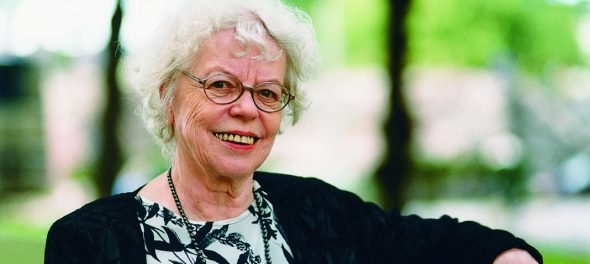
Aila Meriluoto. Photo: Pertti Nisonen
When Aila Meriluoto burst on to the world of Finnish poetry 40 years ago in the autumn of 1946 she was at once hailed as a youthful prodigy. Praised lavishly by the leading critics, the 22-year-old poet’s first collection, Lasimaalaus, sold in phenomenal numbers: in a couple of years it went through eight editions, or 25,000 copies, which in Finland is still a record figure. Today total sales are well over 30,000.
Two poems attracted particular attention. One was Kivinen Jumala (‘God of stone’), a poem of defiance unleashed by the experience of wartime bombing, in which God is portrayed as having changed into a stone statue, and people as having hardened correspondingly. It was the first reaction of the younger generation to the war – abusive, strong and inevitable, the proclamation of the death of the kind, just God.
The other central poem of the collection was Lasimaalaus (‘Stained glass’) from which the collection took its name: a taut post-symbolist vision and a dazzling synthesis of the oneness of the world. Baudelaire, master of correspondances, might well have been satisfied with it. More…
About calendars and other documents
30 June 1982 | Archives online, Fiction, Prose
An extract from Sudenkorento (‘The dragonfly’, 1970). Introduction by Aarne Kinnunen
I now have. Right here in front of me. To be interviewed. Insulin artist. Caleb Buttocks. I have heard. About his decision. To grasp his nearly. Nonexistent hair and. Lift. Himself and. At the same time. His horse. Out of the swamp into which. He. Claims. He has sunk so deep that. Only. His nose is showing. How is it now, toe dancer Caleb Buttocks. Are you. Perhaps. Or is It your intention. To explain. The self in the world or. The world. In the self. Or is It now that. Just when you. Finally have agreed to. Be interviewed by yourself. You have decided. To go. To the bar for a beer?
– Yes. Can you spare a ten?
– Yes.
– Thanks. See, what’s really happened is that. My hands have started shaking. But when I down two or three bottles of beer, that corpse-washing water as I’ve heard them call it, my hands stop shaking and I don’t make so many typing errors. If I put away six or seven they stop shaking even more and the typing mistakes turn really strange. They become like dreams: all of a sudden you notice you’ve struck it just right. Let’s say, ‘arty’ becomes ‘farty’. Or I mean to say, ‘it strikes me to the core’ I end up typing ‘score’. It’s like that. A friend of mine, an artist, once stuck a revolver in my hand. Imagine, a revolver! I’ve never shot anything with any kind of weapon except a puppy once with a miniature rifle. My God, how nicely it wagged its tail when I aimed at it, but what I’m talking about are handguns, those shiny black steelblue clumps people worship as heaven knows what symbols. It’s not as if I haven’t been hoping to all my life. And now, finally, after I’d waited over fifty years, it turned out that the revolver was a star Nagant, just the kind I’d always dreamed of. So if I ever got one of those, oh, then would sleep through the lulls between shots with that black steel clump ready under my pillow. Well, my friend the artist set out one vodka bottle with a white label and three brown beer bottles with gold labels on the edge of a potato pit – we had just emptied all of them together – stuck the fully loaded star Nagant into my hand, took me thirty yards away and said:
– Oh, Lord. More…