

Search results for "tommi+musturi/2010/2009/10/writing-and-power"
A roof with a view
27 August 2009 | Fiction, Prose
Extracts from the novel Mistä on mustat tytöt tehty? (‘What are black girls made of?’, Tammi, 2009) Introduction by Tuomas Juntunen
I’m a chimney sweep’s daughter, born October 1962 as a gift, a light to a darkened world. I’ve had lots of mothers, but none of them ever stuck around for good. One of them gave birth to me, so she’s Mother, not mother. Her name is Dewdrop, because water has spilled over the only photograph of My Mother and now her face has dissolved into a single translucent droplet; her nose, cheeks and chin are now a fat, shiny blob that looks like it’s about to fall out of the bottom of the picture. More…
Not so weird?
12 December 2013 | Non-fiction, Reviews

Johanna Sinisalo. Photo: Katja Lösönen
Johanna Sinisalo’s new novel Auringon ydin (‘The core of the sun‘, Teos, 2013), invites readers to take part in a thought experiment: What if a few minor details in the course of history had set things on a different track?
If Finnish society were built on the same principle of sisu, or inner grit, as it is now but with an emphasis on slightly different aspects, Finland in 2017 might be a ‘eusistocracy’. This term comes from the ancient Greek and Latin roots eu (meaning ‘good’) and sistere (‘stop, stand’), and it means an extreme welfare state.
In the alternative Finland portrayed in Auringon ydin, individual freedoms have been drastically restricted in the name of the public good. Restrictions have been placed on dangerous foreign influences: no internet, no mobile phones. All mood-enhancing substances such as alcohol and nicotine have been eradicated. Only one such substance remains in the authorities’ sights: chilli, which continues to make it over the border on occasion. More…
Landscape
30 June 2006 | Archives online, Fiction, Prose
(Landskap, 1919). Introduction by Juha Virkkunen
12 March
To begin with, there’s a great white field. The field is criss-crossed with low slender fences and little patches of yellow-green stubble peering up through the snow, and hare-tracks slanting away towards the stubble. But we won’t notice the fences and the stubble and the hare tracks. Because we’re going to take a wider, more sort of decorative view.
So we see the great white field. And where the field ends a dark green screen has been drawn. The screen has been cut short rather amusingly in the middle, so one can see yet another white held. This belongs to another village. And this other village itself has crept up timidly to the forest-clad hill and lies close to it, so we don’t notice this other village. Because we want to take a wider view of things. More…
Sisters beneath the skin — the letters of Edith Södergran and Hagar Olsson
11 February 2009 | Articles, Authors, Extracts
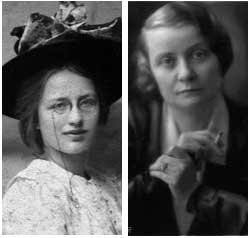
Edith Södergran and Hagar Olsson. – Photos: Svenska litteratursällskapet i Finland, Åbo Akademis bildsamlingar.
Almost one hundred years ago, a small Karelian village close to St Petersburg, near the Finno-Russian border, saw the birth of a fearless new form of modern poetry.
The Finland-Swedish poet Edith Södergran (1892–1923) began writing her burning lines inspired by Friedrich Nietzsche’s ideal of the new man and his philosophy of creativity. Södergrans’ poems were free of any traditional pattern and full of strong images. Her work, which ran to six collections of poems, later achieved classic status in the modernist traditon that she presaged.
Beyond good and evil?
30 June 1987 | Archives online, Authors, Interviews
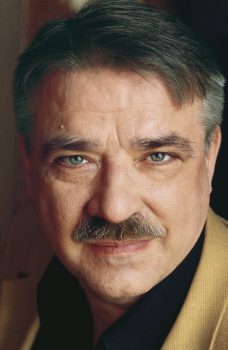
Esa Sariola. Kuva Irmeli Jung
Markku Huotari interviews Esa Sariola
A stylish restaurant in the Stock Exchange building in Helsinki. Esa Sariola and I order a businessmen’s lunch. We talk about hard-nosed success stories. About technocracy, casino economics.
About profit.
A steely-eyed businessman enters the room from the stock exchange and sees us two soft-talkers, even if we look like men, wasting time. The ruthless gambler bolts down his lunch and disappears to the upper floor again, where he is making money.
We remain.
We’re just talking.
And there’s no money accruing in our wallets.
All the same we have a grip on that investor. Esa Sariola has already laid siege to people like him in three books: Väärinkäsityksiä (‘Misconceptions’, 1983), a collection of short stories, and two novels: Rakas ystävä (‘Dear friend’, 1985) and Kuolemaani saakka (‘Until my dying day’, 1986). More…
Chill climates
30 June 1984 | Archives online, Authors, Interviews
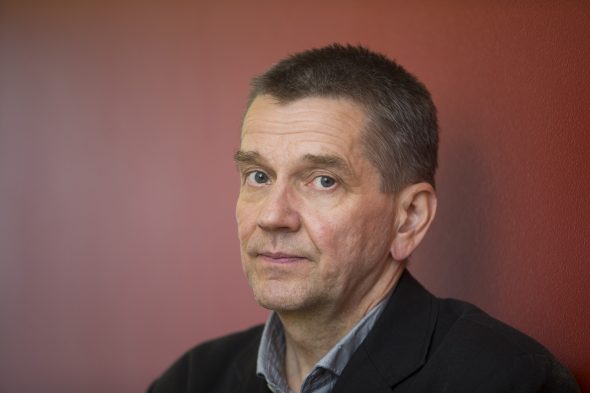
Olli Jalonen. Photo: Pekka Nieminen.
Olli Jalonen was born in 1954 and lives in Hämeenlinna. His first work, a collection of short stories entitled Unien tausta (‘The background of dreams’, 1978) and two later novels, Sulkaturkki (‘Feather coat’, 1979) and Ilo ja häpeä (‘Joy and shame’, 1981) were reviewed with exceptional warmth by the critics. His latest novel, Hotelli eläville (‘Hotel for the living’, 1983) brought him a State Prize for Literature in 1984. The awarding committee commented that the novel is ‘a representative of that rare genre in Finnish literature, the grotesque novel’. Jalonen also received the ‘Spurs of Criticism’, the annual prize awarded by the Finnish Critics’ Association. The hotel for the living is the book’s ironic name for a nuclear shelter that is being quarried into the living rock of Finland; Jalonen sets up a situation that allows him to examine the crevices of his characters’ personalities. He studies their attitudes to life with cool satire – they live in the bleak climate of buying and selling, the struggle for power and material goods, the domination of others, and submission to their fates. Interview by Markku Huotari
‘Poetry in a world under threat’ was the headline for a survey of Finnish poetry by poet and critic Väinö Kirstina that appeared in the Tampere daily newspaper Aamulehti in 1981.
Two years later that headline is just as bitingly relevant. Only one alteration is necessary: to poetry must be added prose, for prose, too, is addressing itself to that future, difficult enough to imagine, in which the threat of nuclear war may involve Finland, living in the shadow of the super powers, in a conflict in which she wishes no part.
One of the scenes in Olli Jalonen’s novel Hotelli eläville (‘Hotel for the living’) is set in a nuclear shelter that is being built inside the living rock on which Helsinki stands. Even now the planners of that ‘shelter’ use the fear of other people to their own ends, and divide them into those who will be saved and those who will perish.
A sermon on the day of judgement? Cliche? Milking of a fashionable subject? More…
Manmother
31 December 2002 | Archives online, Fiction, Prose
Extracts from the novel Granaattiomena (‘Pomegranate’, WSOY, 2002). Introduction by Kristina Carlson
The journey
Mother had sent her son to the island of Rome.
She’d sent him for pleasure and recreation, and also to have a little time by herself. Even though their life together was on an even keel, it was sensible to have some time away from each other. She herself was sixty-eight, and her son an unmarried hermit in his thirties, on sickness allowance for the last couple of years. He was afflicted with chronic depression. The doctors had been unable to identify the cause. The origin of a disorder of that sort was often looked for in some infant trauma; but the boy’s childhood, from all appearances, had been harmonious. One doctor suspected the time of his father’s terminal illness, when the boy had had to nurse his father for a long while. More…
Back in the USSR
3 October 2011 | Fiction, Prose
Extracts from Rosa Liksom’s novel Hytti nro 6 (‘Compartment no 6’, WSOY, 2011). Review by Mervi Kantokorpi
Moscow hunched itself in the dry, frosty March night, protecting itself from the touch of the icy red sun as it set. The girl entered the train’s last sleeping carriage, found her compartment, compartment number six, and breathed deeply. There were four beds in the compartment, the upper ones folded agains the wall, while between the beds was a small table, on the table a white table cloth and a plastic flower vase containing a bunch of pink paper carnations, faded by time; the shelf above the end of the bed was full of large, untidily secured parcels. The girl shoved her modest old suitcase, the one she had got from Zahar, into the metal luggage space under the hard, narrow bed; her small backpack she threw on the bed. When the station bell sounded for the first time, the girl went to stand by the corridor window. She breathed in the scent of the train, iron, coal-dust, the smells left behind by dozens of cities and thousands of people. Travellers and those who had come to see them off pushed past her, shoving her with their cases and parcels. The girl touched the cold window with her hand and looked at the platform. This train would take her through villages inhabited by deportees, through the open and closed towns of Siberia to the capital of Mongolia, Ulan Bator. More…
The trees
31 March 1998 | Archives online, Fiction, Prose
A short story from Sunnuntaina kahdelta (‘Sunday at two’, Otava, 1997)
Maisa enjoyed her trees without knowing their names, without ever counting how many of them there actually were. The trunks twisted together and then forked again, the branches wound round and stretched past each other, and the tapered leaves rustled in dark, wide fans. In the autumn, when the wind blew and the rain fell, the naked stand of trees flailed in a single damp movement, and in February the branches snapped and cracked invisibly under the snow like a promise that would be fulfilled before long.
Sometimes on summer evenings, when the boy was asleep, she listened to the birds fluttering among the shaded lower branches, to the shrews and field mice dashing between the trunks on their nocturnal journeys and the roots pushing deeper into the soil day by day. When she shut her eyes, she could see the sap pulsing under the bark, and her own arms and legs moved more lightly, her heart beat strongly, and her thoughts welled up. More…
How I saved the world for communism
30 September 1996 | Archives online, Fiction, Prose
Extracts from the novel Kreisland (WSOY, 1996). Rosa Liksom’s first novel is a picaresque story of a heroine whose adventures range through Finland, Soviet Russia and America. Introduction by Soila Lehtonen
Maid Agafiina: Got myself some shiny black rubber boots, the kind with the red felt lining, and a colorful crepe de chine dress and a rayon coat, and while shopping for all that I checked out the four wonders of Moscow: a bell that doesn’t ring, a cannon you can’t fire, a ruler who doesn’t speak, and money that doesn’t stink.
In no time at all I made up a new personality, learned the language real good, and obtained a Soviet citizen’s passport. I was totally excited by everything I’d seen. My cheeks were as red as the flag. I wanted to find out about everything and see every achievement of this huge Soviet land. More…
The life of a lonely friend
30 September 1986 | Archives online, Fiction, Prose
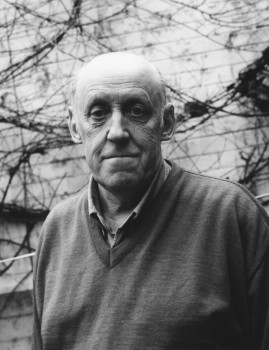
Bo Carpelan. Photo: Charlotta Boucht
Extracts from Bo Carpelan‘s novel Axel, ‘a fictional memoir’ (1986). In his preface to the novel Bo explains how he ‘found’ Axel.
Preface
In the 1930s I came across the name of Axel Carpelan (1858-1919), my paternal grandfather’s brother, in Karl Ekman’s Jean Sibelius and His Work (1935). In the bibliography, the author briefly mentions quotes from letters in the book addressed to Axel Carpelan, ‘who belonged to the Master’s most intimate circle of friends, and in musical matters was his constant confidant. Sibelius commemorated their friendship by dedicating his second symphony to him’. I had never heard Axel’s name mentioned in my own family.
Many years after Karl Ekman, the original incentive for the novel about Axel arose through Erik Tawaststjerna’s biography of Sibelius, in which Axel is portrayed in the second volume (1967) of the Finnish edition, and whose life came to an end in Part IV (1978). From early 1970s onwards, I started notes for Axel’s fictional diary from to 1919. It is not known whether Axel himself ever kept a diary. I relied as muchas possible on all the available facts. These increased when I was given access to letters exchanged between Axel and Janne from the year 1900 onwards. It became the story of the hidden strength a very lonely and sick man, and of a friendship in which the give and take both sides was far greater than Axel himself could ever have imagined.
Hagalund, June 1st, 1985
Bo Carpelan

1878, Axel’s diary
15.1.
On my twentieth birthday, I remember the young Wolfgang; ‘Little Wolfgang has no time to write because he has nothing to do. He wanders up and down the room like a dog troubled by flies’. However, that dog achieved a paradise. I have learnt yet one more piece of wisdom: ‘It is my habit to treat people as I find them; that is the most rewarding in the long run’. More…
To sleep, to die
30 September 2004 | Fiction, Prose
Extracts from the novel Unelmakuolema (‘Dreamdeath’, Teos, 2004)
Dreamdeath
Who would not like to cheat the grim reaper? Ways are known, of course, both scientific and non-scientific, but all of them are uncertain and temporary. Except for the simplest: to get there first oneself.
The refinement of this idea was Dreamdeath’s business idea. ‘Dreamdeath – because you deserve it!’ went Dreamdeath’s slogan.
The Dreamdeath home offered those who wished it the means to the most pleasant, even luxurious realisation of an autonomic death in an atmosphere of moral approval, against a suitable fee. At Dreamdeath the client himself decided when and in what conditions he would leave his mortal clay. More…
Becoming Finland
23 May 2013 | Reviews
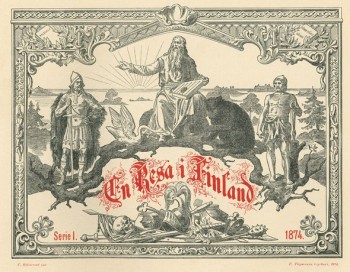
Imaginary heroes: the title page of En resa i Finland. Illustration by C.E. Sjöstrand (1828–1906)
Zacharias Topelius
En resa i Finland
[A journey in Finland (1873)]
Helsinki: Svenska litteratursällskapet i Finland, 2013. 173 p., ill.
Utgivare [Editor]: Katarina Pihlflyckt
ISBN 978-951-583-260-3
€38, hardback
(Stockholm: Atlantis förlag, 2013. ISBN 978-91-7353-616-5)
The birth of Finland as a country came as a surprise to those who lived there.
It was created by Napoleon and Alexander I, becoming a reality following Russia’s victory over Sweden in the so called Finnish War. In 1809 Alexander exalted Finland as ‘a nation among nations’, however the new nation still needed to feel like a nation. The Russian rulers supported gentle and non-political nationalism in Finland, in the hope that it would mentally distance the country from Sweden. In this tranquillity, the sense of community they had envisioned grew in Finland.
For this, there were three key factors, all of which stemmed from the 1830s. Elias Lönnrot published the Kalevala, the national epic, proving that Finnish mythology and culture did indeed exist. The poet J.L. Runeberg (who would later become known as the national poet) gave Finland an appearance that was an ideology. He depicted a poor, pious and simple people, a harsh and beautiful wilderness, and with his poems he described the Finnish War, that Finland had lost, as a heroic battle of the people, fought for Finnish values. More…