

Search results for "Riikka/2010/10/mikko-rimminen-nenapaiva-nose-day"
Male parole
30 June 2006 | Authors, Interviews

Hannu Luntiala. Photo: Jukka Uotila
In his first collection of short stories Hannu Luntiala reinvents the form to examine the lives of 16 men. One story consists of just one long sentence; another is written in the made-up ‘Katalanian’ language; a third omits all the commas
A successful IT boss; a humble Greek Orthodox monk; an old man lying like a vegetable hooked up to a life-support machine. Hannu Luntiala’s collection of short stories presents us with sixteen men’s emotional landscapes. Entitled Hommes, the collection is the debut by Hannu Luntiala (born 1952).
Variety is to be found not only in the characters themselves, but in the language and style of each of Luntiala’s stories. For him language is an integral part of the story; it can open up new perspectives that a simple plot cannot. More…
The trees
31 March 1998 | Archives online, Fiction, Prose
A short story from Sunnuntaina kahdelta (‘Sunday at two’, Otava, 1997)
Maisa enjoyed her trees without knowing their names, without ever counting how many of them there actually were. The trunks twisted together and then forked again, the branches wound round and stretched past each other, and the tapered leaves rustled in dark, wide fans. In the autumn, when the wind blew and the rain fell, the naked stand of trees flailed in a single damp movement, and in February the branches snapped and cracked invisibly under the snow like a promise that would be fulfilled before long.
Sometimes on summer evenings, when the boy was asleep, she listened to the birds fluttering among the shaded lower branches, to the shrews and field mice dashing between the trunks on their nocturnal journeys and the roots pushing deeper into the soil day by day. When she shut her eyes, she could see the sap pulsing under the bark, and her own arms and legs moved more lightly, her heart beat strongly, and her thoughts welled up. More…
Power or weakness?
30 September 1986 | Archives online, Drama, Fiction
An extract from the play Hypnoosi (‘Hypnosis’, 1986). Introduction by Soila Lehtonen
As you all know, this company has been my life’s work and it stands for everything I’ve had to renounce. You know that for years I have not received a penny for my personal expenses, that I am on the firm’s lowest wage level, zero.
I haven’t even had a free cup of coffee; if, because I have been working hard or I wanted to improve my concentration, I have felt like a cup of coffee, I have always gone to the canteen during my coffee break and challenged one of the boys to a bout of arm wrestling under the agreement that the loser buys the coffees, and the bloke has paid. The money never came out of the firm’s running expenses, investments, trusts or funds. More…
Howl came upon Mr Boo
31 December 1983 | Archives online, Children's books, Drama, Fiction
The first Mr Boo book was published in 1973. Mr Boo has also made his appearance on stage this year; his theatrical companions are the children Mike and Jenny, who are not easily frightened – Mr Boo’s courage is a different matter, as can be seen in the extract from the stage play that follows overleaf.
Hannu Mäkelä describes the birth of Mr Boo:
To be honest, Mr Boo has long been my other self. The first time I drew a character who looked like him, without naming it Boo, I was really thinking of my fifteen year-old self.
The years went by and the Mr Boo drawing was forgotten for a time. It hadn’t occurred to me to write for children; I seemed to have enough to do coping with myself. Then I met Mr Boo, whom I had not yet linked up with my old drawing. My son was about six years old and we had been invited out. There were several children present. As I recall it it was a wet Sunday afternoon. I had entrenched myself with the other grown-ups in the kitchen to drink beer. The noise of the children grew worse and worse (in other words they were enjoying themselves). At last the women could bear it no longer and demanded that I, too, get to work. Really, what right had I always to be sprawled at a table with a beer glass in my hand? None. So I rose and went into the sitting-room. I shouted at the children to form a circle around me. At that time I had a motto: ‘Mäkelä – friend to children and dogs’. The reverse was true of course. The name Mr Boo occurred to me, probably as a result of some obscure private (and possibly even erotic) pun and I begun to tell a story about him. In telling it I paused dramatically and accelerated just as primary school teachers are taught to do: that part of my training, after all, wasn’t wasted. I was astonished; the children listened in complete silence. And if my memory doesn’t fail me (or even if it does, this is the way I wish to remember it), at the end of the story the smallest of the children said, rolling his r’s awkwardly, ‘Hurrrrah’. I was hooked.
The children themselves asked me to tell the same stories again. They still enjoyed them. It wasn’t long before I began to think seriously of writing a whole book about Mr Boo. For the first time in my life I really wanted to write for children. Every day after work I wrote a new Mr Boo story. Then in the evening I read it to my son. That is how the stories grew into a book.
The child likes right to triumph; he likes the good and the moral. The child is the kind of person we adults try in vain to be. It was only through Mr Boo that I began to see children in a totally new way and above all to become seriously interested in them.
Piranesi
30 August 2013 | Fiction, Prose
An extract from the novel För många länder sedan (‘Many lands ago’ Schildts & Söderströms, 2013; Finnish edition: Monta maata sitten; Otava, 2013). Introduction by Pia Ingström
‘I assume your father wanted you to become a doctor?’ asked Igor at the beginning of our life together. My parents did indeed want me to become a doctor. Not a pathologist, but a general practitioner. I became an art historian instead. There was a time when my area of research aroused curiosity in Igor.
‘Why Piranesi?’ he wondered.
‘As a child I devoured classic novels about pale, emaciated families living in a cellar,’ I explained jokingly. ‘I became interested in catacombs and vaults. That’s why I wanted to study the history of drawing.’
I’ve always had a fascination for underground spaces. I’m drawn to them like a homing missile. This interest of mine must have genetic roots. My mother was born in a bomb shelter during the first German air raid over Leningrad. More…
On the make
31 December 2007 | Fiction, Prose
Extracts from the novel Benjamin Kivi (WSOY, 2007). Introduction by Lauri Sihvonen
Benjamin Kivi alias Into Penger, the 1930s
What was Kuihkä worth? What were this little man and his sons worth? What was I worth?
I drove where the little man told me to, with no lights, through a densely populated area. I could only see half a meter in front of me, trying to sense the bends and curves in the road and still keep Tallus’ car in good shape. When we got to the woods I turned on the lights and glanced at the little man sitting next to me. He was stuffing a handkerchief into his sleeve like an old housewife. The top of his head was sweating. He brushed his hair back and shoved his cap down on his head.
I had two hours to think as I drove, but it felt like a few minutes. If I didn’t drive the car, someone else would have, everything would happen just like the little man had planned, and I wouldn’t know anything about Kuihkä. What was I going to do, watch while he was thrown to the wolves? Kuihkä rescued me once. Was it meant to be that I should drive the car? Was I meant to change the course of events? How many coincidences can there be in one lifetime, and what do they signify? If events weren’t random, then what the hell was I supposed to do? More…
A modern mystery play
31 December 1983 | Archives online, Authors
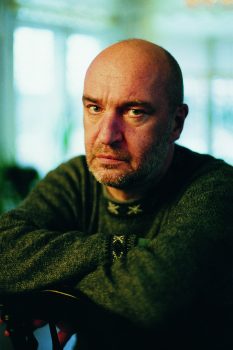
Jussi Kylätasku. Photo: Pertti Nisonen.
Jussi Kylätasku (born 1943) is a prolific writer of poetry, plays – stage and radio – film scripts and novels. Iconoclastically he casts aside the realism that is so characteristic of Finnish drama and so beloved by Finns; but at the same time Kylätasku is very Finnish: paradox is, indeed, characteristic of this infuriating writer, who has delighted critics and public alike. Perhaps the best-known of his plays is Runar ja Kyllikki (‘Runar and Kyllikki’), which was first performed in 1974; his newest work is a novel, published in November by Werner Söderström. One of his most revolutionary plays, however, is Maaria Blomma (‘Mary Bloom’), which might be called an extraordinary modern version of a mediaeval mystery play. What follows is a personal view of the director of the first performance of the play, in 1980, Väinö Vainio.
There are drama scripts, technically assured texts addressing themselves to the burning issues of the day, that inspire one at first reading to predict fruitful interpretations and lasting recognition. Unfortunately, in the Finnish theatre world such forecasts seldom come true. Almost without exception, even those plays whose first performances are successful fall into the jaws of Moloch and rapidly pass into obscurity on dim and dusty archive shelves. More…
Until the sun rises
30 September 2000 | Archives online, Fiction, poetry
Poems from Rakkaus tuli kun lähdin maan ääriin (‘Love came when I left for the ends of the earth’, Tammi, 2000). Introduction by Helena Sinervo
metaxy, like summer
The moon strokes boulders
Left warm by the day, examines
The granite, passion gone tepid
Descends from its solitude
Into sea-carved channels More…
The forest and us
30 June 2008 | Fiction, poetry
Poems from Kerttu ja Hannu (‘Gretel and Hansel’, Tammi, 2007). Introduction by Anselm Hollo
In the emptiness
When we were children. We went to sleep in our father’s and mother’s bed. I got father’s sweaty side. You got mother’s fragrant blankets. We dreamed pale green spherical cloud dreams in wrought-iron beds and burnt our fumbling paws on the red-hot shade of the night light. We did not know. That this downy softness wouldn’t last. The rooms were always large and the big people were big and there was no sin. More…
Timeless time
30 December 2005 | Fiction, poetry
Poems from Jumala saalistaa öisin eli Jobin kirjaan meidän on aina palaaminen. Osittain kursivoituja runoja (‘God hunts at night, or, we shall always return to the Book of Job. Partly italicised poems’, Otava, 2005)
Greek delights
I eat Giorgios D. Haniotis'
                    small joys
     buried in powdered sugar,
vanilla, rose petal and strawberry,
           as if wooing his three daughters,
reading Angelos Sikelianos' poem
                         'A country wedding':
and it is a beautiful blue day, Sunday,
the strange charm of Greek letters: i kiriaki,
hazelnut kernels dipped in thyme honey,
white herb ashes from the roadside,
a cigarette taste deep as sin,
tobacco smoke the only haze one can stand looking at,
a little quarrelsome noise, bus station flu,
promises made by Turks,
the threadbare pile carpet of the entrance hall as a word of honor, More…
Pig cheeks and chanterelle dust
21 August 2014 | This 'n' that
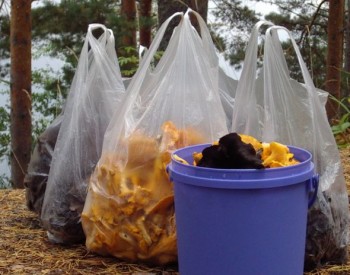
Wild and plentiful: chanterelles, black horns of plenty. Photo: Soila Lehtonen
Pop-up restaurants came into being in Helsinki in 2011: a few times every year any eager amateur cook is able to set up a ‘restaurant’ for one day on a street corner or in a park: citizens are welcome to take their pick, at a modest price.
In a northern city, not exactly suitable for street food trade all year round, in a country where rules of food hygiene are strict, the innovation of the Restaurant Day has been welcomed by the public. The latest event took place on 17 August.
The idea has now spread to at least 60 countries. Foodie culture thrives.
We find an article in The New Yorker by Adam Gopnik, No rules! Is Le Fooding, the French culinary movement, more than a feeling? interesting – according to comments quoted in it, ‘food must belong to its time’, and the traditional French cuisine ‘was caught in a museum culture: the dictatorship of a fossilized idea of gastronomy’.
In the 1960s, ‘nouvelle cuisine’, as opposed to cuisine classique, began to promote lighter, simpler, inventive, technically more advanced cooking. Well – some of us may remember that, at worst, this could also manifest itself in, say, three morsels of some edible substance placed decoratively on a plate topped with three chives: expensive, insubstantially elegant and pretty useless.
Today, Finland, the traditional stronghold of liver casserole, brown sauce and ham-mincemeat-pineapple pizzas (yes), seems to have moved onto a higher level of the culinary art – at least in selected restaurants. In a recent article, Helsinki’s food scene, coming on strong, published in The Washington Post, Tom Sietsema enjoys the pleasure of discovering things Finnish.
He is treated to parsnip leaves turned into ice cream imparting a coconut flavour, crackers made from leek ash and risotto in which ‘tiny green hops and their purple flowers interrupt the beige surface of the bowl, whose rim is dusted with golden chanterelle powder.’
The Executive Chef of Helsinki’s esteemed Savoy restaurant (est. 1937) cooks braised pig cheeks served with rhubarb and spring greens. A hunter-gatherer chef collects wild things: wood sorrel, spruce shoots and orpine and serves them in an omelette, with a drink made of chaga mushrooms (used for making tea; a sort of ‘sterile conk trunk rot of birch’, currently very much in vogue among the most eager of foodies for its medicinal [antioxidant, anti-inflammatory] properties).
It is true that Copenhagen and Stockholm have advanced further on their way to international fame of cuisine, but perhaps Helsinki will follow suit. And people who go out for a meal are no longer expected to settle for morsels with chives on top – food belongs to its time, and time changes food(ies).
A comment on Sietsema’s article claims though that his ‘verbiage’ has ‘nothing to do with what 99.999% of Finns eat! and what 99.99% of Finnish restaurants offer!’
But the truth (we know) is now closer to Sietsema than the commentator: ambitious restaurants may play with golden chanterelle powder, and even if it is not exactly what Finns often have for tea, we believe Finns today are losing interest in cheap chicken slivers in industrial marinade for dinner, and even beginning to accept that greens may not be only for bunnies.
Chanterelles have always been considered as a treat: fresh from the woods, quickly cooked in butter and cream, served with new potatoes and rye bread, or in an omelette: bon appetit (even without orpine)!
Sensitivity session
30 June 1978 | Archives online, Fiction, Prose
An extract from the novel Ja pesäpuu itki (‘And the nesting-tree wept’). Introduction by Pekka Tarkka
Taito Suutarinen knew quite a bit about Freud. Where Mannerheim’s statue now stands, Taito felt that there ought instead to be an equestrian statue of Sigmund Freud. It would be like truth revealed.
Freud, urging on his trusty stallion Libido, would be clad from head to foot in sexual symbols – hat, trousers, shoes: one hand thrust deep into his pocket, the other grasping a walking-stick. The stick would point eloquently in the direction of the railway tracks, where the red trains slid into the arching womb of the station.
Taito had also attended a couple of seven-day sensitivity training courses, where people expressed their feelings openly, directly and spontaneously. By the end of the first course Taito was so direct and spontaneous that he couldn’t get on with anybody. By the end of the second he was so open that everyone was embarrassed. Every member of the group had cried at least once, except the group leader. Never before had Taito witnessed such power. He could not wait to found a group of his own. Taito’s group met in a basement room, where they reclined on mattresses to assist the liberation process. Everyone was free to have problems, quite openly. You were not regarded as ill: on the contrary, if you realized your problem you were more healthy than a person who still thought he mattered. Moreover, as Taito, fixing you with his piercing gaze, was always careful to emphasize, every problem was ultimately a sexual problem. Taito would spontaneously scratch his crotch as he spoke, making it clear that he himself had virtually no problems left. More…
Autumn’s child
17 November 2011 | Fiction, Prose
Extracts from Bo Carpelan’s novel Blad ur höstens arkiv. Tomas Skarfelts anteckningar (‘Leaves from autumn’s archive. The notes of Tomas Skarfelt’). Introduction by Clas Zilliacus
When I took my first walk here in Udda, along the road down to the end of the bay, my legs wanted to go left up to the forest, while I strove to walk straight ahead. It was an unsteadiness reminiscent of being slightly drunk. A slight vertigo I have already noticed before. Trees soughed through me and the water of the bay tasted almost like salt on my lips. All sorts of things try to pass straight through me nowadays. I am becoming a general store. The few people I know go there and choose, and I try to sell. Most of it is old memories with attendant dust. They are in no chronological order at all, and make involuntary, rapid leaps, like kangaroos. Even when I went to school they hopped around. They forced me to learn my lessons by heart. They continued to skip over me at university and added an extra complexity to my studies in general history: concentrate of reign lengths.
And if I followed my legs and gave not a damn about my dead straight road? Digressions from what was planned provided me later on with my best experiences, and coincidences were grains of gold. Improvisations were lucky throws, or disasters. Afterwards came the restrictions, the constructions, the architecture. Now only that squared-paper notebook remains with its pitfalls. The uncertainty is sometimes imperceptible, but is there: Am I not superfluous? Are not my legs somewhat irrational? More…