

Search results for "tommi+musturi/2010/05/song-without-words/2009/09/what-god-said/2011/04/matti-suurpaa-parnasso-1951–2011-parnasso-1951–2011"
Juha Maasola: Kirves [The axe]
4 March 2010 | Mini reviews, Reviews
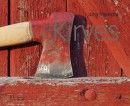 Kirves
[The axe]
Helsinki: Maahenki, 2009. 207 p., ill.
ISBN 978-952-5652-74-1
€ 44, hardback
This book by Juha Maasola, a forestry protection officer, provides an economic, cultural and social history of the axe from prehistoric times to the present day. The axe was the sole implement used for felling trees in Finland up until the turn of the 20th century. Most Finnish men still know how to chop their own wood for the sauna, while one axe model produced by Fiskars has won awards for outstanding product design. This impressively illustrated work also explains the techniques and history of forestry and logging. In the 1940s, wartime ‘woodcutting bees’ united the Finnish nation, with women picking up their axes and joining in. Buildings have traditionally been constructed from wood, and builders had to be handy with a hatchet. This skill gave carpenters their name in Finnish: kirvesmies – literally, ‘axeman’. A list of over 300 Finnish-language terms meaning ‘axe’, gleaned from the archives of the Research Institute for the Languages of Finland, is included. The book concludes with a look at portrayals of the use of axes in Finnish literature, film and art.
Ruminations
16 April 2010 | Authors, Reviews
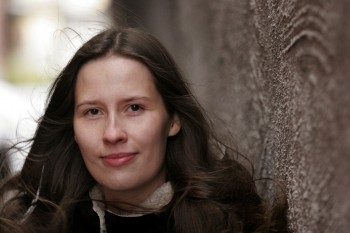
Vilja-Tuulia Huotarinen. Photo: Heini Lehväslaiho
One of the most exciting features of Finnish poetry since 2000 has been the wealth and breadth of poetry by young women. Compared to literature written by women in earlier decades, contemporary poetry appears to have freed itself from one-track feminism and knotted brow earnestness to become a literature with a richer approach to womanhood, its forms and history.
The first collection by Vilja-Tuulia Huotarinen (born 1977), Sakset kädessä ei saa juosta (‘You mustn’t run with scissors in your hand’, 2004) was a glimpse into the culturally restricted but nevertheless autonomous world of young girls. Mother’s instructions and Father’s advice will be broken down as one grows up; in spite of the genderised system, it is still possible for a young woman to make her own choices. More…
Tomi Kontio: Viidakon kutsu [The call of the jungle]
12 February 2010 | Mini reviews, Reviews
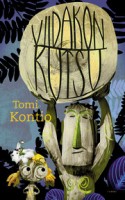 Viidakon kutsu
[The call of the jungle]
Helsinki: Tammi, 2009, 240 p.
ISBN 978-951-31-5042-6
16.20 €, hardback
Poet and author Tomi Kontio’s book for young teenagers is a take-off of the boys’ adventure story and fantasy novel, a genre he has used in the past. But Kontio leads 12-year-old Alma and Alpo into the jungle… of eastern Finland – the backwoods of Kainuu, to be precise. There they meet the Vimbas, a tribe living in harmony with nature, who teach them many important lessons. Kontio succeeds in combining his two narrative talents: he doesn’t underestimate the value of lively and lyrical language to his target audience, and he entertains his readers with fabulations that mix the rational and the absurd into a cohesive whole. Viidakon kutsu is a portrait of a world that is considerably brighter than in Kontio’s previous books for young readers.
Linnut vauhdissa [Birds caught in motion]
18 December 2009 | Mini reviews, Reviews
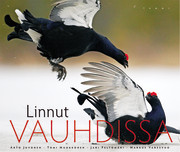 Arto Juvonen & Tomi Muukkonen & Jari Peltomäki & Markus Varesvuo
Linnut vauhdissa
[Birds caught in motion]
Helsinki: Tammi, 2009. 191 p., ill.
ISBN 978-951-31-4605-7
€ 39, hardback
Linnut vauhdissa features the work of several specialist bird photographers, contains astonishingly sharp photos of birds caught in mid-flight. This book breaks with convention by presenting surprising analogies and juxtapositions of photographs, thereby providing a more in-depth viewing experience than mere biological facts and identification of species. The majority of the photos were shot in Finland, where the Nordic light and winter snow offer unique qualities for nature photography. The preface was written by Hannu Hautala, arguably Finland’s best-known nature photographer. All of the photographers whose work is presented here are experienced birders. They also maintain a website that attracts many visitors, both from Finland and abroad.
Maria Turtschaninoff: Arra. Legender från Lavora [Arra. Legends from Lavora]
12 February 2010 | Mini reviews, Reviews
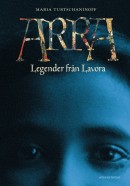 Arra. Legender från Lavora
[Arra. Legends from Lavora]
Helsinki: Söderströms, 2009. 251 p.
ISBN 978-951-52-2604-4
19.90 €, hardback
Legender från Lavora by Maria Turtschaninoff (born 1977) is limpid and leisurely in tone, yet the story of Arra, a girl from a poor family, is intense, tragic and original. Because she is mute, Arra is thought to be feeble-minded, and thus of no value to her family. She becomes, in fact, an ‘invisible child’ – the author’s reference to neglected children of the present day. The girl uses a special power to compensate for the contempt of those around her: she binds herself in living connection with nature, which leads her in the end to glory and honour. Because of Arra’s long period of muteness as she enters her teens, dialogue is a very small portion of the book. The narrative may be challenging for young readers, but the vivid love story of Arra and Prince Surando has an irresistible, magical enchantment.
Night of the Living….
5 September 2013 | In the news
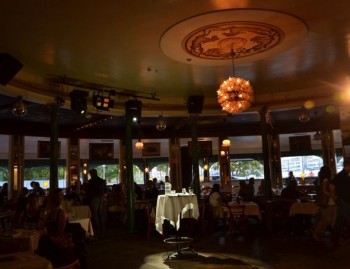
Poetry in focus: Kaisaniemi Restaurant, Helsinki, 24 August. Photo: Irene Dimitropoulos
…Poets was the main event of the annual literature festival Runokuu, Poetry Moon, taking place on 24 August in a Helsinki restaurant. The theme was the sea: the invited guests were from around the Baltic Sea – as well as beyond.
The Poetry Moon festival is organised by Nuoren Voiman Liitto and Helsinki Festival, now for the ninth time, with more than 30 events taking place in the city between 22 and 28 August.
‘In four hours writers and languages kept changing fast,’ reports Irene Dimitropoulos, an intern at FILI (Finnish Literature Exchange): ‘You had to throw yourself into the rhythms and sounds of languages both familiar and strange.
‘The programme contained lots of poetry, but the short story and non-fiction were also included. The idea of the literary evenings is to meet with writers from abroad and also to support translated foreign poetry, as very little gets translated into Finnish, so translators perform with poets.
‘The stylistic and thematic variations of different generations of writers were introduced in many ways. A translation of I Am Going to Clone Myself Then Kill the Clone and Eat It [2009/2012] by the American poet Sam Pink was published in Finnish earlier this year: his style, both simple and strikingly comical, and the way he depicts everyday experiences and the violent fantasies they invoke, made the audience laugh. Crowds were also drawn to listen to the Finnish novelist Monika Fagerholm and the German poet and translator Ulrike Draesner; Fagerholm read from her book of lyrical essays on the sea, Draesner her poems dealing with womanhood and the interaction between language and body.’
Among the other poets were Peeter Sauter and Maarja Kangro from Estonia, Igor Belov and Irina Maksimova from Russia and Toh Hsien Min from Singapore.
Seita Parkkola: Usva [Mist]
29 January 2010 | Mini reviews, Reviews
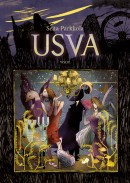 Usva
Usva
[Mist]
Kuvitus: [Ill. by] Jani Ikonen
Helsinki: WSOY, 2009. 375 p.
ISBN 978-951-0-35352-3
19.70 €, hardback
Usva, the 13-year-old protagonist of Seita Parkkola’s novel of the same name, is unusually tall. From her height, she can see farther and more clearly than other people. Usva is a coming of age story in a minor key, its melancholy underlined by Jani Ikonen’s dark black and white illustrations. The images ooze with romantic dereliction, run-down buildings, storm-driven tree limbs, fish on dry land gasping for air. The illustrations are a good example of the visual world brought to life by the success of Japanese manga. Parkkola aptly describes the painful aspects of puberty from the point of view of both the child and the parent. She adds an air of mystification to the age of 13, which she sees as a turning point between childhood and adulthood. The novel can be read as a vision of the near future, of the disintegration of societal support, the increasing fragility of parenthood. Childhood’s end arrives at an ever younger age, and adulthood is entered with a leap, eyes open, without parental support to guide a child into her own adulthood.
Mirkka Lappalainen: Susimessu – 1590-luvun sisällissota Ruotsissa ja Suomessa [Wolf Mass. Civil war in Sweden and Finland in the 1590s]
4 June 2010 | Mini reviews
 Susimessu – 1590-luvun sisällissota Ruotsissa ja Suomessa
[Wolf Mass. Civil war in Sweden and Finland in the 1590s]
Helsinki: Siltala, 2009. 319 p.
ISBN 978-952-234-016-0
€32, hardback
Sweden at the end of the 16th century was riven by struggles for power: the opponents were the Protestant Duke Charles and Sigismund, King of Poland and Sweden, a strong supporter of the Counter-Reformation in the Nordic lands. A peasant uprising that came to be known as the ‘Cudgel War’ was underway in Finland – then part of the kingdom of Sweden. This book recounts the dramatic history of that civil war and, in line with current interpretive methods of historical research, explodes some popular myths that have been built up around these events. Mirkka Lappalainen has gained recognition as a bold writer who skilfully combines micro- and macro-level history. She characterises Sigismund, whom the Vatican supported to no avail, as a ‘melancholy, absent-minded vacillator, who preferred to play music.’ Lappalainen provides a fascinating alternative historical interpretation of what would have happened if the Vatican’s plans to wrest Finland away from Sweden and unite it with Poland had come to fruition.
Survival games
9 October 2009 | Authors, Reviews
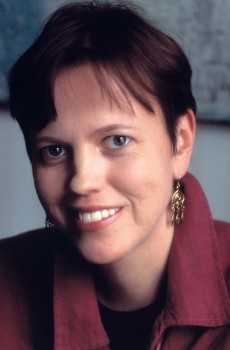
Sari Malkamäki. - Photo: Irmeli Jung
Fathers and sons, mothers and daughters in Sari Malkamäki’s new short stories
The relationship between parents and children is the central theme of Sari Malkamäki’s fifteen new short stories. She published her first collection in 1994; in Jälkikasvu (‘Offspring’, Otava, 2009), her tenth book, the few stories in which children don’t appear nevertheless allude to childhood experiences or to a child who sets the narrative in motion.
The point of view may be that of the child or of the parent, the focus of description some moment that forms a turning point in the characters’ circumstances, or even in their lives. Malkamäki’s children are often touchingly resourceful and brave, even when their adults fail them. More…
New from the archive
30 April 2015 | This 'n' that
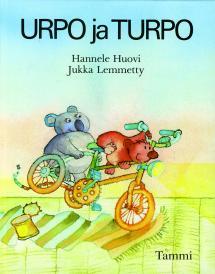 The first of Hannele Huovi’s much loved Urpo ja Turpo (‘Urpo and Turpo’) books – featuring two little bears, the grey, bob-tailed Urpo, who likes flowers, and Turpo, the grey, intrepid adventurer – appeared in 1987.
With comically characterised illustrations by Jukka Lemmetty, these vignettes cast a philosophical light on life as seen from a small child’s viewpoint, whether the subject is monsters at bedtime, what to play on a rainy day, using the family dog as a sailing ship or learning good manners.
Hannele Huovi (born 1949) won the prestigious Eino Leino Prize in 2009. Her work has been translated into Swedish, Danish, Norwegian, Estonian, German, Japanese, Russian and Arabic.
Sirpa Kivilaakso: Satukuningatar Anni Swan [Anni Swan, the queen of storytelling]
7 May 2010 | Mini reviews, Reviews
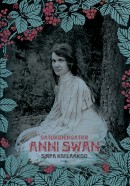 Satukuningatar Anni Swan. Elämä ja teokset
[Anni Swan, the queen of storytelling. Her life and works]
Jyväskylä: Atena, 2009. 275 p., ill.
ISBN 978-951-796-561-3
€ 32, hardback
Anni Swan (1875–1958) was a writer, translator and editor of children’s magazines. Her symbolic tales utilise her highly original language of sensory imagery. Swan’s symbolism is rooted in the golden age of Finnish arts at the end of the 19th century. The pre-eminent setting for Swan’s stories is the Finnish forest. Her ‘eco-criticism’ of practices that exploited the natural environment can be seen as radical for her time. Swan is also considered to be the first true writer of books for young people in Finland. Her stories about upper-class characters who overcome obstacles emphasise the class conflicts and other injustices of their day, yet they have remained popular into the 21st century. This book, based on Sirpa Kivilaakso’s doctoral thesis on Swan’s fairy-tale symbolism, presents a biography of the author, with supporting extracts from her books, diary entries and letters.
What Finland read in April
14 May 2010 | In the news
In April Sofi Oksanen’s best-selling novel Puhdistus, Purge (winner of the Finlandia Prize for Fiction in 2008, WSOY, and now available in English translation) was top of the best-selling Finnish fiction list again. Quite an achievement.
Finns seem to be besotted with Pertti Jarla’s comic books: three of them, set in the weird city of Fingerpori (‘Fingerborg’, Arktinen Banaani), were on the list.
The final volume of artist and writer Hannu Väisänen’s fictionalised autobiography, Kuperat ja koverat (‘Convex and concave’, Otava, 2009), was number five on the list. Number three was a newcomer, Tumman veden päällä (‘On dark water’, Tammi), also an autobiographical novel about childhood, by the the actor Peter Franzén.
Names appearing high on the foreign fiction list in April included Child Lee, Dan Brown, Falcones Ildefonso, Liza Marklund, Pamuk Orhan and W.G. Sebald.
Archives open!
12 December 2014 | This 'n' that
Illustration: Hannu Konttinen
For 41 years, from 1967 to 2008, Books from Finland was a printed journal. In 1976, after a decade of existence as not much more than a pamphlet, it began to expand: with more editorial staff and more pages, hundreds of Finnish books and authors were featured in the following decades.
Those texts remain archive treasures.
In 1998 Books from Finland went online, partially: we set up a website of our own, offering a few samples of text from each printed issue. In January 2009 Books from Finland became an online journal in its entirety, now accessible to everyone.
We then decided that we would digitise material from the printed volumes of 1976 to 2008: samples of fiction and related interviews, reviews, and articles should become part of the new website.
The process took a couple of years – thank you, diligent Finnish Literature Exchange (FILI) interns (and Johanna Sillanpää) : Claire Saint-Germain, Bruna di Pastena, Merethe Kristiansen, Franziska Fiebig, Saara Wille and Claire Dickenson! – and now it’s time to start publishing the results. We’re going to do so volume by volume, going backwards.
The first to go online was the fiction published in 2008: among the authors are the poets Tomi Kontio and Rakel Liehu and prose writers Helvi Hämäläinen (1907–1998), Sirpa Kähkönen, Maritta Lintunen, Arne Nevanlinna, Hagar Olsson (1893–1979), Juhani Peltonen (1941–1998) and Mika Waltari (1908–1979).
To introduce these new texts, we will feature a box on our website, entitled New from the archives, where links will take you to the new material. The digitised texts work in the same way as the rest of the posts, using the website’s search engine (although for technical reasons we have been unable to include all the original pictures).

By the time we reach the year 1976, there will be texts by more than 400 fiction authors on our website. We are proud and delighted that the printed treasures of past decades – the best of the Finnish literature published over the period – will be available to all readers of Books from Finland.
The small world of Finnish fiction will be even more accessible to the great English-speaking universe. Read on!
Tuomas Kyrö: 700 grammaa [700 grams]
12 November 2009 | Mini reviews, Reviews
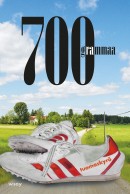 700 grammaa
[700 grams]
Helsinki: WSOY, 2009. 379 p.
ISBN 978-951-0-35601-2
€ 30, hardback
The genre of the picaresque novel is doing well, and one of its foremost exponents in Finland is Tuomas Kyrö (born 1974). The plot of his ingenious first novel, Nahkatakki (‘Leather jacket’, 2001), revolved around a jacket that moves from one owner to another. His later novels maintain this comical tension, but with a deepening of themes and a more sober outlook. Liitto (‘Union’, 2005) portrayed people scarred by war, while Benjamin Kivi (2007, featured in Books from Finland 4/2007) retold Finland’s history in a light-hearted and anachronistic manner. 700 grammaa is a book about sports fever and family relationships, the exploration of love and the pursuit of dreams. The main character is a boy who at birth weighs only 700 grams, and whose father vows to perform a seven metre long-jump if his son survives. He does, and the father has to devote his life to this almost impossible sporting achievement This novel, with its fast-developing plot and varied narrative techniques, is a paean to the heroism latent in mediocrity.
Memory in my hands
19 August 2010 | Fiction, poetry
A couple of years ago Timo Harju chose the non-military alternative to national service and was detailed to work at an old people’s home. Its director warned him that its inhabitants were ‘no sweet old grannies and grandpas’. Harju thought this might be a joke. In his first collection of poems, entitled Kastelimme heitä runsaasti kahvilla (‘We watered them abundantly with coffee’, Ntamo, 2009), he patiently gathers fragments of dreams and fears, memories and forgotten songs in the house of oblivion, treating them with gentle empathy. Commentary by Pia Ingström
Ward A5, Thursday
The clouds in the nursing home corridors, sky-open springlike after a bathe
and forgotten, in a frayed blue dressing-gown beside an osiery.
The grannies in the nursing home corridors, the last beautiful pride
you keep in a small wooden box behind your forehead:
if the lid opens by accident all the things may drop to the floor
topsy-turvy you won’t be able to find them, your back won’t let you
you won’t recognise them any more even if you do,
the springtime tears your insides to pieces.
Here they come, the grannies.
Better to stay here indoors, the journey to the dining room is a rough one
exposed like this
a long way and all by sleigh.
You stare at the keyhole: the clouds are coming. More…