

Search results for "tommi+musturi/2010/05/song-without-words/2009/09/what-god-said"
The prisoner and the prophet
30 June 1997 | Archives online, Fiction, poetry
Poems from Timmermannen (‘The carpenter’, Söderströms, 1996). Introduction by Jyrki Kiiskinen
The greatest message
Reader, love is
a secret, waiting
for wind, not a choice
between loving or not.
As commandment, degraded
to demand, it will soon be
fanatic like a wound,
a form of hate. How
could a secret
become reality
without dying? Every
decree destroys its region. Made a law
goodness turns
into the protecting
skin, with which the good
touches everything. A demand
for understanding, that,
which we call wisdom,
makes of wisdom
an armour, a cold
father around us.
The real communication is
his life. Against evil stands
the tale of a face.
How could such a secret
become real
or die? More…
Jarkko Laine Prize 2011
1 June 2011 | In the news
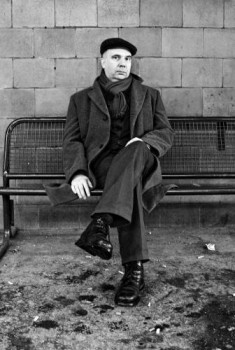
Juha Kulmala. Photo: Lotta Djupsund
The Jarkko Laine Literary Prize (see our news from 6 May), worth €10,000, was awarded to Juha Kulmala (born 1962) on 19 May for his collection of poems entitled Emme ole dodo (‘We are not dodo’, Savukeidas, 2009).
The prize is awarded to a ‘challenging new literary work’ published during the previous two years. Shortlisted were also two novels, Kristina Carlson’s Herra Darwinin puutarhuri (‘Mr Darwin’s gardener’, Otava, 2009) and Erik Wahlström’s Flugtämjaren (‘Fly tamer’, Finnish translation Kärpäsenkesyttäjä, Schildts, 2010).
Jarkko Laine (1947–2006) was a poet, writer, playwright, translator, long-time editor of the literary journal Parnasso and chair of the Finnish Writers’s Union.
Late summer in Tulavall
30 September 1990 | Archives online, Children's books, Fiction
An extract from Mattan från Kars (‘The rug from Kars’). Introduction by Tuva Korsström
Mother Limberg and Apelman’s Anna Lina were sitting together on the steps up to Mother Limberg’s cabin in Mickelgård Street in Tulavall. They were mourning. They were grieving for the old army captain, Alexander Grunnstedt, who had fought in the Caucasus in his youth, had lived alone in the Limberg’s gable room in his old age and then had lost his way in the forest, had a heart attack and been carried off in his coffin by his daughter-in-law.
It was late summer and sunny weather.
‘She could’ve had him buried here,’ said Mother Limberg.
‘She thought it too simple here,’ said Anna Lina. More…
Oink oink
23 June 2011 | This 'n' that
 Naturally, here at Books from Finland, we’re keen to use the internet for serious (or not so serious) reading, but at the other end of the scale Finns are garnering considerable success in the world of smartphone games.
We don’t like to blow our collective trumpets, but it’s a little-known fact that the phone game Angry Birds, with birds and pigs in the starring roles, is actually Finnish, developed in 2009 by a company called Rovio. As the Helsinki freesheet Metro (31 May) notes, Angry Birds has been downloaded more than 200 million times on different devices since its launch in December 2009.
What is the secret of Angry Birds’ success? ‘I like it because it doesn’t really have any rules and you never know exactly what’s going to happen next,’ says our young reviewer Sophia, 9; her sister, Tia, 5, says ‘I like it because you get to shoot in it.’ To judge by the amount of time they spend playing Angry Birds, they like it a lot.
And how did Angry Birds come about? ‘At the beginning of 2009 our design group went through a number of different options,’ Rovio’s communications director Ville Heijari tells Metro. ‘One of them was angry-looking birds, and everyone fell in love with them right away.’ And what does Heijari himself like best about the game? ‘Definitely the fact that when you make a mistake, the pig laughs at you. That really makes you want to try again.’
In the pipeline is an Angry Birds movie, plus further development of the game itself. ‘So far the world has only seen an glimpse of the birds’ world,’ says Heijari.
Who for? On new books for children and young people
29 January 2010 | Articles, Non-fiction
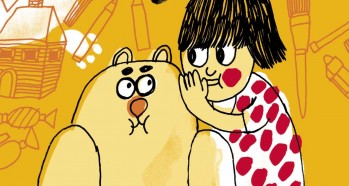
Secrets: an illustration by Aino-Maija Metsola from Minä ja Muro (‘Me and Muro) by Mari Kujanpää
Books have a tough time in their struggle for the souls of the young: more titles for children and young adults than ever before are published in Finland, all of them trying to find their readers. Päivi Heikkilä-Halttunen picks out some of the best and most innovative reading from among last year’s titles
Nine-year-old Lauha’s only friend and confidant is her teddy bear Muro, because Lauha is an outsider both at home and at school. The children’s novel Minä ja Muro (‘Muro and me’, Otava), which won the 2009 Finlandia Junior Prize, provoked discussion of whether it was appropriate for children, with its oppressive mood and the lack of any bright side brought into the life of the main character in its resolution. More…
Nothing but light
30 December 2003 | Fiction, poetry
Prose poems from Huoneiden kirja (‘A book of rooms‘, Otava, 2003)
The ladies’ room
Behind the shining mirror twin girls are squealing, they disappeared inside the walls long ago. They had plaits, red pompons, bad moods – all of them moulded and twisted by wire coathangers from the very start. They gouged the house full of passageways, they hollowed out the paper walls with silver christening-spoons. They disappeared between the stairs on the staircase, saying: evil’s a gateway onto a void with hundreds of gateways inside. Now they’re in this room, behind this mirror. Now the sun’s rising over the firtree-tops, creeping step by step higher towards the overarching sky. Inside us there are two hundred girl-embryos, the girls shout, they’re handicrafts fashioned by themselves like us: out of pearls, blood, splinters of mirror, it’s these we were made of. If you don’t find us, you’ll not sleep a single night. Until you do you’ll wander about the house, astray with each memory, until your hands are thinner than your words, the days slenderer than your hands. More…
The sea so open
30 September 2008 | Archives online, Fiction, poetry
Poems from Delta (Teos, 2008). Introduction by Jukka Koskelainen
Like wave-polished stones
we sit on a seashore rock, shading our eyes
from the sun, each other, the deltoid sails, the water.
You ask nothing more,
you know the sum of the angles of a triangle,
that you have your sides, as I do
sometimes they near each other
as if to penetrate each other, cut
a hole in the landscape.
A seagull settles on a crag,
without a glance aside, you’re up and disappear
from my side.
Sails, other sails.
the sea so open and the sky open. More…
When I’m ninety-four
14 November 2013 | Fiction, Prose
An extract from the novel Kuolema Ehtoolehdossa (‘Death in Twilight Grove’, Teos, 2013). Minna Lindgren interviewed by Anna-Leena Ekroos
At the Health Clinic, Siiri Kettunen once more found a new ‘personal physician’ waiting for her. The doctor was so young that Siiri had to ask whether a little girl like her could be a real doctor at all, but that was a mistake. By the time she remembered that there had been a series of articles in the paper about fake doctors, the girl doctor had already taken offence.
‘Shall we get down to business?’ the unknown personal physician said, after a brief lecture. She told Siiri to take off her blouse, then listened to her lungs with an ice-cold stethoscope that almost stopped her heart, and wrote a referral to Meilahti hospital for urgent tests. Apparently the stethoscope was the gizmo that gave the doctor the same kind of certainty that the blood pressure cuff had given the nurse.
‘I can order an ambulance,’ the doctor said, but that was a bit much, in Siiri’s opinion, so she thanked her politely for listening to her lungs and promised to catch the very next tram to the heart exam. More…
Kjell Westö: Gå inte ensam ut i natten [Don’t go out into the night alone]
23 October 2009 | Mini reviews, Reviews
 Gå inte ensam ut i natten
[Don’t go out into the night alone]
Helsinki: Söderströms, 2009. 604 p.
ISBN 978-951-52-2609-9
25 €, hardback
Finnish translation (by Katriina Savolainen): Älä käy yöhön yksin
Helsinki: Otava, 2009. 604 p.
ISBN 978-951-1-23833-1
25 €, hardback
This novel completes Kjell Westö’s Helsinki series and is his tenth book. As is the case with the three earlier books in this series (Drakarna över Helsingfors [‘The kites over Helsinki’], 1994, Vådan av att vara Skrake [‘The perils of being a Skrake’], 2000, and Där vi en gång gått [‘Where we once walked’], 2006, all also translated into Finnish) this is a character-driven, nostalgia-laden story that spans several decades. The central factor is music: in the 1960s three young people from different backgrounds become friends and record a single that ought to have been a huge hit, but because the song fades into obscurity, the circle of friends breaks up. In the latter part of the novel, a young man begins to investigate what became of the members of the trio and realises that his own life is linked to theirs. Westö (born 1961) writes remarkable experiential prose that brings the reader close to the characters. The retro setting may be a bit much for some: the avalanche of details feels rather excessive in places. Där vi en gång gått was awarded the Finlandia Prize in 2006. Another of Westö’s novels, Lang (2002), was published in England under the same title in 2005.
Across Europe
30 June 1990 | Archives online, Fiction, Prose
Mika Waltari (1908–1979) was a prolific writer, journalist and translator. In addition to historical novels, he wrote short stories, travel books, thrillers, plays, books for children, film scripts and poetry. The newly independent Finland of the 1920s, as it emerged from a traumatic period of civil war, declared that its windows were open to Europe, and Waltari’s first novel Suuri illusioni (‘The great illusion’), written in Paris when he was only 19, represents urban romanticism and the world of European capitals.The optimism and enthusiasm for modern life of the 1920s are strongly present in Waltari’s travelogue, Yksinäisen miehen juna, (‘Lonely man’s train’; 1929), an account, both ironic and engagingly naïve, of a great adventure in Europe after the post-1918 redrawing of the continent’s map. The book’s motto is a phrase from Paul Morand, a writer Waltari admired: ‘How is it possible to remain stationary when time slips like ice through our hot hands.’ This work of Waltari’s youth has never before been translated. The author travels by ship and train as far as Turkey; in the following extract, he has reached Hungary
Yksinäisen miehen juna (‘Lonely Man’s train’)
How adorable express trains are – the mighty engines, the rhythm of the rails, the sway of the carriages, the flashing-by of the milestones, the gravel embankments contracting into speeding lines. A train is the only place you can be completely at ease, free from heartache, free from longing, free from tormenting thoughts. Whenever I die, I hope it will be on a train flashing towards some unknown town at eighty miles an hour, with mountains looming on the horizon, and the points lighting up in the descending dusk…. More…
A perfect storm
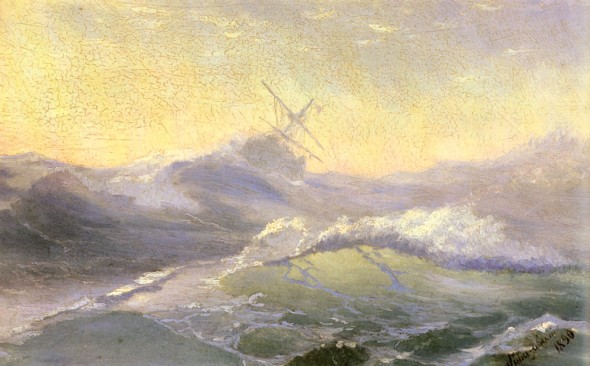
Bracing the waves. Ivan Aivazovsky, 1890.
According to Petri Tamminen, Finns are burdened by the need to succeed. Instead, he argues they should learn to fail better.
Part comedy, part tragedy, part picaresque novel, with a dash of Joseph Conrad – Tamminen’s new book, Meriromaani. Eräitä valoisia hetkiä merikapteeni Vilhelm Huurnan synkässä elämässä (‘A maritime novel. A few bright moments in Captain Vilhelm Huurna’s sombre life’, Otava, 2015) is set in an indeterminate seafaring past of the 18th or 19th century. It tells the story of the world’s most unsuccessful sea captain, Vilhelm Huurna who, one by one, sinks all the ships he commands.
Tamminen (born 1966) is a master of very short prose – this miniature novel is a a huge undertaking in the context of his work as a whole – and at Books from Finland we’re big fans. You can read more of his work here.
We join the story as Huurna, leaving behind him a failed romance in Viipuri, sets sail for Archangel, on the far north coast of Russia.

An excerpt from Meriromaani. Eräitä valoisia hetkiä merikapteeni Vilhelm Huurnan synkässä elämässä (‘A maritime novel. A few bright moments in Captain Vilhelm Huurna’s sombre life’, Otava, 2015)
The sun shone on the Arctic Ocean night and day, and the voyage went amazingly well, as did all the tasks and jobs that Huurna particularly feared beforehand.
Ships lay in Archangel harbour like objects on a collector’s shelf. They were waiting for timber cargo from the local sawmills where work was at a standstill because the mills lacked the machines and machine parts that they were now bringing them. When their cargo had been unloaded and the machines installed, timber began arriving from the sawmills. They found themselves at the end of the queue, and after the other ships had departed, one by one, they were still waiting in Archangel. That suited Huurna; in the first few days of his stay he had become acquainted with two English merchants and, through them, had received invitations to parties. He had stood in salons drinking toasts to the honour of this or that and made the acquaintance of some charming ladies into whose eyes he wished to gaze another time. He was quite moved by the whirl of this unexpected social life, and brightened at the thought that there was really nothing to complain about in his life apart from the fact that he happened still to be a bachelor. More…
Poems
30 June 1982 | Archives online, Fiction, poetry
Sirkka Turkka is among the most important poets who started their work in the 1970s. So far she has published five collections of poetry and one work in prose. ‘I speak of death when I mean to speak of life,’ writes Sirkka Turkka in one of the poems in her collection Mies joka rakasti vaimoaan liikaa (‘The man who loved his wife too much’, 1979). The theme of death is close at hand, too, in the previously unpublished poems printed below. Introduction by Arto Kytöhonka
1
Before death itself comes
it paints the pine boles red
around this house
It erects a moon in the sky, a luminous moon,
set on edge like an old dish
with the light enamel peeling off.
Onto this house, over which
night is now pleating.
And the house, in the veering waters, in the clinging waters,
is slowly preparing itself, quite by itself, for death. More…
Father
31 December 1980 | Archives online, Fiction, Prose
An excerpt from Laturi (‘The explosives expert’, 1979). Introduction by Pekka Tarkka
“It only took one good bash!” With tears in his eyes, chuckling and spluttering, Korppi, the sentimentalist, told the story of Linda’s love affair. Korppi hadn’t been an old codger then; like Chekov’s Versinin, he could have been dubbed the love-lorn major, although he was only a lieutenant for he had loved little Linda when he had been an officer guarding the refugees interned on Suursaari: interned not for their safety but for the protection of his country. “She loved getting parcels, oh yes, but she didn’t give a damn for me! And did I take what belonged to me?
Yes! No! I nibbled here and there but I never swallowed a whole bite … On the other hand, there were some who took a bite and swallowed it, one of them was called …”
“Selim!” shouted Enver.
Selim, that jelly. He was Korppi’s subordinate on guard duty, and had he known the other fellow had been flirting with Linda he would have killed her! But how could he have known? What took place under a clump of hills along a wooded lake shore… More…