

Search results for "tommi+musturi/2010/05/song-without-words/2009/09/what-god-said"

The bad and the ugly in the writing of Pentti Haanpää

31 December 1984 | Archives online, Authors
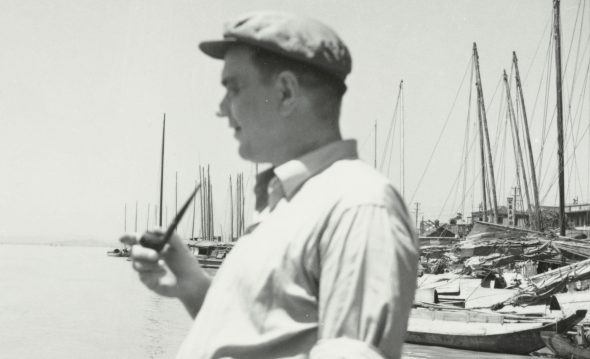
Pentti Haanpää

Pentti Haanpää. Photo: SKS Archives

Pentti Haanpää (1905-1955), author of ten novels and three hundred short stories, wrote about lumberjacks, woodsmen, crofters and smallholders; his individual style has established him as one of the most popular short story writers in Finnish literature.

The first full biography of Haanpää, by Vesa Karonen, Haanpään elämä (‘Haanpää’s life’), is to be published in January 1985 by Finnish Literature Society.

Haanpää’s strength as a writer is in his short stories. He is a man’s writer who writes about a man’s world: logging and other heavy manual work, hiking, war hunting, fishing, sport. His language, too: is masculine: rugged, sometimes rough, dense, laconic. Haanpää’s scale of emotions is wide and varied, but there is a bass note that is often sounded in his work. It is one of the characteristics that gives Haanpää’s work its particular stamp: his preoccupation with the bad and the ugly. More…

The house of the rising sun

30 June 1998 | Archives online, Fiction, poetry

Poems from Nousevan auringon talo (The house of the rising sun’, Tammi, 1997). Introduction by Jyrki Kiiskinen

Closeness. License to kill. And to go on living
         becomes impossible.
 When you see a waterfowl’s eyes, if you see them
         in the dark, that is the right distance.

Now the fire power of our forces consists of infantry arms.
         You are hard ammo exercises, controlled
 regression, kiss of a porcupine, flower
                   from the great gardener's garden, who
                          shall be killed nevertheless.
         The one who in every piss-stained jail cell tries
                   to inch his own death forward a little.
*  More...

Food for thought

31 March 2006 | Archives online, Articles, Authors, Non-fiction

Are thrillers the junk food of literature – or is there any haute cuisine in the genre of crime? And who cares anyway, if the books make you tum the page? Pia Ingström takes a look at some Finnish whodunits

Finnish crime fiction has kept itself largely free of the illusions of grandeur which have made the same genre in neighbouring Sweden begin to seem ever more pretentious and ridiculous. In the recent past, Sweden has exported blockbusters by Henning Mankell, Liza Marklund and Åke Edwardson to the international crime Fiction market, followed by a great flood of successors totally lacking in originality but presented as important literary contributions to some vaguely defined ‘contemporary debate’.

In Finland, detective stories and thrillers are sensibly treated simply as detective stories and thrillers crafted according to a recognisable formula, avoiding the sort of monstrosities characteristic of Sweden which mix scenes of brutal violence clearly intended as entertainment with claims to social relevance. Finnish crime novels tend to be less pretentious, and can sometimes happily surprise the reader by their high quality.

Take for example the flashy new doorstopper by Ilkka Remes, or a rather clumsily executed but at times bizarrely original private-eye story by Anja Angel, or a bittersweet tale of Russian-Karelian blood-and-crime-brotherhood by Matti Rönkä, or a feminist offering from Leena Lehtolainen. None of these makes any great claim to the status of art – they are honestly, at times brilliantly, crafted products of the genre that here and there reveal a glimpse of one or another of the true signs of real literature – originality, pain, and individuality – even if this is not necessarily presented with consummate technical skill.

Ilkka Remes’ thirteenth book Nimessä ja veressä (‘In the name and the blood’, WSOY, 2005) is strictly speaking the product of neither art nor craft so much as of a kind of industrial design. The writer’s name is a pseudonym and he makes very few public appearances, which perfectly matches the polished anonymity of his books. His themes are international terrorism, chemical warfare and political conspiracy. His plots teem with extra-powerful secret agents from a variety of security services, and he seasons the mix with a dose of competently researched local colour. In his latest offering, Nimessä ja veressä, the story moves be­tween fundamentalist Christians in the Bible belt of northern Finland, entrepreneurs in the tourist business, and the deserts of Iraq. Its action scenes are more convincing than those in some of his earlier novels in which a surfeit of heavy artillery, explosives and scrap metal sometimes confused the picture and made it difficult to understand which of the characters survived (not that knowing this was necessarily of vital importance). Reviewers have not praised Remes for creating interesting characters. But since his latest offering has sold 119,000 copies – an astonishing number and the highest figure among last year’s bestselling books in Finland – who cares if his books don’t exactly lead the field in psychological insight?

The success of the Da Vinci Code has proved that God, Jesus and all that is hot stuff these days, and Remes surfs the trend skilfully. His main character, a Bible scholar from the dark winters of the far north, is on the trail of something unique that has cast new light on the Dead Sea Scrolls, St Thomas’s Gospel and some discoveries in Qumran and attracted the attention not only of her old schoolmates and sisters-in-belief in the northern village of Pudasjoki but of the Israeli intelligence service Mossad, too. The discoveries are then lost.

Now that he has a religious subject safely under his belt, Remes is already no doubt well advanced with his research into the avian flu pandemic that is now on its way to us.

The novels of Leena Lehtolainen are as easy to classify as the thrillers of Remes: socially-and gender-sensitive detective stories with wholesome human interest. Her plot construction is a little uneven – sometimes her motives and characters are believable, at others they seem forced. There is not much to say about her literary style – but for whatever reason, like many other people (her most recent book sold 50,000 copies in 2005). I have read all her crime novels with profit. In recent years she has alternated between a series built round the police officer Maria Kallio, and other novels in which violent crime within intimate family relationships is seen from a grassroots perspective. Possibly her family novels – Tappava Säde (‘Lethal Ray’), Kun luulit unohtaneesi (‘When you thought you’d forgotten’) and Jonakin onnellisena päivänä (‘One happy day’; Tammi) are her best, with their interesting prickly characters and greater feeling for sorrow and suffering.

However, Inspector Maria Kallio brings to the novels in which she appears a pleasant stability and fullness. Her children have now been born and her career is firmly established, but marriage complications remain and a little whiff of predictability is beginning to creep into the domestic scenes, something the reader can often identify with. Lehtolainen is quick to react to topical subjects. In her thirteenth novel Rivo Satakieli (‘Naughty Nightingale’, 2005), a prosperous prostitute is murdered as she is about to enter a television studio to take part in a live talk show. Just before this one of her associates, a young Ukrainian woman, is found on a forest path wearing nothing but a fur coat and boots with stiletto heels with her genitals brutally slashed. And one of Kallio’s female underlings, who has problems with female solidarity, becomes involved in shady business while planning her career.

If Lehtolainen is perhaps excessively politically correct from a feminist point of view, Anja Angel leans firmly in a trendier direction. Laitinen, Angel’s fat and ferocious female private detective and Laitinen’s assistant Marco in Marokkolainen makeinen (‘A Moroccan sweetmeat’, Otava, 2oo4) are both in their way queer and the relationship between them is described with warmth and sympathy, even playfully. Marco becomes rather lice besotted with a young Moroccan he’s supposed to be shadowing; their interaction is much more interesting than the strained plot. Angel is pleasantly different.

Matti Rönkä works as a news editor for Finnish television and has written three books centred on businessman and fixer called Viktor Kärppä. In Ystävät kaukana (‘Friends far away’, Gummerus, 2005), Rönkä’s fantasies of conspiracy have an altogether different and more intimate international flavour than those of Remes. Rönkä’s subject is what is popularly known in Finland as ‘eastern crime’, which includes everything from shady everyday business deals involving fake icons and old fridges to prostitution, drugs and contract murder.

Rönkä’s hero Viktor Kärppä belongs to the category ‘returning emigrant by grace of Koivisto’, i.e. he’s one of those former Soviet citizens of more or less Finnish stock who after the fall of the Soviet Union were granted Finnish citizenship and the right to ‘return’ to a homeland where they had never lived and whose language they couldn’t speak, by the President of the time, Mauno Koivisto (in office 1982­–94). Kärppä has built up a respectable building business in Finland. The sources of his original capital may not bear close inspection, but he no longer has links with drugs and prostitution, lives with a steady partner in a house of their own, and is determined to keep any unpleasant tastes or smells well away from his middle-class Finnish suburb. One day he gets an unwelcome visit from two well-dressed Russian gangsters who scare the wits out of his confused secretary and burn down his house. Someone is about to take over his firm, and it’s high time to find out who.

Rönkä’s two earlier Kärppä books, Tappajan näköinen mies (‘The man who looked like a killer’) and Hyvä veli, paha veli (‘Good brother, bad brother’) are somewhat hampered by tangled plots and a confusing cast of characters. Ystävät kaukana has a better balance between narrator and action, and the course of events is easier to grasp. Rönkä likes his principal characters. He manages to give them personality and individual dialogue, even feelings. The story is a sort of combination of melancholy road movie and picaresque novel, though normal human affections find a place in it too. The evil is not metaphysical but everyday, and the base human motives that lead to crime and deceit sit extremely well within the greater framework.

The border between Finland and Russia is one of the sharpest frontiers between prosperity and poverty in Europe, even in the whole world, and has long been a setting for undercover transactions. Rönkä presents this world with imagination and ingenuity through the story of this small-scale criminal, and the background is thoroughly researched and presented without fuss. Ystävät kaukana is a much smarter, warmer and more truthful book than it claims to be.

But no brief overview of Finnish crime fiction would be complete, however, without a mention of Matti Yrjänä Joensuu. After a career as a policeman spanning three decades and 11 novels, he is still writing though he publishes infrequently and is periodically afflicted by writer’s block. His more recent books have increasingly slipped into a kind of muffled, melancholy prose not normally associated with detective stories and thrillers. In fact, Harjunpää ja rakkauden nälkä (Harjunpää and the hunger for love’, Otava 1993) and Harjunpää ja pahan pappi (Harjunpää and the priest of evil’, 2003) are really meditations over various kinds of major deprivation, whether specifically within the family or the wider society, or more generally and existentially.

Concrete features – parts of dead bodies, crime scenes, victims and wrongdoers alike – have a marked tendency to blend into heavy metaphors for evil, want and suffering, though simultaneously preserving their original concrete quality. No one who has read Harjunpää ja pahan pappi will ever again be able to travel on the Helsinki Metro without being aware of the mysterious potential menace of the underground tunnel system and the shabby lives of those who live in it and never really belong to the daylight world.

Two of Joensuu’s book have been shortlisted for the Finlandia Prize. His concern with the requirements of the crime genre has diminished in inverse proportion to the growth of his obsession with affliction and deprivation. His innovative method of using trivial criminal material as a basis for heavily loaded symbols is literary in an individual and unpredictable way. None of the other books discussed here is unashamedly literary to the same extent.

If we were to arrange these samples of Finnish crime writing on a scale from the most formulaic to the most individual we should get: Remes – Lehtolainen – Angel – Rönkä, with Joensuu a few steps behind Rönkä, the most individual of all.

Remes’s writing is about as memorable as fish fingers, and one may well ask why any of us should be satisfied with such grub in a world that has oysters, goose liver and fresh aparagus to offer. For myself, I’m sure I could do without Remes for the rest of my life, and without fish fingers too.

But the safe comfort food of the intellect can sometimes contain surprises, so it would be rash to consider myself too fine for writers in this genre. Sometimes they have the courage to deviate from the standard recipe, and, losing themselves in some strange byway that really interests them, they may come up with something highly original.

Translated by Silvester Mazzarella

Eight novels by Matti Yrjänä Joensuu have been translated into 13 languages; his Harjunpää ja pahan pappi (‘Harjunpää and the priest of evil’, 2004) was published in England in 2006 by Arcadia Books, translated by David Hackston. Crime novels by Leena Lehtolainen have been translated into ten languages .The first translation of a thriller by Ilkka Remes, Ikiyö (‘Eternal night’, 2004), was published in Germany by dtv in 2005 under the title Ewige Nacht, translated by Stefan Moster.

An intimation of Paradise

31 December 1984 | Archives online, Fiction, poetry

Poems from Paratiisiaavistus (‘An intimation of Paradise’, 1983). Introduction by Pertti Lassila

Satu Salminiitty (born 1959) has published only one collection of poetry since her first appeared in 1981, but with these two volumes she has achieved considerable success. She writes with a fine rhetoric using language and rhythm that are far removed from those of spoken Finnish. Religious pathos has a prominent place in her work, and her poems often derive from praise, prayer or even magic incantations; Salminiitty is a creator of vision who trusts to her metaphysical intuition, a quality not generally discernible among today’s Finnish poets. Equally rare is her lively faith in the goodness and beauty of people and of the world. A conscious rejoinder to materialism, pessimism and fear of the future can be read in her poems. More…

Here, now

1 October 2012 | Extracts, Non-fiction
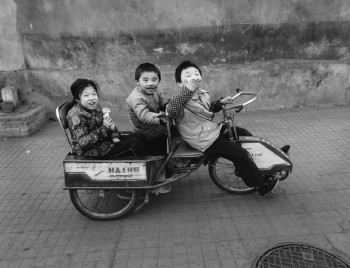
Beijing, China, 1989. Photo: Pentti Sammallahti

Photographer Pentti Sammallahti (born 1950) has travelled widely over six decades; his mostly black-and-white photographs portray humans, animals, cities as well as open landscapes, in Nepal, France, Kalmykia, the US, Morocco, Russia – in more than 40 countries. His beautifully executed retrospective work, entitled ‘here far away’, containing more than 250 photographs, is introduced by Finn Thrane


Here far away is a retrospective work that comprises nearly fifty years of photographic activity and unfolds in almost as many countries. Despite this, Pentti Sammallahti’s discreet title points to the paradox that the photograph always represents a here-and-now: an encounter in the exhibition or on the page of the book between artist and viewer, which is of course subject to the law of mutability, but constantly reflects the capacity of the two to enter into a dialogue, to extend the picture’s mirror of the past into the viewer’s present and future. More…

What makes a classic?

31 March 2004 | Archives online, Authors, Reviews

In the bicentenary year of Finland’s national poet, Johan Ludvig Runeberg, Pertti Lassila sets his work against the background of the country’s turbulent history

The fifth of February, birthday of Johan Runeberg (1804–1877), a Finnish poet who wrote in his native Swedish, was already a patriotic festival in the 19th century; lighted candles were set in the windows of the Grand Duchy of Finland. Late in the century, the custom became a silent protest against the measures which, in the opinion of Finns, represented Russian oppression and threatened the country’s autonomy. The candle tradition later moved to Finland’s independence day, 6 December.

When, in 1904, the centenary of Runeberg’s birth was celebrated, Russian pressure meant that this was a politically uncertain and dramatic period. A crisis developed when a Finnish student named Eugen Schauman, in the June of the same year, murdered the Russian governor general, Nikolai Ivanovitch Bobrikov, in Helsinki for political reasons. Runeberg’s centenary year gathered the nation around the poet who, more than any other in Finland, was the symbol of love of the country. The first systematic translation project for the rendering of Runeberg’s work into Finnish was also in progress. More…

L’Amour à la Moulin Rouge

30 June 2011 | Fiction, Prose

Extracts from the novella Yksin (‘Alone’, 1890). Introduction by Jyrki Nummi

After dining at the Duval on the Left Bank I take the same route back and drop in at the Café Régence to flick through the Finnish papers they have there.

I find my familiar café almost empty. The waiters are hanging about idly, and the billiard tables are quiet under their covers. The habitués are of course at home with their families. Anyone who has a friend or acquaintance is sharing their company this Christmas Eve. Only a few elderly gentlemen are seated there, reading papers and smoking pipes. Perhaps they’re foreigners, perhaps people for whom the café is their only home, as for me.

A little way off at the other end of the same table is a somewhat younger man. He was there when I came in. He’s finished his coffee and appears to be waiting. He’s restless and keeps consulting his watch. An agreed time has obviously passed. He calms himself and lights a cigarette. A moment later I can see a woman through the glass door. She’s hurrying across the street in front of a moving bus and running straight here. Now the man notices her too, and he cheers up and signals to the waiter for the bill. The woman slips through the door and goes straight across to him. They altercate for a moment, come to an understanding and depart hand in hand. More…

The price of a free lunch

31 December 1994 | Archives online, Fiction, Interviews

Eeva Joenpelto’s new novel, Tuomari Müller, hieno mies (‘Judge Müller, a fine man’), is the story of a good woman with a bad conscience, and of the small-town, big-business corruption of Finland in the 1980s. (Interview of EJ: 1994)

… the front door of the office building flew open. Men swept out and down the street, as fast-moving, garrulous and laughing as if it had been decided by vote in a council meeting. The entire width of the street was filled with the scent of vigorous, masculine deodorants: thyme, tarragon, gunpowder.

At the end of the 1980s, successful men smelt of gunpowder even in the Finnish boondocks: then, after all, money was on the move, whatever the business – bank management, whirlpool baths or local politics. This last seemed to move significantly closer to business life when the fast-moving and garrulous politicians organised a few benefits for themselves from the flowing stream of money, and no one saw fit to object. Yet. More…

Green gold, black gold

31 March 2001 | Archives online, Fiction, poetry

Poems from Jakutian aurinko (‘The Yakutian sun’; Tammi, 2000). Introduction by Kari Sallamaa

So this, then, is Tomsk,
a town, tumbling into snow.
Even its lanes rise up into the sky.
No longer fragrant the pine,
the juniper, not even the gardens.
Can’t trust the skirts,
above the rooftops,
stripes are beaten out of the carpet,
yellow and turquoise for the horizon,
under the rooftops, fingernails
rip the wallpaper,
those white frost fingernails.

So, this is Tomsk,
in its streets the Volgas zip by.
And when I get a ride, the back seat fills up in no time.
Breath steams, nylon rips. The ladies
apply lipstick, unconcerned. More…

Conversation pieces

31 March 2005 | Archives online, Authors

Maria Jotuni (1880–1943) was a master of dialogue, in prose and drama. Pekka Tarkka takes a look at her talents and introduces a short story from the 1920s

The Norwegian Nobel prize-winning writer Knut Hamsun admired the stories by the young Maria Jotuni and wrote to her: ‘Extraordinary, what a sure sense of form you have – but above all, your book is full of profound poetry…. My God, how beautifully and warmly you write about things which another might treat coarsely unpleasantly. I admire you.’

Both Jotuni and Hamsun belong to the same literary atmosphere as the fin de siècle Viennese masters of the erotic, Arthur Schnitzler et consortes. Joutuni’s masterly use of dialogue was at its most brilliant in those stories in which we do not hear the other party in the conversation at all. Jotuni used her dramatic skill in a number of plays, such as Tohvelisankarin rouva (‘The wife of the henpecked hero’, 1924), whose burlesque satire even today stirs the most conservative audiences to rage. More…

The dance of the living

30 June 1994 | Archives online, Fiction, poetry

From Dikter från havets botten (‘Poems from the bottom of the sea’, Söderström & Co, 1993)

Who was he that lived my life and now
is some Other? Who was the little boy
asking questions? Who the teenager asking
who the little boy was? The yellowing photo
remains, and the hand holding the photo. The photograph,
the hand, the image of the boy, the hand’s image. More…

Scenes from a marriage

31 December 2005 | Archives online, Authors, Reviews

Everything seems fine. A middle-class pastor’s family has found their place in the world. The holy family – husband, wife, and son – have been getting up for years without questioning the new day. But when the son leaves home, the coupIe’s thirty-year marriage soon goes flat like champagne left to stand in a glass overnight.

Pirkko Saisio’s novel Voimattomuus (‘Powerlessness’, WSOY, 2005) is not merely an ordinary family drama or love triangle story. It is an extraordinarily sharp analysis of the people of our time. Saisio (born 1949) is a writer and theatre professional who has no difficulty in building her various sets in such a way that the people she places in them have flesh and blood, and an economical dramaturgy courses through events. More…

Thrills ‘n’ spills

3 October 2011 | In the news
Thrillers occupied half the top ten spaces on August’s list of best-selling fiction titles in Finland, compiled by the Finnish Booksellers’ Association. Top place was taken by Leena Lehtolainen’s latest crime thriller, Oikeuden jalopeura (‘The lion of justice’, Tammi).

At number two was Kaari Utrio’s new historical novel, Oppinut neiti (‘Learned Miss’, Amanita), followed by Kari Hotakainen’s  Jumalan sana (‘God’s word’, Siltala).

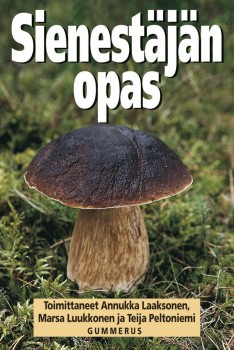
The non-fiction list reflected Finns’ passion for mushrooming. Since August, rain and warmth have worked wonders for friends of fungi: zillions of ceps, boletuses, chanterelles as well as poisonous specimens are abundant everywhere, so you’d better know which are safe to put into your pan. The top 20 list includes four guidebooks/cookbooks for those who love roaming in the forests and fields in pursuit of mycotic delicacies. The list was topped by Sienestäjän opas (‘Mushroom hunter’s guide’, Gummerus), which even beat the Finnish version of  Harry Potter Film Wizardy.

Love and war

31 December 2000 | Archives online, Authors, Reviews

Väinö Linna ‘s famous war novel, Tuntematon sotilas (The Unknown Soldier), was editorially censored, with the author’s agreement, on its first publication in 1954. But, as Pekka Tarkka discovers, the English translation that appeared three years later was outrageously falsified

Tuntematon sotilas (The Unknown Soldier) is a story about Finnish soldiers fighting Soviet forces in Second World War. When it came out in 1954, it immediately gained an almost incredibly important place in the hearts of Finnish readers: it sold 160,000 copies in the first year, it has been made into a movie twice, and over the years, it has been one of the steadiest sellers of Finnish literature, reaching a record figure of more than 600,000 copies. More…

All the grace

21 February 2013 | Fiction, poetry

Poems from Huhtikuu (‘April’, 1932), Sateen jälkeen (‘After the rain’, 1935), Hunnutettu (‘Veiled’, 1936), Kaukainen maa (‘Distant land’, posthumous, 1937; all published by WSOY). Introduction by Vesa Haapala

ON THE SHORE

The wonderful pale clouds
cross the sky like wings.
Quiet and enchanting
the open water sings.

The sand has grown weary
of the waves’ caressing play.
Now come in perfect quiet,
now come here, right away…

17.3.1930 More…