

Search results for "harjunpää/2010/10/mikko-rimminen-nenapaiva-nose-day"
On Erno Paasilinna
31 December 1978 | Archives online, Authors
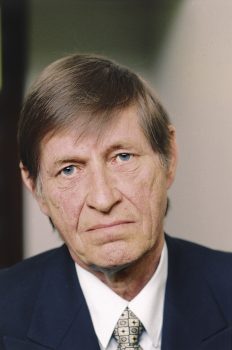
Erno Paasilinna. Photo: Irmeli Jung
In one of his essays Erno Paasilinna speaks of a modern phenomenon, the ‘quasi-author’. A quasi-author is the kind of literary buff who writes for the papers, takes part in congresses, sits in panels and appears frequently on television. Wherever there is controversy, be it over the function of the President, the legality of strikes, the abortion laws, the evangelical movement or the present state of lyric poetry, the quasi-author is invariably to be found. Paasilinna atones for his irony by freely admitting that he is himself a typical specimen of the breed.
For the concept of the quasi-author Paasilinna refers us back to Ilya Ehrenburg, who noted in his memoirs that the profession of authorship had been undergoing a steady diminution of social and political influence ever since the early 30s. Since Ehrenburg’s day the process has accelerated: television, efficient communications, and the ceaseless output of ‘information’ by what amounts to a major modern industry, have finally toppled the novelist from the throne he successfully occupied for so long. The quasi-author has replaced him, availing himself of all the new media in the hope of achieving a more rapid and direct impact on the public – and perhaps also of preserving the traditional influence of the writing fraternity. Erno Paasilinna was born in 1935 near Petsamo (now Pechenga) on the Arctic coast: from 1922 till 1944 this region was part of Finland. Evacuated during the upheavals of the Second World War, the family was forced to lead the nomadic life of refugees, wandering across the Arctic wastes as far as Norway before they were able to find a settled home in Finland. Erno Paasilinna has not rejected the landscape or the traditions of his native area: he has edited four anthologies of extracts from early accounts of travel in Lapland. It was in Northern Finland, too, that Paasilinna completed his education (he attended the Lapland College of Further Education) and began his writing career. More…
The light itself
31 March 2008 | Archives online, Essays, On writing and not writing
What should you do when writer’s block strikes? Lie down and wait for inspiration to return, Petri Tamminen suggests
All autobiographical depictions of writer’s block are fundamentally flawed and false. If you happen to be suffering from writer’s block, these accounts make for painful reading.
The wittier, more carefully crafted and closely observed an account the writer gives of his affliction, the more gut-wrenching it feels. It’s like treading water and preparing to drown and having to listen to someone in dry clothes standing on the deck of a ship recalling a close call he had back in the seventies.
On the other hand, when you’re suffering from writer’s block everything annoys you. Good books seem overwhelmingly good, so much so that you realise you can never achieve that level of greatness. Similarly, bad books seem so overwhelmingly bad that you wonder why anyone bothers reading books and realise that it’s pointless trying to write one. More…
Hearth, home – and writing
30 December 2007 | Archives online, Extracts, Non-fiction
Extracts from Fredrika Runeberg’s Min pennas saga, (‘The story of my pen’, ca. 1869–1877). Introduction by Merete Mazzarella
The joy and happiness I experience at being able to see into [her husband] Runeberg’s soul, at living with him in his heart and his thoughts, belong far too firmly to the mysteries of my soul that I should wish to attempt to express them in words. But of the life that existed around us I should like to try and give an impression of sorts.
We moved to Borgå in 1837. I was unfamiliar with the town and knew only a little old lady, weak with age, and found myself very lonely indeed, accustomed as I was to living with relatives and a genial circle of friends. I did, however, still have my two eldest sons at home to keep me happy and occupied. More…
The joy of work
24 October 2011 | Fiction, Prose
Short prose from Sivullisia (‘Outsiders’, Like, 2011). Introduction by Teppo Kulmala
Since I’ve been unemployed, I started a blog called Outsiders. It soon came to serve as work, and I became dependent on its benefits. Although describing being an outsider helped to anaesthetise me, and verbalising all of my afternoons didn’t even take up all my time, the feedback that came in was reward enough. I wouldn’t have taken any other reimbursement anyway because of the restrictions set on recipients of government benefits. Increasingly frequently I found myself longing for more. Even a short blog comment about being an outsider felt even truer than what I with my self-employed, jobless person’s competence was able to achieve in relation to being sidelined as an unemployed person, regardless of what kind of manager I had been in my previous life. When asking for more accounts of other people’s well-being, I wanted them to use their own names. I justified this because I did not want to read lies, which often come from and lead to chatter in cafés and on the web. Apart from the pure enjoyment of being present, using one’s own name – even in wrong-headed topics or notions – makes it easier to approach the harsh laws of the working world. When one knows that by using one’s own signature one is dragging one’s family into the mire, including those who have gone before and those yet to come, one is able to blaze trails along which one can outflank the passive to activate another, equally unemployed. I did not place any further requirements on the other commenters besides first name and surname, as the rules had been drawn up by professionals in their own field. The regulator’s work also requires skill, if not a tremendous craving, for damming up another flood of text so that one’s own advantages do not have a chance to dry up. To facilitate reading for myself and others, I introduced only a couple of restrictions, which I imagined that I, too, would be able to adhere to. Only one side of a sheet of A4 was to be used – that is, one page – and what people wrote had to be true. Truth, beauty and quality ensured that everyone would begin what they had to say by writing about their current work. More stories, anecdotes, even poems piled up than the law permits me to read – much less compile – during working hours. For this book I have selected only 157 stories from the Greater Helsinki area for the sake of efficiency. The faster you can read the work, the less time it will distract you from your main job. I chose to limit things to the capital area so that the stories about well-being from individuals linked to this place would seem to form a more integral work, or document at least, about what was happening in the Big H, the centre of the nation, at the start of the millennium. I will publish the tales of work from beyond the outer ring road at some later stage, if I manage to come to an agreement with the writers concerning intellectual property rights. More…
All the grace
21 February 2013 | Fiction, poetry
Poems from Huhtikuu (‘April’, 1932), Sateen jälkeen (‘After the rain’, 1935), Hunnutettu (‘Veiled’, 1936), Kaukainen maa (‘Distant land’, posthumous, 1937; all published by WSOY). Introduction by Vesa Haapala
ON THE SHORE
The wonderful pale clouds
cross the sky like wings.
Quiet and enchanting
the open water sings.
The sand has grown weary
of the waves’ caressing play.
Now come in perfect quiet,
now come here, right away…
17.3.1930 More…
About butterflies
30 September 2000 | Authors, Reviews

Photo: Charlotta Boucht
To think that it can be so cold in Cairo…
A woman sits there writing, and she feels cold. Her name is merely J; around her lie her mother’s posthumous papers. They look like a kaleidoscope. Beautiful formations succeed one another, but the picture is never fixed or unambiguous. Not until the day J is able to see something more than the enticing pictures in the kaleidoscope is she free. That day she stops feeling cold. That day she leaves Cairo in order to continue loving in Finland. More…
The path-walker
A short story from Sisustus (‘Interior decoration’, Tammi, 2000)
I do not know where I came from. Suddenly, I was just there. I stood on my feet. They support me. I look out of my eyes. I do not see them.
Sounds arrive in my ears. Moment by moment, I distinguish them better. I see the landscape through which I am walking. I distinguish the trees from each other. The path runs between them, and I stare at them, as if staring into a twilight that, when you look more closely, splits into trees, bushes, birds. I feel the roots through the soles of my shoes. I feel the softness of the moss, the pine-cones and the little stones. More…
Works in progress
30 September 2008 | Archives online, Essays, On writing and not writing
Olli Jalonen’s latest novel, 14 solmua Greenwichiin (’14 knots to Greenwich’, 2008), was 19 years in the making. He ponders the joys and tribulations of such a slow maturation
When you spend years or decades writing the same book, what is the drive, passion or compulsion that keeps the cogs turning through the quieter months? Or are the months when you don’t write silent at all? Isn’t it the case that the core of a text or a book is born out of a state of peaceful nothingness?
More often than not, the most important ideas, the strongest details and the sturdiest structures of the art of writing come into being somewhere other than at the computer keyboard. One of the greatest benefits and pleasures of a writer’s work is carrying that work around in mind and body. At these times the writing machinery is whirring, quietly, calmly, freely and unpressured. More…
The Last War Hero
31 March 1981 | Archives online, Fiction, Prose
An extract from 30-åriga kriget (‘The Thirty Years’ War’). Introduction by Markku Envall
First he heard the noise.
It was an unfamiliar noise and therefore doubly dangerous. Viktor grabbed his machine-pistol. It was a sputtering noise, like that of a cracked machine-gun. But it came from above. And what came from above could be dangerous, Viktor knew.
Then he saw the helicopter, flying just above the tree-tops. He had never seen a helicopter before. Nor had he ever seen the circular markings carried by the aircraft as a sign of the nationality. More and more nations were getting involved, he had had a visit from an American, for all he knew this might be a plane from Australia. The Russians must be in a tight corner if they had to keep sending their allies into the firing line.
He bitterly regretted having let the American sergeant get away.
Now they were after him in real earnest. It must have been the Yankee who had sent them.
Viktor directed a long burst of fire at the plane, which was now hovering almost motionless in the air, like a bee over a flower. The bullets shattered the roboter blades, splinters flew in all directions, and the helicopter dived at a steep angle and plunged into the lake. Viktor leapt to his feet and shouted “Hurrah!” and proceeded to execute a gleeful victory dance. He had shot down an enemy aircraft. More…
Is this all?
10 October 2013 | Extracts, Non-fiction
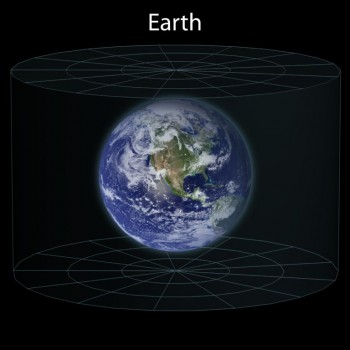
Earth. Andrew Z. Colvin/Wikimedia
In today’s world, many people find that it is not the lack of something that is problematic, but excess: the same goes for knowledge. According to professor of space astronomy, Esko Valtaoja, knowledge should contribute to the creation of a better world. His latest book is a contribution to the sum of all knowledge; over the course of two hundred pages Valtaoja delves deep into the inner space of man by taking his reader on a brief tour of the universe. Extracts from Kaiken käsikirja. Mitä jokaisen tulisi tietää (‘A handbook to everything. What everybody should know’, Ursa, 2012)
Whatever god you bow down to, you’re probably worshipping the wrong god.
The above is almost the only completely certain thing that can be said about religion, and even it does not encompass any deep truth; it’s just a simple mathematical statement. The world’s biggest religion is Roman Catholicism, which is confessed, at least nominally, by 1.1 billion people. If the Roman Catholic god were the true god, the majority of people in the world are therefore worshipping a false god. (According to the official stance of the Catholic church, the other Christian denominations are heresies, and their believers will be condemned to perdition: extra ecclesiam nulla salus. This inconvenient truth is, understandably, politely bypassed in ecumenical debate. But even if all those who call themselves Christians were counted as worshipping the same god, two thirds of the world’s population are still knocking at the wrong door.)
If you’re a religious person, don’t worry; I’m not blaspheming. And if you’re a campaigning atheist, hang on a minute: all I want to do is to find a clear and undisputed starting point to consider what it is we’re talking about when we speak of religion. More…
A perfect storm
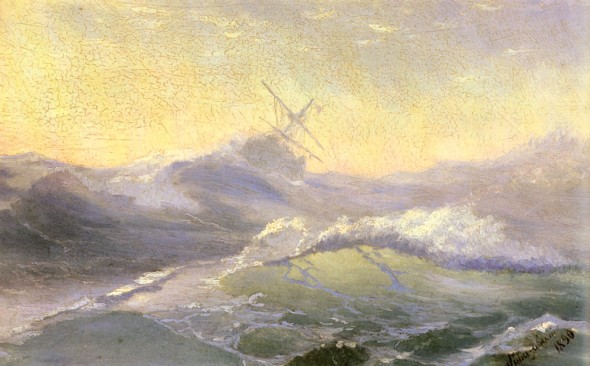
Bracing the waves. Ivan Aivazovsky, 1890.
According to Petri Tamminen, Finns are burdened by the need to succeed. Instead, he argues they should learn to fail better.
Part comedy, part tragedy, part picaresque novel, with a dash of Joseph Conrad – Tamminen’s new book, Meriromaani. Eräitä valoisia hetkiä merikapteeni Vilhelm Huurnan synkässä elämässä (‘A maritime novel. A few bright moments in Captain Vilhelm Huurna’s sombre life’, Otava, 2015) is set in an indeterminate seafaring past of the 18th or 19th century. It tells the story of the world’s most unsuccessful sea captain, Vilhelm Huurna who, one by one, sinks all the ships he commands.
Tamminen (born 1966) is a master of very short prose – this miniature novel is a a huge undertaking in the context of his work as a whole – and at Books from Finland we’re big fans. You can read more of his work here.
We join the story as Huurna, leaving behind him a failed romance in Viipuri, sets sail for Archangel, on the far north coast of Russia.

An excerpt from Meriromaani. Eräitä valoisia hetkiä merikapteeni Vilhelm Huurnan synkässä elämässä (‘A maritime novel. A few bright moments in Captain Vilhelm Huurna’s sombre life’, Otava, 2015)
The sun shone on the Arctic Ocean night and day, and the voyage went amazingly well, as did all the tasks and jobs that Huurna particularly feared beforehand.
Ships lay in Archangel harbour like objects on a collector’s shelf. They were waiting for timber cargo from the local sawmills where work was at a standstill because the mills lacked the machines and machine parts that they were now bringing them. When their cargo had been unloaded and the machines installed, timber began arriving from the sawmills. They found themselves at the end of the queue, and after the other ships had departed, one by one, they were still waiting in Archangel. That suited Huurna; in the first few days of his stay he had become acquainted with two English merchants and, through them, had received invitations to parties. He had stood in salons drinking toasts to the honour of this or that and made the acquaintance of some charming ladies into whose eyes he wished to gaze another time. He was quite moved by the whirl of this unexpected social life, and brightened at the thought that there was really nothing to complain about in his life apart from the fact that he happened still to be a bachelor. More…
Male parole
30 June 2006 | Authors, Interviews

Hannu Luntiala. Photo: Jukka Uotila
In his first collection of short stories Hannu Luntiala reinvents the form to examine the lives of 16 men. One story consists of just one long sentence; another is written in the made-up ‘Katalanian’ language; a third omits all the commas
A successful IT boss; a humble Greek Orthodox monk; an old man lying like a vegetable hooked up to a life-support machine. Hannu Luntiala’s collection of short stories presents us with sixteen men’s emotional landscapes. Entitled Hommes, the collection is the debut by Hannu Luntiala (born 1952).
Variety is to be found not only in the characters themselves, but in the language and style of each of Luntiala’s stories. For him language is an integral part of the story; it can open up new perspectives that a simple plot cannot. More…
The trees
31 March 1998 | Archives online, Fiction, Prose
A short story from Sunnuntaina kahdelta (‘Sunday at two’, Otava, 1997)
Maisa enjoyed her trees without knowing their names, without ever counting how many of them there actually were. The trunks twisted together and then forked again, the branches wound round and stretched past each other, and the tapered leaves rustled in dark, wide fans. In the autumn, when the wind blew and the rain fell, the naked stand of trees flailed in a single damp movement, and in February the branches snapped and cracked invisibly under the snow like a promise that would be fulfilled before long.
Sometimes on summer evenings, when the boy was asleep, she listened to the birds fluttering among the shaded lower branches, to the shrews and field mice dashing between the trunks on their nocturnal journeys and the roots pushing deeper into the soil day by day. When she shut her eyes, she could see the sap pulsing under the bark, and her own arms and legs moved more lightly, her heart beat strongly, and her thoughts welled up. More…