

Search results for "tommi+musturi/2010/05/song-without-words/2009/09/what-god-said/2011/04/matti-suurpaa-parnasso-1951–2011-parnasso-1951–2011"
The party’s not yet over
14 November 2013 | Authors, Interviews
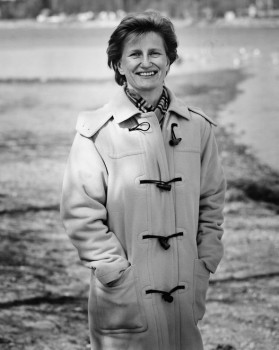
Minna Lindgren. Photo: Ville Palonen
Ordinary, boring, controlled life in an old folks’ home takes an interesting turn as crimes are committed. But daily tramrides in Helsinki, the virtues of friendship and general joie de vivre are enjoyed by 90-year-plus-old ladies who refuse to act as expected – as Bette Davis put it, old age is no place for sissies. Minna Lindgren is interviewed by Anna- Leena Ekroos
Welcome to Twilight Grove, a Helsinki home for the elderly – the bright, institutional lighting in its parlour creating an atmosphere like a dentist’s office, the odd resident dozing on the sofas, waiting for the next meal. The menu often includes mashed potatoes, easy for those with bad teeth. Residents seeking recreation are offered chair aerobics, accordion recitals, and crafts. A very ordinary assisted living centre, or is it? In Minna Lindgren’s novel, Kuolema Ehtoolehdossa (‘Death at Twilight Grove’, Teos), the everyday life of a home for the elderly is the setting for absurd and even criminal happenings, suspicious deaths and medical mix-ups.
Anna-Leena Ekroos: You’re a journalist and writer. Formerly you worked for the Finnish Broadcasting Company. In 2009 you won the Bonnier journalism prize for an article of yours about the last phases of your father’s life, and his death. Kuolema Ehtoolehdossa is your first novel. How did it come into being?
Minna Lindgren: I’ve always known I was a writer but the mere urge to write isn’t enough for a novel – you have to have a meaningful story. The more absorbed I became in the life of the old, the more important it felt to me to write this story. Writing a novel turned out to be carefree compared to working as a journalist. Many of the stories I heard would have become bad social porn in the media, dissolved into banality, but in a novel they become genuinely tragic, or tragicomic, as the case may be. More…
Kari Hotakainen: Ihmisen osa [The human lot]
9 October 2009 | Mini reviews, Reviews
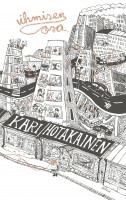 Ihmisen osa
[The human lot]
Helsinki: Siltala, 2009. 276 p.
ISBN 978-952-234-021-4
30 €, hardback
Kari Hotakainen (born 1957) is one of Finland’s most internationally successful contemporary authors, and is widely known for his children’s books, plays and television screenplays. Like many of Hotakainen’s other works, Ihmisen osa is a contemporary novel, but it is one that sees the author being angrier and more ferocious than before; this is a story that will move readers and make them laugh. Its plot gets off to a slightly ungainly start: an impatient writer wants to ‘buy someone’s life’ for the purpose of turning it into material for a novel and is prepared to pay an elderly widow €7,000 for hers. A former yarn-seller tells him all about her life as she remembers it, and the writer writes it up into his own book – the husband’s wilful silence, a serious accident suffered by one of the three children, gradually being revealed. Having got the beginning out of the way, Hotakainen then puts his foot on the gas: in his laconic style he throws light on the conditions at the edges of contemporary working life: the business of selling images, selfishness and greed, the power of words. The yarn-seller writes to one of her children: ‘Don’t rise above your station. There’s no air up there, and you’ll get dizzy.’ Hotakainen’s novel Juoksuhaudantie (‘Trench Road’) was awarded the Finlandia Prize for Fiction in 2002. It has been translated into 17 languages and was awarded the Nordic Council’s Literature Prize in 2004.
Self-made life
2 April 2011 | This 'n' that
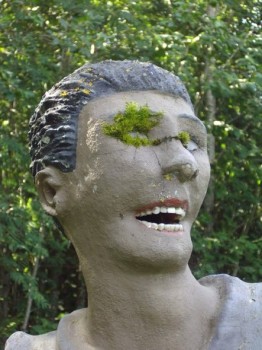
Art & nature: one of Veijo Rönkkönen's sculptures. Photo: Soila Lehtonen
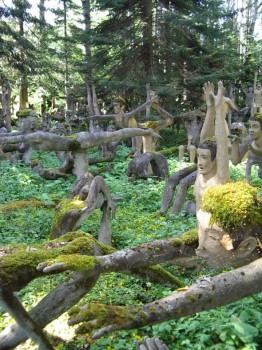
You may perhaps remember an article entitled Self-made man, published on these pages in 2009: the sculptor Veijo Rönkkönen lived on a small, isolated farm in Parikkala, eastern Finland, where he spent his spare time building a garden of five hundred figures of concrete.
He lived in a cottage in the middle of his garden. Rönkkönen died a year ago, at the age of 66, and the future of his park, open and free to all, was unsolved for a while, as the Parikkala authorities were not willing to foot the bill for the upkeep the place – despite the fact that more than 25,000 people visit the park each year.
Now, the problem of the upkeep of the statue park, a ‘total work of art’, has been solved, as a businessman has bought the garden from Rönkkönen’s estate. and a number of institutions and individuals, among them friends of art and voluntary workers, have pledged keep the park open to visitors.
Yoga bare: Veijo Rönkkönen himself practised yoga. Photo: Soila Lehtonen
Photographer and writer Veli Granö introduced the life and works of this self-made artist in his book Veijo Rönkkösen todellinen elämä / The real life of Veijo Rönkkönen (Maahenki, 2007). Contemporary folk art goes by the acronym ITE, from the words itse tehty elämä, ‘self-made life’. The English-language term is ‘outsider art’.
The future of Rönkkönen’s cottage is undecided: it may become a park-keeper’s residence, or be used as an artist’s residence. Around it, the extraordinary legacy of this self-made artist – hundreds of statues, human and animal figures – will keep growing lichen and moss, ageing naturally.
The Finlandia Prize for Fiction 2012
13 December 2012 | In the news

Ulla-Lena Lundberg. Photo: Cata Portin
The winner of the 29th Finlandia Prize for Fiction 2012, worth €30,000, is Ulla-Lena Lundberg for her novel Is (‘Ice’, Schildts & Söderströms), Finnish translation Jää (Teos & Schildts & Söderströms). The prize was awarded on 4 December.
The winning novel – set in a young priest’s family in the Åland archipelago – was selected by Tarja Halonen, President of Finland between 2000 and 2012, from a shortlist of six.
In her award speech she said that she had read Lundberg’s novel as ‘purely fictive’, and that it was only later that she had heard that it was based on the history of the writer’s own family; ‘I fell in love with the book as a book. Lundberg’s language is in some inexplicable way ageless. The book depicts the islanders’ lives in the years of post-war austerity. Pastor Petter Kummel is, I believe, almost the symbol of the age of the new peace, an optimist who believes in goodness, but who needs others to put his visions into practice, above all his wife Mona.’
Author and ethnologist Ulla-Lena Lundberg (born 1947) has since 1962 written novels, short stories, radio plays and non-fiction books: here you will find extracts from her Jägarens leende. Resor in hällkonstens rymd (‘Smile of the hunter. Travels in the space of rock art’, Söderströms, 2010). Among her novels is a trilogy (1989–1995) set in her native Åland islands, which lie midway between Finland and Sweden. Her books have been translated into five languages.
Appointed by the Finnish Book Foundation, the prize jury (researcher Janna Kantola, teacher of Finnish Riitta Kulmanen and film producer Lasse Saarinen) shortlisted the following novels: Maihinnousu (‘The landing’, Like) by Riikka Ala-Harja, Popula (Otava) by Pirjo Hassinen, Dora, Dora (Otava) by Heidi Köngäs, Nälkävuosi (‘The year of hunger’, Siltala) by Aki Ollikainen and Mr. Smith (WSOY) by Juha Seppälä.
Fair assessment
7 November 2009 | This 'n' that

Hello Tatu – or is it Patu?: heroes from the popular children's books by Aino Havukainen and Sami Toivonen meet a fan. – Photo: Suomen Messut
A thousand people more than last year – a record total of 76,800 – attended the Helsinki Book Fair in late October. This year the event was particularly popular with families with children.
More than half of the visitors said they were interested primarily in writer guests, of whom the most popular were, not surprisingly, crime writers, among them Karin Slaughter from the US and Jens Lapidus from Sweden.
Two other fairs, entitled the Wine, Food and the Good Living and the Helsinki Music Fair, were held at the same time at the Helsinki Fairs Centre.
The theme country in 2010 – when the Book Fair celebrates its tenth anniversary – will be France.
Poems
30 June 1982 | Archives online, Fiction, poetry
Introduction by George C. Schoolfield
The Cranes
Today the springtime shot its arrow point
into the winter’s heart:
the cranes’ crooked plow.
Today on the ice
the water splashed
half-a-yard high beneath the horse’s hooves –
may the magpie laugh cunningly
beside the ice-hole’s edge –
beneath the snow the earth growls
the hidden bodies of the trees cry:
the cranes the cranes!
From Taggiga lågor (‘Barbed flames’, 1924)
Hamlet in blue velvet
22 January 2010 | Fiction, poetry
Physical, mythical, sensual, playful: Sirkka Turkka’s poems, never abstract, speak of life, death, dogs, horses, nature and humans. In her universe the humorous and the grave socialise without effort. These texts, in prose form, with Hamlet as one of the characters, are often set in a wintry landscape (see Nature girl)
Poems from Yö aukeaa kuin vilja (‘The night opens like corn’, Tammi, 1978)
Of his early childhood, Hamlet really only remembered his father’s slightly crooked and gnarled index finger, pointing at the lowest branch of a holly oak. A small owl sat on it. It can’t see anything, it’s asleep now. It won’t fly off until night. These were the only words Hamlet remembered his father saying to him during the first six years of his life. Later, all he saw of his father was his back, bent over in study of agricultural conditions in a village called Jawohl or of waterside traffic on the river Vistula at the turn of a particular century. When it came to governmental matters, the king placed his trust chiefly in his unconscious and in wheat bread, thick white slices of which he devoured from the moment he awoke. More…
Debt to life
28 May 2014 | Authors, Non-fiction
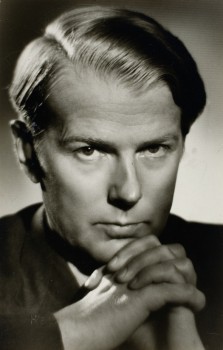
Kaarlo Sarkia (1902–1945). Photo: Ivar Helander (The Literary Archives/Finnish Literature Society)
Joie de vivre, dream, death, love: Kaarlo Sarkia’s rhymed poetry made him one of the Finnish classics, even if he only had time to publish four collections. Like several unfortunate poets of the first half of the 20th century – among them Edith Södergran, Saima Harmaja, Katri Vala, Uuno Kailas – he died of tuberculosis. Poems from Unen kaivo (‘The well of dreams’, WSOY, 1936)
From the point of view of both form and content, Kaarlo Sarkia’s poem ‘Älä elämää pelkää’ (‘Don’t be afraid of life’, 1936) is among the best examples of Finnish poetry. It crystallises several typical themes and features of his work: a declamatory absoluteness and existential courage, a faith in beauty, and the presence of death.
Don’t be afraid of life,
don’t shut out its beauty.
Invite it to sit by your fire,
or should your hearth expire,
to meet it outside is your duty.
– – –
More…
In defence of small people
15 November 2012 | Non-fiction, Reviews
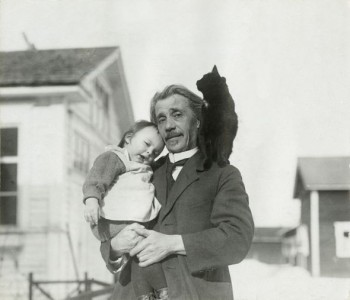
Teuvo Pakkala with grandson Teuvo-Pentti and Mirri the cat. Photo: F. Suomela / Otava, 1922
The best-known work of author Teuvo Pakkala (1862–1925) is Tukkijoella (‘On the log river’, 1899), Finland’s most-performed play. The song-studded comedy set in motion a phase of ‘logger romanticism’ in Finnish literature which later spread to film as well. Like the cowboy of the old west, the wandering lumberjack became the prototype for the Finnish masculine adventurer.
The entertaining musical play was a blockbuster. Pakkala’s works of more literary significance, however, encountered more difficulty. His short story collections on the lives of children – Lapsia (‘Children’, 1895) and Pikku ihmisiä (‘Little people’, 1913) – were greeted with flattering acclaim, but marked the author as hopelessly ‘effeminate’, as the critics put it. The stories were read as a kind of child-rearing guide, or even as tales for children. It wasn’t until much later, in the second half of the 20th century, that these psychological studies of children were re-examined as early gems of the short story form by a contemporary of Freud. More…
Poems
30 June 1984 | Archives online, Fiction, poetry
Interview by Philip Binham
Birdmount
I hear a happy tale, it makes me sad:
no-one will remember me for long.
I will send a letter with nothing inside, the emptiness will reek
as the pines do, of fruit-peel and of smoke,
a scent only.
Here I have stayed a week, seven riverside days.
The river treads the mill, ah, treads the mill,
the river’s wide, this is a placid reach, the sky is near:
smoke, like the shadow of a birdflock passing, nothing else.
And now it is September:
there are more pine trees here, and more darkness too. More…
Trial and error?
31 December 2008 | Archives online, Essays, On writing and not writing
If you want to write, you need to do it every day, says the author Monika Fagerholm. Trial and error are necessary for her – and so is not being afraid of getting lost in the woods in the process, because only then can amazing things be found
Writers write and writers write every day. I remember seeing this in one of those inspirational guides on writing I enjoy reading – even if they don’t necessarily help you in pursuing your daily writing as much as you would hope. At the worst, they give you a kind of exhausting energy which just leaves you drained. And yes, turning to these kinds of manuals almost always involves an element of desperation; you don’t need advice when everything is going great. More…
In the Metro
31 December 1995 | Archives online, Fiction, Prose
Extract from the collection of short stories Tidig tvekan (‘Early doubt’, 1938). Introduction by David McDuff
– Mademoiselle! You’re late this evening. Was there overtime again? I’ve put a newspaper aside for you. I saw you were in such a hurry in the morning that you didn’t have time to take it. The fashion page is in today, so I thought you’d like to see it. There’s nothing to thank me for, nothing at all. You see, I seem to have got a bit of a secret liking for you. One gradually learns to pick out all the people who come this way in the morning and go back again at night. And you, you see, I noticed you right from the very first day. You looked so frightened, and then you always smiled at me in such a friendly way. I got the idea that you were someone who wasn’t at home here and who was possibly using the underground in the morning rush hour for the first time. More…
More Tumpkin tales
30 June 1992 | Archives online, Children's books, Fiction, poetry
Poems from Tiitiäisen pippurimylly (‘The Tumpkin’s pepper mill’, Otava, 1991). Kirsi Kunnas’s classic children’s books, Tiitiäisen satupuu (‘The Tumpkin’s story tree’) and Tiitiäisen tarinoita (‘The Tumpkin’s tales’), appeared in 1956 and 1957
Mr Saxophone and Miss Clarinet
Mr Saxophone
	went moony
	beginning to fret
about Miss Clarinet:
	Moan moan moan
	darling little crow!
	I love you so!
moaned Mr Saxophone.
Miss Clarinet
was very upset:
	I won't be owned!
	And I'm no little crow!
	I sob like a dove,
	and even about love
	I sing alone!

	Oh moan moan moan
groaned Mr Saxophone.